
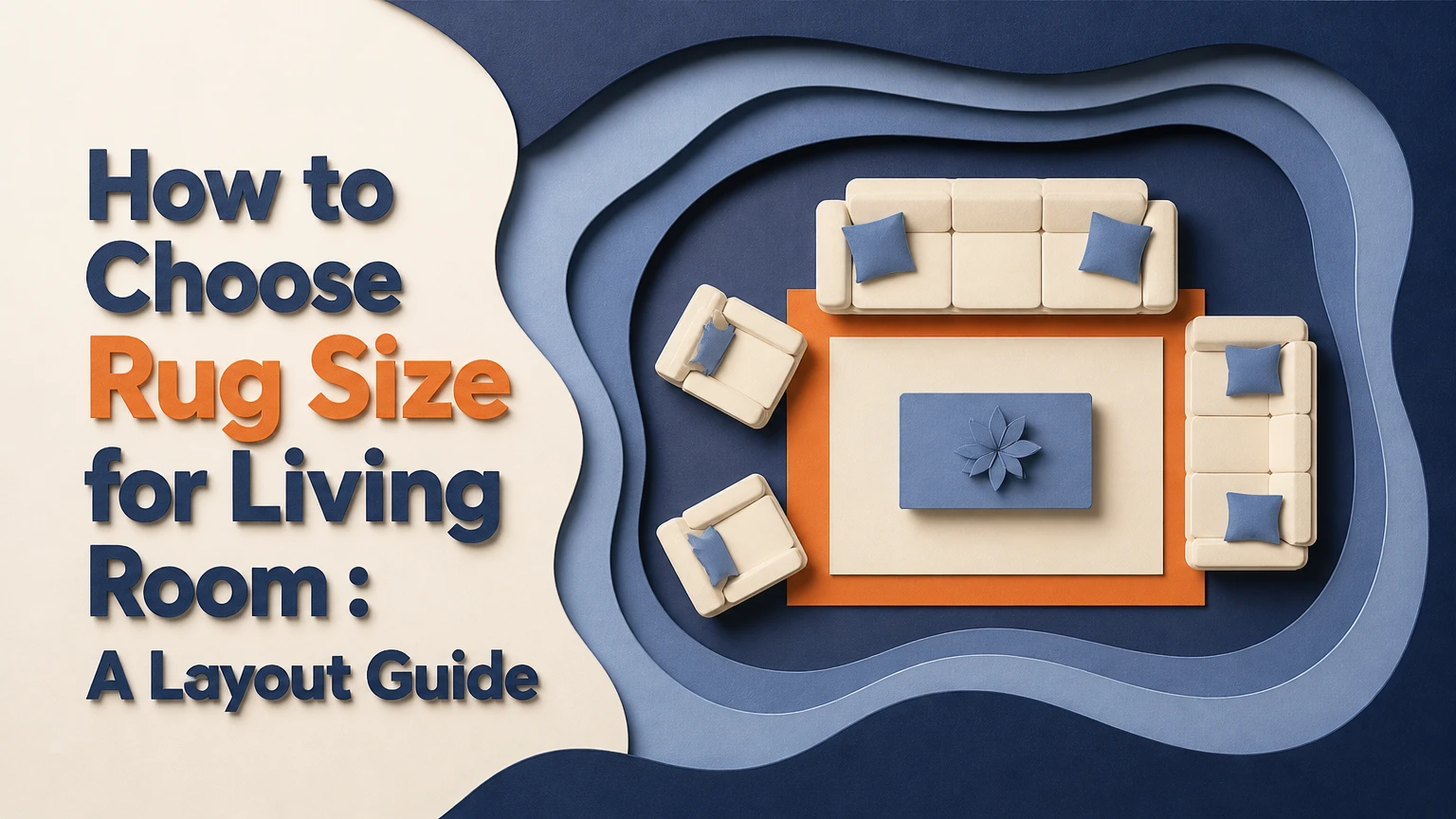
To choose a rug size for a living room in the USA, measure the complete seating arrangement first, then select the smallest standard rug that places at least the sofa’s front legs on the rug and leaves about 12-18 inches of visible floor near major walls. For most average living rooms, an 8×10 rug is the safest starting point, while larger seating groups usually need a 9×12.
Key Facts at a Glance
An 8×10-foot rug usually suits a medium living room with one sofa, two chairs, and a coffee table.
A front-legs-on layout requires about 6-8 inches of rug beneath the front portion of each sofa or chair.
A 12-18-inch floor border usually provides balanced wall clearance in a conventional rectangular room.
A 5×8-foot rug works under a coffee table and partial seating in a small apartment, but often looks undersized beneath a full sofa.
A 9×12-foot rug generally suits a large seating group, sectional, or open-plan living area.
A rug pad should usually be about 1 inch smaller than the rug on every side.
How to Choose Rug Size for Living Room in USA
The correct living room rug size is determined by the seating footprint, the desired furniture placement, and the clearances around doors and walkways. The room’s square footage provides a useful boundary, but the furniture envelope determines whether a 5×8, 8×10, or 9×12 rug will actually anchor the conversation area.
Measure the sofa, chairs, sectional, coffee table, and occasional tables as one arrangement. Do not measure each item separately and add the numbers, because gaps between furniture change the usable footprint. A rug should connect the principal seats visually, support the coffee table, and leave enough exposed flooring to show where the circulation route begins.
Interior designer Albert Hadley’s widely repeated principle, “The essence of interior design will always be about the people and how they live,” applies directly here. A formal layout can tolerate a large rug, while a household that frequently moves chairs, uses a robot vacuum, or protects hardwood may need a different boundary.
What Is the Furniture-Envelope Method?
The furniture-envelope method measures the rectangle or irregular outline enclosing the seating group, including the outer edges of sofas and chairs. Add approximately 12-16 inches to the furniture envelope’s length and width for a front-legs-on layout, then round up to the next standard rug size.
For example, a sofa and two chairs may occupy 94 inches by 112 inches when arranged around a coffee table. A 5×8 rug measures only 60 by 96 inches, so it cannot support the full arrangement. An 8×10 rug measures 96 by 120 inches and may work if the chairs angle inward, while a 9×12 rug gives more consistent coverage.
The formula is a starting point, not a substitute for a floor test. Furniture depth, leg position, room orientation, and the location of a fireplace can change the best choice by one standard size.
Which Living Room Rug Layout Should You Use?
The three accepted living room rug layouts are all legs on, front legs on, and all legs off. Front legs on is the most adaptable default because it connects the furniture without requiring a rug large enough to sit beneath every rear leg.
| Layout | Typical rug overlap | Best room condition | Main limitation |
|---|---|---|---|
| All legs on | 18-30 inches under furniture | Rooms at least 13×16 feet | Higher purchase cost |
| Front legs on | 6-8 inches under front legs | Rooms from 11×13 to 12×15 feet | Rear legs remain on floor |
| All legs off | 0 inches under furniture | Small rooms under 10×12 feet | Can look disconnected |
| Layered floating rug | 0 inches for top rug, 12-24 inches for base | Apartments and small budgets | Edges require careful securing |
When Should All Furniture Legs Be on the Rug?
Place all major furniture legs on the rug when the room is large enough to preserve a visible floor border and the seating group functions as one defined zone. The rug should extend beneath the sofa, chairs, side tables, and coffee table, with furniture generally 18-30 inches inside the rug perimeter.
This arrangement creates the most unified appearance in a large living room or great room. It also reduces the chance that individual furniture pieces appear scattered across the floor. The trade-off is cost: moving from an 8×10 to a 9×12 or 10×14 can substantially increase material, shipping, and cleaning expenses.
All-legs-on placement is not ideal when a rug would touch the walls, block a door, cover a floor register, or force a walkway below about 30 inches. A large rug that eliminates usable circulation is functionally worse than a smaller rug with deliberate furniture placement.
Is Front Legs Only the Best Default?
Front-legs-on placement is the best default for most US living rooms because the rug can anchor the seating group while remaining smaller and easier to maintain than an all-legs-on layout. Position the sofa and chairs so their front 6-8 inches rest on the rug, with the coffee table fully supported.
The rug must reach far enough sideways to connect the chairs. If the rug ends between the sofa and a chair, the furniture will look separated even when the coffee table is centered. For a standard sofa measuring 84 inches wide, a rug should usually extend at least several inches beyond both sofa arms when the room permits.
Some sofas have rear legs much lower than their front legs. If the rug creates instability, use firm furniture cups or matching pads beneath the rear legs, but check that the sofa remains level and stable before regular use.
When Does an All-Legs-Off Rug Work?
An all-legs-off rug works when the room is small, the seating is compact, and the rug is intentionally treated as a coffee-table zone rather than a foundation for every seat. The rug should sit centered beneath the coffee table, with its edges positioned evenly in relation to the surrounding furniture.
A 5×8 rug can work in a small apartment with a loveseat and two compact chairs, especially when the seating is only 6-12 inches beyond the rug edge. The same rug can look like a floating island under a full-size sofa and two deep lounge chairs.
The visual test is simple: the coffee table should feel connected to the seats, and the rug should not appear stranded in a large field of bare floor. A rug pad becomes more important in this layout because furniture does not hold down its edges.
What Standard Rug Size Fits Your Room?
Standard US rug sizes are useful because retailers stock them widely and replacement costs are easier to compare. Room dimensions alone do not guarantee fit, but the following ranges provide a practical starting point for rectangular living rooms.
| Rug size | Actual area | Typical room example | Common furniture arrangement |
|---|---|---|---|
| 5×8 feet | 40 square feet | 8×10 to 10×12 feet | Loveseat, two small chairs, coffee table |
| 6×9 feet | 54 square feet | 9×12 to 11×13 feet | Apartment sofa, one chair, coffee table |
| 8×10 feet | 80 square feet | 11×13 to 12×15 feet | Sofa, two chairs, coffee table |
| 9×12 feet | 108 square feet | 13×16 to 15×20 feet | Sectional or large sofa grouping |
| 10×14 feet | 140 square feet | 15×20 feet and larger | Grand room with all legs on |
Is an 8×10 Rug Big Enough?
An 8×10 rug is usually big enough for a medium living room when the seating arrangement measures no more than about 96 inches by 120 inches and the front legs of the principal furniture can sit on the rug. It is often the best balance between coverage, availability, and price.
An 8×10 may be too small for a deep sectional, a sofa longer than 90 inches paired with widely separated chairs, or an open-plan area where the rug must define a complete zone. Tape the 96×120-inch outline before purchasing.
Orient the rug according to the room’s long axis unless the furniture arrangement clearly favors another direction. Turning an 8×10 sideways can leave chair legs outside the rug or reduce the walkway beside a sofa.
When Is a 9×12 Rug Better?
Choose a 9×12 rug when an 8×10 cannot extend beyond both ends of the seating group, when a sectional needs continuous support, or when an open-plan room requires a stronger visual boundary. A 9×12 rug provides 108 square feet, which is 28 square feet more than an 8×10.
The extra area often makes the difference between front-legs-on and all-legs-on placement. In a 14×18-foot living area, a 9×12 can leave approximately 18-36 inches of floor at the room edges while supporting a sectional and two occasional chairs.
A 9×12 is too large when its edges sit within a few inches of every wall, cover a heating register, or extend into a separate dining zone without a deliberate transition. Oversizing is less common than undersizing, but a rug can overwhelm a room when the border disappears.
How Much Bare Floor Should Surround a Rug?
Leave about 12-18 inches of visible floor between the rug edge and the nearest wall in a conventional living room. In a very small apartment, 6-8 inches can work, while an open-plan room may need a larger visual gap to distinguish the living zone from nearby dining or kitchen areas.
Measure from the rug edge to the wall, built-in cabinet, fireplace hearth, or other fixed boundary. A fireplace hearth is a functional edge, not empty floor, so the rug should stop before the hearth if heat, sparks, or door clearance create a risk.
| Room condition | Recommended border | Reason |
|---|---|---|
| Small apartment | 6-8 inches | Preserves maximum usable rug area |
| Standard enclosed room | 12-18 inches | Creates balanced perimeter spacing |
| Large formal room | 18-30 inches | Prevents the rug from appearing undersized |
| Open-plan living zone | 18-36 inches | Separates living and dining functions |
| Fireplace or built-in wall | 12-24 inches | Protects clearance and preserves visual boundary |
The border does not need to be identical on every side when architecture is asymmetrical. Center the rug on the furniture grouping first, then verify that the remaining clearances are safe and visually intentional.
How Do You Measure for a Living Room Rug?
Measure the intended furniture arrangement, mark the proposed rug boundary, and inspect clearances before ordering. A careful tape test takes about 20-30 minutes and requires a tape measure, painter’s tape, a notepad, and the manufacturer’s stated rug dimensions.
Step 1: Arrange the Furniture
Place the sofa, sectional, chairs, coffee table, and side tables in their final positions. Include the distance needed to pull chairs out, open nearby cabinets, and walk behind the sofa.
Success checkpoint: The arrangement supports a normal conversation area and leaves a continuous walkway of roughly 30-36 inches where people regularly pass.
Common mistake: Measuring furniture against the wall before deciding whether chairs will angle inward or face the sofa.
Step 2: Measure the Furniture Envelope
Measure the widest left-to-right distance and the deepest front-to-back distance across the complete seating group. Record the position of each leg, because a sofa with legs set far inward may need a different rug width than a sofa with legs near its arms.
Success checkpoint: Your notes show both the outer furniture dimensions and the intended rug overlap, such as 96 by 120 inches with 6 inches beneath the front legs.
Common mistake: Measuring only the sofa and forgetting that side chairs determine the rug’s required width.
Step 3: Select the Smallest Suitable Standard Size
Add 12-16 inches to the furniture envelope for front-legs-on placement. Compare the result with standard sizes, then choose the next size up if a rug edge would stop between connected furniture pieces.
Success checkpoint: The selected rug extends beyond the outer furniture edges or reaches beneath all front legs without touching walls.
Common mistake: Choosing a 5×8 because it fits the coffee table, even though the sofa and chairs remain visually disconnected.
Step 4: Mark the Rug With Painter’s Tape
Apply painter’s tape in the exact dimensions of the rug, such as 96 by 120 inches for an 8×10. Measure the tape rather than estimating from the roll, since many rugs have finished dimensions that vary slightly from nominal retail sizes.
Success checkpoint: You can walk around the taped perimeter, open doors, reach floor vents, and pull out chairs without stepping awkwardly over the boundary.
Common mistake: Taping only the visible center area and ignoring the rug’s full length beneath the sofa.
Step 5: Check Doors, Vents, and Furniture Stability
Open every door near the proposed rug, including closet and patio doors. Check floor registers, return vents, robot-vacuum clearance, and whether the furniture rocks when its front legs sit on the rug.
Success checkpoint: Doors open fully, vents remain unobstructed, and furniture stays level under normal use.
Common mistake: Buying a thick rug for a door swing without measuring the gap beneath the door.
Step 6: Confirm the Rug Pad and Order Dimensions
Choose a pad that matches the floor type and reduce its dimensions by about 1 inch on every side so the pad remains hidden. Confirm the retailer’s actual dimensions, return policy, cleaning instructions, and delivery method before payment.
Success checkpoint: The pad will not extend beyond the rug, and the rug’s pile height is compatible with doors and seating.
Common mistake: Treating a rug pad as optional in a floating layout or on smooth hardwood.
Which Rug Material Fits Your Household?
Polypropylene and other synthetic rugs usually offer the lowest initial cost and easiest stain management, while wool provides stronger resilience and repair potential at a higher price. Construction method matters as much as fiber: machine-woven, hand-tufted, and hand-knotted rugs have different lifespans and maintenance needs.
| Rug type | Typical 8×10 US price | Typical lifespan | Cleaning and use profile |
|---|---|---|---|
| Machine-woven polypropylene | $150-$500 | 3-5 years | Easy spot cleaning, high turnover |
| Machine-woven polyester | $120-$450 | 3-6 years | Soft feel, moderate crushing |
| Hand-tufted wool | $400-$1,200 | 10-15 years | Periodic professional cleaning |
| Hand-knotted wool | $1,500-$4,000+ | 30-50+ years | Repairable, heirloom ownership |
| Flatweave cotton or wool | $200-$900 | 5-15 years | Low profile, reversible options |
Price ranges are typical US retail ranges, not fixed market prices. Sale timing, country of manufacture, pattern complexity, natural fiber grade, and retailer markup can move the price substantially.
What Is Best for Children and Pets?
A low- or medium-pile polypropylene rug is usually the most practical choice for children and pets because it resists many household stains, dries faster than dense natural fibers, and costs less to replace after severe damage. A washable rug can reduce spot-cleaning effort, but its removable top layer may have size and weight limits.
For a family room, choose an 8×10 or 9×12 when the seating footprint allows it, use front-legs-on placement, and select a pattern that disguises small marks. Avoid very high shag near dining areas, shedding pets, or homes that rely on robot vacuums.
Wool is durable and naturally resilient, but it can shed during its early months and may require more careful cleaning. It is not the simplest option for repeated liquid accidents or owners who want to put the entire rug into a household washing machine.
What Is Best for Renters?
Renters usually benefit from a 5×8 or 6×9 flatweave or machine-woven rug when the apartment has a compact loveseat or apartment sofa. An 8×10 becomes worthwhile when the floor plan can support front-leg placement without narrowing the primary walkway.
Check elevator dimensions, stair turns, package weight, and return shipping before ordering a large rug. A 9×12 rug can be difficult to move through a narrow apartment even when it fits the room.
What Rug Pad and Pile Height Should You Use?
Use a dense, non-slip pad sized approximately 1 inch smaller than the rug on every side, and choose a low pile under 1/4 inch where doors, vents, dining chairs, or robot vacuums are involved. Rug pads reduce sliding, protect flooring, and improve comfort, but they cannot correct an incorrectly sized rug.
| Location or floor | Recommended pad | Preferred pile | Main check |
|---|---|---|---|
| Smooth hardwood | Felt with rubber backing | 1/8-1/4 inch | Confirm manufacturer floor compatibility |
| Carpet over carpet | Thin dense pad | 1/8 inch | Prevent shifting and rippling |
| Entry-adjacent living room | Rubber or thin felt-rubber | Under 1/4 inch | Test door swing |
| Pet household | Washable or moisture-resistant pad | 1/8-1/4 inch | Inspect underside after accidents |
| Uneven old flooring | Dense felt pad | 1/4-3/8 inch | Confirm furniture stability |
Do not place rubber-backed products on a finished floor unless the manufacturer confirms compatibility. Some backings can trap moisture or mark certain finishes. Follow the flooring maker’s care instructions.
What Are the Most Common Rug-Size Mistakes?
The most common mistakes are buying for the coffee table alone, ignoring the seating envelope, losing door clearance, and choosing a size that divides rather than connects furniture. Each problem has a measurable correction.
- Using a 5×8 under a full seating group: Move to an 8×10 or use the 5×8 only as a deliberate floating coffee-table rug.
- Ending the rug between sofa and chair: Rotate or enlarge the rug until both pieces connect visually.
- Leaving no wall border: Return or reposition the rug if it reaches within a few inches of multiple walls.
- Blocking a door or vent: Choose a low-pile rug, reduce the size, or change the rug orientation.
- Creating an unstable sofa: Add appropriate furniture pads beneath rear legs and verify levelness.
- Skipping the tape test: Mark the exact retail dimensions before buying, especially for a 9×12 or larger rug.
- Layering incompatible sizes: Use a base rug at least 12-24 inches larger on every exposed side, rather than placing two nearly identical rectangles together.
Layering works best when the lower rug is neutral and durable, while the upper rug is smaller and more distinctive. Layering does not solve a circulation problem, a blocked vent, or an unstable furniture arrangement.
How Should You Handle Sectionals and Open-Plan Rooms?
A sectional usually needs a 9×12 rug when the chaise, sofa run, and coffee table must share one visual foundation. For a compact L-shaped sectional, an 8×10 may work if the rug reaches beneath the front legs of both sections and extends beyond the coffee table.
Open-plan rooms require zoning rather than wall-to-wall coverage. Center the rug under the living furniture, keep its edges visibly separate from the dining rug or kitchen work area, and preserve a clear path between zones.
| Situation | Starting size | Layout | Adjustment |
|---|---|---|---|
| 84-inch sofa plus two chairs | 8×10 | Front legs on | Use 9×12 if chairs sit wide |
| Compact L-sectional | 8×10 | Front legs on | Tape chaise clearance first |
| Large sectional plus two chairs | 9×12 | Front or all legs on | Use 10×14 in rooms over 15×20 |
| Sofa facing fireplace | 8×10 | Front legs on | Stop before hearth and preserve heat clearance |
| Open-plan living zone | 9×12 | All or front legs on | Keep 18-36 inches from adjacent zone |
| Narrow apartment living room | 5×8 or 6×9 | Floating or front legs on | Keep 30-inch circulation path |
A sectional’s long dimension can mislead buyers. The chaise depth often determines the rug’s front-to-back requirement, while the sofa run determines its width.
How Much Should a Living Room Rug Cost?
A typical US living room rug costs about $80-$250 for a 5×8 synthetic machine-made model, $150-$500 for an 8×10 synthetic model, and $250-$800 for a 9×12 synthetic model. Wool and hand-knotted construction can raise the same sizes into the $400-$6,000-plus range.
| Size and construction | Typical purchase range | Replacement horizon | Approximate annualized cost |
|---|---|---|---|
| 5×8 synthetic | $80-$250 | 3-5 years | $16-$83 per year |
| 8×10 synthetic | $150-$500 | 3-6 years | $25-$167 per year |
| 8×10 hand-tufted wool | $400-$1,200 | 10-15 years | $27-$120 per year |
| 9×12 hand-knotted wool | $2,500-$6,000+ | 30-50+ years | $50-$200+ per year |
Annualized cost is a simple purchase-price calculation and excludes cleaning, pads, shipping, and resale value. A more expensive wool rug can cost less per year when it remains attractive for decades, but that does not make it economical for every renter or high-mess household.
Which Rug Size Should You Choose?
Choose a 5×8 for a compact apartment seating group, an 8×10 for the typical medium living room, and a 9×12 for a large sectional or open-plan arrangement. The final choice should be the smallest standard size that supports the intended leg placement, connects the seats, and preserves safe circulation.
For a Small Apartment
Choose a 5×8 or 6×9 if the room is about 10×12 feet or smaller and the seating is compact. Use an 8×10 only after tape confirms that the rug will not crowd walls, doors, or the main walkway.
For a Typical Family Room
Choose an 8×10 with front legs on when the room falls near 11×13 to 12×15 feet. Select a stain-resistant synthetic fiber or low-pile washable construction when spills, pets, and frequent cleaning outweigh long-term heirloom value.
For a Large or Open-Plan Room
Choose a 9×12 when the seating group includes a sectional, widely spaced chairs, or a large coffee table. Choose a 10×14 only when the room leaves at least 18 inches of floor border and the rug will not cross into an unrelated functional zone.
FAQ
Can a 5×8 Rug Fit Under a Sofa?
A 5×8 rug can fit beneath the front portion of a compact sofa, but it often cannot extend beyond the sofa arms or connect additional chairs. Use it for a loveseat, small apartment, or intentional coffee-table zone; choose an 8×10 when a full sofa and two chairs need visual connection.
Should a Living Room Rug Be Wider Than the Sofa?
A living room rug should usually be at least as wide as the sofa and preferably extend several inches beyond both arms. A rug that ends inside the sofa’s width can make the furniture appear cramped, although a narrow floating rug may work when the room uses a deliberately minimal layout.
Can a Living Room Rug Touch the Wall?
A living room rug can touch or nearly touch a wall in a very small room, but 12-18 inches of exposed floor usually creates a more balanced border. Avoid touching multiple walls unless the rug is intended to function as fitted carpet or the architecture leaves no practical alternative.
Should a Coffee Table Be Completely on the Rug?
A coffee table should normally sit completely on the rug, even in a front-legs-on layout. Full table support keeps the table visually connected to the seating and prevents legs from catching at the rug edge, especially when the table is moved during cleaning.
What Rug Shape Works in a Non-Rectangular Room?
A round rug works well beneath a round coffee table or in a square seating arrangement, while a runner can suit a narrow living room. Match the rug shape to the furniture geometry, then preserve door, vent, and walkway clearances just as you would with a rectangle.
How Do You Keep a Large Rug From Sliding?
Keep a large rug from sliding with a correctly sized felt-and-rubber pad, a clean dry floor, and furniture positioned according to the selected layout. If the rug still shifts, check whether the floor finish or pad material is compatible, rather than adding loose adhesive beneath the entire rug.
The Bottom Line
To choose a rug size for a living room in the USA, arrange the furniture, measure its full envelope, mark the candidate dimensions with painter’s tape, and select the smallest standard rug that supports the desired layout. An 8×10 is the practical default for many medium rooms, a 9×12 suits larger seating groups, and a 5×8 belongs mainly in compact or floating arrangements. Preserve 12-18 inches of visible floor when possible, verify door and vent clearance, and budget for a properly fitted rug pad.