
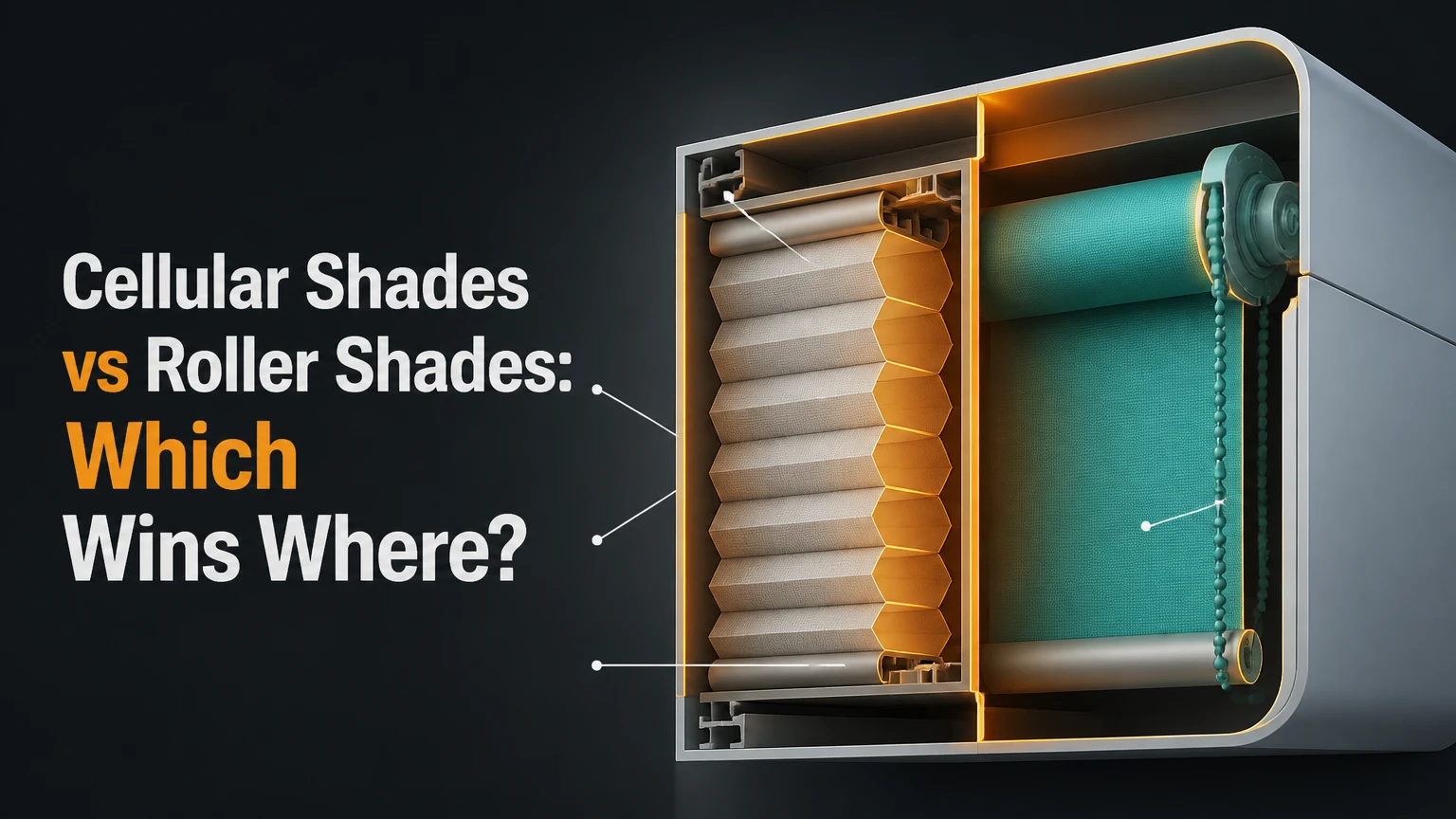
Cellular shades win for insulation, top-down privacy, and bedrooms in harsh climates. Roller shades win for lower upfront cost, simple cleaning, durable high-traffic use, and a completely clear view when raised. The deciding factors are window exposure, privacy needs, room moisture, desired appearance, and whether energy savings justify the higher purchase price.
Quick Verdict
- For cold or hot climates: Cellular shades, preferably double-cell on exposed windows.
- For modern interiors and outdoor views: Roller shades, especially solar or cassette models.
- For bedrooms and nurseries: Cellular shades with blackout fabric and cordless operation.
- For kitchens, bathrooms, pets, and rentals: Moisture-resistant roller shades.
- For tight budgets: Basic roller shades, unless uncomfortable windows drive high heating or cooling costs.
- For lower-half privacy with daylight above: Top-down/bottom-up cellular shades.
- For glare control while preserving a view: Solar roller shades with a suitable openness percentage.
Cellular Shades vs Roller Shades: Master Comparison
The table uses a 1-5 performance scale, where 5 is strongest for the stated criterion. Prices are typical custom or high-quality retail ranges per window, not guaranteed quotes.
| Criterion | Cellular shades | Roller shades |
|---|---|---|
| Thermal performance | 4-5/5; double-cell products can raise assembly performance toward R-4 or higher | 1-3/5; usually adds less than 0.5 R-value, with solar fabrics helping glare more than insulation |
| Privacy flexibility | 5/5 with top-down/bottom-up and blackout options | 3-4/5; excellent when lowered, limited when raised |
| Light control | 4-5/5; translucent, room-darkening, and blackout fabrics | 3-5/5; blackout can block about 99% before edge leakage |
| Cleaning | 2-3/5; cells need dusting or cool-air cleaning | 4-5/5; flat fabric, vinyl, or mesh can be wiped or vacuumed |
| Durability | 3-4/5; cells may crush or bow after rough handling | 4-5/5; sturdy fabrics and roller hardware suit frequent use |
| Open-window view | 3-4/5; compressed stack remains at the top | 5/5; fabric rolls around the tube and can fully clear the glass |
| Typical price | $70-$250+ per window | $40-$180+ per window |
| Typical DIY installation | 15-30 minutes per window | 15-30 minutes per window, assuming accurate measurements and suitable depth |
Criterion verdict: Cellular shades are the stronger all-around performance product, while roller shades win when cleaning, price, durability, and a fully open view matter more.
Thermal Performance and Energy Savings
Cellular shades are the clear thermal winner because their honeycomb pockets hold relatively still air between the room and the glass. That extra layer reduces conductive heat transfer, especially when the shade fits closely and remains closed during the hottest or coldest periods.
The U.S. Department of Energy identifies insulated window coverings as a way to reduce heat loss and solar gain, but actual savings depend on the window, climate, shade fit, fabric, and user behavior. A double-cell cellular shade may increase a window assembly from roughly R-1 to R-4 or higher, although that is not a guaranteed whole-house energy result.
Roller shades do not create the same deep air-trapping structure. A thick blackout roller can reduce drafts and solar exposure, while a light-colored or reflective fabric can reject some summer radiation, but typical roller products add less than 0.5 R-value.
Orientation changes the decision. North-facing windows in cold climates reward insulation. West-facing windows in hot climates may benefit more from exterior solar screens or low-openness solar rollers, because stopping sunlight before it reaches the glass is more effective than treating the room side.
Thermal verdict: Choose double-cell cellular shades for winter heat loss and indoor comfort; choose solar rollers or exterior shading for severe afternoon solar gain.
Thermal Performance by Product Type
| Product | Typical thermal role | Best use |
|---|---|---|
| Single-cell cellular | Moderate insulation with lower cost and smaller stack | Temperate rooms and ordinary exposures |
| Double-cell cellular | Highest interior insulation among the two main options | Cold climates, hot climates, drafty older windows |
| Light-filtering roller | Minimal insulation, useful daylight diffusion | Living rooms where glare is moderate |
| Blackout roller | Blocks light and some radiant exposure, but has limited air resistance | Bedrooms and media rooms |
| Solar roller, 1%-5% openness | Strong glare and UV control with restricted view | Sunny offices and west-facing rooms |
| Exterior solar screen | Stops solar radiation before the glass heats | Severe heat gain and large windows |
Privacy and Light Control
Cellular shades offer the more flexible privacy system. Top-down/bottom-up operation lets occupants cover the lower portion of a window while leaving the upper glass open for daylight. That configuration is especially effective on street-facing ground-floor windows, bathrooms with dry ventilation, and bedrooms that need privacy without constant darkness.
Roller shades provide more predictable full-window coverage. A blackout roller can block about 99% of incoming light at the fabric, but side gaps often remain around 1/2-3/4 inch unless the product includes side channels, an oversized fabric width, or a cassette designed to reduce leakage. Inside mounting can make those gaps more noticeable.
Solar rollers solve a different problem. Their mesh allows outward visibility while reducing glare and ultraviolet exposure. Openness commonly ranges from 1% to 14%; lower percentages generally provide more glare control and privacy during daylight, while higher percentages preserve a clearer view. At night, interior lighting can reverse that privacy advantage.
Cordless lifts and motorized controls improve child safety and accessibility for both types. A shade that remains permanently closed because its controls are inconvenient is a poor light-control system, regardless of laboratory specifications.
Privacy verdict: Cellular shades win for adjustable privacy and daylight; roller shades win for simple full-window blackout or daytime solar filtering.
Cleaning, Durability, and Repairs
Roller shades are easier to maintain because their fabric forms one accessible plane. Routine care usually requires a soft brush attachment or a dry microfiber cloth, and many vinyl or polyester products tolerate a lightly damp cloth. Solar mesh should be cleaned gently because aggressive scrubbing can distort the weave.
Cellular shades require more careful handling. Dust can settle inside the honeycomb channels, and insects may enter through the open cell ends. A vacuum with low suction, a soft brush, a cool hairdryer, or compressed air can remove debris. Heat is a poor choice because it can deform synthetic fabric or adhesive components.
The damage pattern also differs. Cellular fabric may crush, bow, or develop uneven pleats if pulled sideways or forced against an obstruction. Roller shades more often develop telescoping, tube drift, frayed edges, clutch wear, or a stretched operating chain. A roller that drifts to one side may sometimes be rebalanced with a small piece of tape on the bare tube, but persistent drift usually indicates an unlevel installation or damaged mechanism.
Moisture changes the recommendation. Fabric cellular shades placed over a sink or in a poorly ventilated bathroom can trap moisture and grease inside the cells, creating staining or mold risk. Moisture-resistant vinyl or polyester rollers are safer in those locations.
Maintenance verdict: Roller shades win for cleaning, moisture tolerance, and high-traffic durability; cellular shades need gentler handling and drier rooms.
Appearance and Open-Window View
Roller shades create the cleaner architectural line. When raised, the fabric wraps around a tube and can disappear into a cassette or sit on compact brackets, leaving the glass nearly unobstructed. That makes roller shades the better choice for picture windows, contemporary interiors, and homes where the landscape is part of the room.
Cellular shades have a softer, pleated appearance and retain a compressed stack at the top. Stack height depends on fabric, cell size, shade length, and product design. Larger cells can look proportionate on wide windows, while 3/8-inch cells often suit narrow openings.
Color affects performance as well as style. Darker blackout fabrics improve perceived darkness, while lighter outward-facing surfaces can reduce solar absorption. Solar roller openness creates a direct trade-off: 1%-3% openness generally controls glare more strongly, while 10%-14% openness preserves more view.
A reverse-roll roller can clear a window crank or handle by placing the fabric toward the room. A standard roll positions fabric closer to the glass and can reduce light leakage when the mounting geometry is suitable.
Appearance verdict: Roller shades win for minimalist design and a fully open view; cellular shades win when pleated texture and a smaller visual scale matter more.
Price and Ownership Cost
Roller shades usually win the initial-price decision. Typical basic products cost about $40-$100 per window, mid-range custom rollers cost $100-$180, and premium solar or dual systems can exceed $180. Cellular shades commonly begin around $70, reach $150-$250 for custom configurations, and cost more with double cells, motorization, or top-down/bottom-up hardware.
Purchase price is only the first cost. A $90 roller may require side channels, a cassette, or blackout upgrades to deliver the intended bedroom result. A $150 cellular shade may reduce drafts and cooling demand on a heavily exposed window, although the payback period depends on local energy prices and the window’s condition.
Motorization adds a premium to either option. Battery replacement, charging access, hub compatibility, and repair support should be included in the ownership calculation. A corded product may cost less, but cordless or motorized operation is usually safer around children and pets.
Replacing a damaged roller fabric can be simpler than replacing cellular fabric, but proprietary cassettes and smart motors can increase switching costs. Before ordering, confirm whether replacement parts, brackets, and compatible remotes remain available.
Cost verdict: Roller shades offer the lower upfront and replacement cost; cellular shades justify their premium mainly on exposed windows where comfort and insulation matter.
Typical Cost Breakdown
| Configuration | Cellular shade | Roller shade |
|---|---|---|
| Basic manually operated window | $70-$130 | $40-$100 |
| Custom light-filtering window | $110-$200 | $90-$160 |
| Blackout bedroom window | $130-$250+ | $100-$220+ with cassette or channels |
| Double-cell or dual-layer upgrade | $160-$300+ | Not directly comparable |
| Solar mesh or dual roller | Not typical | $150-$300+ |
| Motorized upgrade | Often adds $100-$300+ | Often adds $100-$300+ |
| Professional installation | Commonly $50-$150 per window | Commonly $50-$150 per window |
These are typical planning ranges. Brand, size, fabric, control system, region, and installation access can change the quote substantially.
Measurement, Installation, and Switching
Both products can be installed in roughly 15-30 minutes per window by a confident DIY installer, but measuring errors cause more failures than drilling does. For an inside mount, measure width at the top, middle, and bottom, then use the narrowest measurement. Measure height at multiple points as well, because older frames are rarely perfectly square.
Check mounting depth before ordering. Cellular shades and roller cassettes may require roughly 1.5-2.5 inches for a flush inside mount, with exact requirements determined by the manufacturer. A shallow frame may require an outside mount, which changes light leakage, appearance, and available trim clearance.
Switching from one type to another is rarely a direct bracket swap. Cellular headrails and roller tubes use different mounting hardware, and a roller cassette may need more front clearance than a basic cellular headrail. Remove the existing treatment, inspect the frame for stripped screw holes, and measure the clear opening again rather than copying the old order.
For blackout performance, outside mounting with overlap often reduces edge leakage. For a clean appearance, inside mounting looks tighter but exposes irregular frames and may sacrifice fabric width.
Installation verdict: Both options are similarly quick after correct measuring, but roller shades usually offer more retrofit flexibility when outside mounting or simple brackets are acceptable.
Which Should You Choose?
Choose Cellular Shades for Harsh Climates
Choose double-cell cellular shades for rooms that lose heat in winter or gain unwanted heat in summer, especially when the windows are older, large, or uncomfortable near the glass. The higher price buys the strongest interior insulation available from these two categories.
Do not cover every window automatically. Use cellular shades where occupants feel drafts, cold radiant surfaces, or afternoon heat. A low-exposure hallway may not recover the premium.
Choose Roller Shades for Modern Homes and Views
Choose roller shades when a clean horizontal line and an unobstructed view matter more than maximum insulation. A cassette roller can nearly disappear above the window, while a solar mesh roller reduces glare without fully sacrificing the landscape.
Select openness deliberately. A 1%-3% screen suits bright, glare-prone rooms; 5%-10% preserves more view; 10%-14% favors visibility over privacy. Remember that solar mesh usually does not provide nighttime privacy when indoor lights are on.
Choose Cellular Shades for Bedrooms and Ground Floors
Choose top-down/bottom-up cellular shades for bedrooms, nurseries, and street-facing rooms where occupants need lower-window privacy with upper-window daylight. Add blackout fabric when daytime sleep matters, and specify cordless or motorized control for child safety.
A blackout label does not guarantee a dark room. Side gaps, mounting depth, trim, and the fabric’s actual construction determine the result.
Choose Roller Shades for Moisture and High Traffic
Choose moisture-resistant roller shades for kitchens, bathrooms with adequate ventilation, pet areas, and rental properties. Vinyl, coated polyester, and washable solar mesh tolerate wiping better than honeycomb fabric.
Avoid placing any fabric treatment where repeated condensation remains on the glass. Ventilation and window moisture control matter more than the shade category.
Choose Basic Rollers on a Tight Budget
Choose basic roller shades when the goal is affordable coverage across many windows, especially in a mild climate. Allocate the budget selectively: use cellular shades on the coldest bedrooms or sunniest rooms, then use rollers elsewhere.
This mixed strategy often beats installing a premium product everywhere. It also lowers replacement exposure if one high-traffic window receives damage.
Honest Limitations and Better Alternatives
Cellular shades disappoint when easy cleaning is the priority. Their internal cells can hide debris, and a crushed section is difficult to restore cosmetically. Cellular shades also do not replace exterior insulation, quality glazing, weatherstripping, or properly sealed window frames.
Roller shades disappoint when the room needs partial privacy and daylight at the same time. A standard roller must be raised or lowered, while a top-down/bottom-up cellular model can divide the window vertically by function. Roller blackout products also need careful treatment of side gaps.
Neither product is always the best choice. Exterior solar screens or awnings can outperform interior shades for severe west-facing heat. Interior shutters offer stronger structure and privacy but cost more and stack differently. Roman shades provide richer fabric styling, while window film preserves the view but does not provide adjustable privacy.
The hidden issue is product quality. A low-cost shade with poor fabric tension, weak brackets, or unavailable replacement parts can cost more over time than a mid-range product. Ask for fabric composition, openness percentage, cassette dimensions, minimum depth, child-safety certification, warranty terms, and replacement-part availability.
Alternatives by Main Problem
| Main problem | Alternative worth considering | Why it may outperform both |
|---|---|---|
| Severe summer heat | Exterior solar screen or awning | Blocks radiation before it reaches the glass |
| Need permanent glare reduction | Professionally selected window film | Preserves a clear view while filtering solar energy |
| Maximum privacy and structure | Interior shutters | Rigid louvers provide durable directional control |
| Decorative layered window | Roman shade with drapery | Offers stronger visual softness and room-darkening layers |
| Drafty window frame | Weatherstripping or replacement glazing | Treats the air leak rather than covering it |
| Large smart-home installation | Motorized shades with a compatible hub | Centralizes schedules and accessibility controls |
Frequently Asked Questions
Are cellular shades warmer than roller shades?
Yes. Cellular shades generally provide more interior insulation because their honeycomb pockets trap air. Double-cell construction can raise a window assembly toward R-4 or higher, while ordinary roller shades usually add less than 0.5 R-value. Actual comfort depends on fit, glass, frame leakage, climate, and whether the shade remains closed.
Do roller shades block more light than cellular shades?
Neither category automatically blocks more light. Both can reach about 99% fabric-level light blockage with true blackout materials, but side gaps determine room darkness. Roller shades often need side channels or an overlapping outside mount, while cellular shades can reduce edge leakage through their close-fitting design.
Are solar roller shades private at night?
Usually not. Solar roller shades can provide daytime privacy when outdoor light is brighter than indoor light, but the effect reverses after sunset. Interior lights make the room visible through the mesh. Add a blackout roller, drapery, or dual roller system when nighttime privacy is required.
Which shade is safer for children and pets?
Cordless or motorized operation is safer than exposed operating cords for both cellular and roller shades. The category matters less than the control design, installation quality, and compliance with current window-covering safety requirements. Keep looped cords secured and select products with a documented child-safety configuration.
Can cellular shades be used in bathrooms?
Cellular shades can work in a well-ventilated bathroom away from persistent splashing, but they are a poor choice over a damp sink or in a room with recurring condensation. Moisture-resistant roller shades are usually safer because a flat surface is easier to dry and clean than internal honeycomb channels.
Are cellular shades worth the extra cost?
Cellular shades are worth the premium when insulation, adjustable privacy, or lower radiant discomfort matters on specific windows. They are less compelling for mild climates, low-use rooms, or windows already protected by exterior shading. A targeted mix of cellular and roller shades often gives better value than one product throughout the home.