
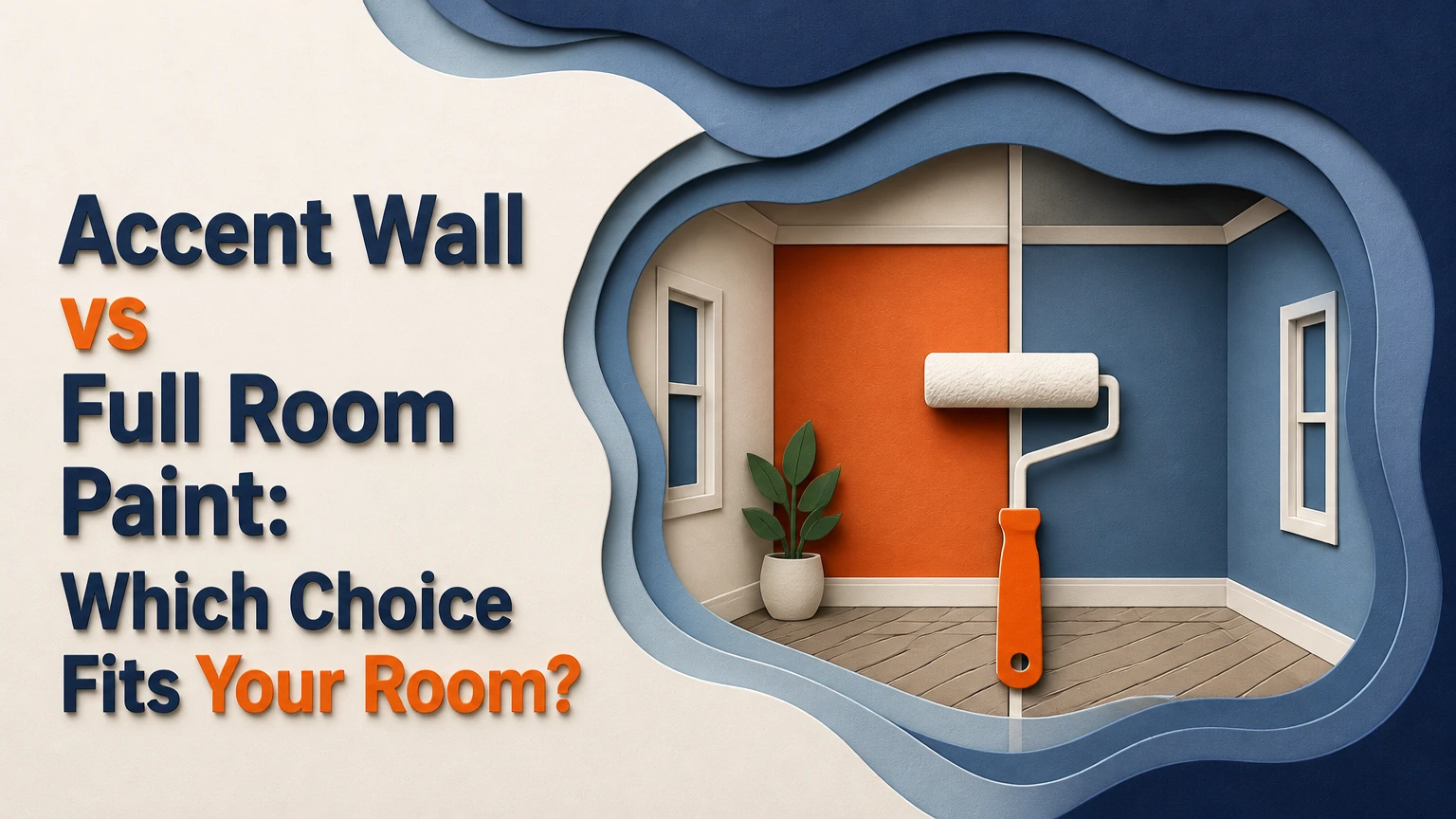
A simple accent wall wins for renters, beginners, and rooms with a strong focal point because it costs less and takes less time. Full-room paint wins for small bedrooms, open plans, damaged walls, and cohesive long-term design. The deciding factors are lighting, wall condition, room connection, maintenance, and how costly repainting would be.
Quick Verdict
For renters: Accent wall.
For DIY beginners: Solid-color accent wall.
For small bedrooms: Full-room paint in a light neutral.
For open-concept homes: Full-room paint with restrained color zoning.
For dramatic design: Accent wall behind a bed, fireplace, or artwork.
For busy family rooms: Full-room eggshell or satin paint.
For color drenching: Full-room paint across walls, trim, doors, and ceiling.
Accent Wall and Full Room Paint Compared
The two approaches solve different design problems. An accent wall concentrates contrast on one surface, while full-room painting creates continuity across the entire enclosure. A single solid accent wall is usually the cheaper and faster project, but full-room painting can deliver a more finished result when the room has patchy walls, connected sightlines, or little architectural detail.
| Criterion | Accent Wall | Full Room Paint |
|---|---|---|
| Surface covered | One wall, usually 25%-35% of wall area | All four walls, usually 100% of wall area |
| Typical professional cost | $350-$450 per standard wall | $450-$950 for a 12-by-12-foot bedroom, walls only |
| Typical DIY materials | $40-$75 for one gallon and supplies | $80-$175 for two gallons and supplies |
| Typical working time | 3-6 hours, including drying | 1-2 days, including preparation |
| Typical coats | 2, or 3 for deep colors | 2, or 3 for deep colors across every wall |
| Design effect | Focal point and contrast | Unified mood and spatial continuity |
| Best room condition | One intentional, mostly solid wall | Rooms needing consistent repair coverage |
| Reversal cost | Low, usually one wall plus primer | Higher, because every painted surface must change |
| Main failure risk | Random placement or harsh contrast | Flat atmosphere, visible flashing, or dark enclosure |
These figures are typical planning ranges, not fixed quotes. Professional pricing changes with region, ceiling height, furniture, wall repairs, trim, paint brand, and whether the estimate includes primer. The $450-$950 full-room range excludes most ceilings and trim, so a color-drenched room can cost substantially more.
Cost, Materials, and Hidden Expenses
An accent wall is the financial winner when the project means one repaired wall, one color, and ordinary interior paint. Full-room paint becomes more competitive when a contractor already has the room protected and prepared, because setup and cleanup are shared across more painted surface. A panel, wallpaper, or elaborate geometric wall can erase the accent wall’s expected savings.
| Project type | Typical DIY materials | Typical professional price | Main cost variables |
|---|---|---|---|
| Solid accent wall | $40-$75 | $350-$450 | Wall size, repairs, paint color |
| Geometric accent wall | $60-$140 | $450-$900 | Extra tape, layout, precision |
| Peel-and-stick wallpaper wall | $100-$400 | $500-$1,500 | Pattern, wall width, removal risk |
| Board-and-batten wall | $400 or more | $900-$2,500 or more | Lumber, trim, labor, caulking |
| Full room, walls only | $80-$175 | $450-$950 | Room size, repairs, coats |
| Full-room color drench | $120-$275 DIY | $900-$2,000 or more | Ceiling, doors, trim, extra coats |
Paint quantity also changes the calculation. One gallon commonly covers about 350-400 square feet per coat, although porous surfaces, dark color changes, and textured walls reduce practical coverage. A 12-by-12-foot bedroom with 8-foot walls has about 384 square feet of wall area before subtracting openings, so two gallons is a sensible planning allowance for two coats.
Hidden expenses matter more than the can price. Add $15-$40 for quality tape, $20-$50 for a roller and brush kit, $20-$60 for drop cloths, and $10-$30 for spackle and sanding supplies. If the existing wall is glossy, damaged, or much darker than the new color, primer can add $25-$60.
Winner for cost: A solid DIY accent wall wins when it needs ordinary paint and minimal preparation; full-room paint wins only when a single contractor setup makes the larger job efficient.
Time, Labor, and Learning Curve
A straightforward accent wall usually takes 3-6 hours from masking to cleanup, with drying time between coats. Full-room painting usually takes 1-2 days because furniture protection, repairs, edge work, and wet-edge rolling multiply across four walls. The smaller project also limits the number of visible mistakes a beginner can make.
| Task | Accent wall | Full room |
|---|---|---|
| Furniture and floor protection | 15-30 minutes | 30-60 minutes |
| Wall repair and sanding | 15-60 minutes | 45-180 minutes |
| Masking and cutting in | 30-60 minutes | 90-240 minutes |
| First coat | 30-60 minutes | 90-180 minutes |
| Drying before next coat | 2-4 hours, product dependent | 2-4 hours, product dependent |
| Second coat | 30-60 minutes | 90-180 minutes |
| Cleanup and hardware replacement | 20-40 minutes | 30-60 minutes |
| Typical total | 3-6 hours | 1-2 days |
The learning curve is not zero for either option. Crisp accent-wall boundaries require straight tape, a controlled brush, and careful removal while the paint remains slightly tacky. Full-room work requires a wet edge, meaning each rolled section overlaps the preceding section before it dries. Pausing halfway across a wall can create lap marks or uneven sheen.
Painter’s tape does not guarantee a sharp line. Sealing the tape edge with the existing wall color before applying the accent color can reduce bleeding, especially on textured drywall. For full-room work, remove outlet plates, patch nail holes, sand repairs flat, and wipe away dust before painting.
Winner for time and learning curve: Accent wall wins because fewer edges, fewer square feet, and fewer wet-edge transitions reduce both working time and beginner error.
Room Size, Light, and Visual Scale
Full-room paint wins when visual continuity matters more than contrast. A uniform light neutral or muted pastel can soften boundaries in a small bedroom or open plan, while a dark accent wall can create depth when placed behind a bed or fireplace. The same dark color on all four walls may feel enclosed in a room with limited daylight.
Light changes the result more than online color chips suggest. North-facing rooms often make colors appear cooler; warm bulbs can push beige, taupe, and greige toward yellow; strong afternoon light can wash out muted colors. Sample the color on the actual wall and inspect it morning, afternoon, and evening before buying several gallons.
| Room condition | Better choice | Reason |
|---|---|---|
| Small room with limited daylight | Full room, light neutral | Fewer contrast breaks and less visual compression |
| Small room with a bed or fireplace | Accent wall behind the feature | Gives the room one clear anchor |
| Long narrow room | Full room or short-end accent | A short-end accent can visually shorten depth |
| Open-plan living and dining area | Full room with controlled zoning | Preserves sightline continuity |
| Large blank room | Accent wall or color drenching | Adds structure without random decoration |
| Strong architectural feature | Accent wall | Reinforces an existing focal point |
| Many windows and doors | Full room | Avoids fragmented accent boundaries |
Dark colors do not always make a room smaller. A deep navy or charcoal can make a wall recede when the surrounding design supports it, but a high-contrast wall beside several bright walls can make the room feel more segmented. The wall’s position, natural light, furniture, and trim color determine the effect.
Winner for visual scale: Full-room paint wins in small or connected spaces; an accent wall wins when it reinforces a bed, fireplace, media unit, or artwork.
Flow, Focal Points, and Design Control
An accent wall directs the eye, so placement must follow the room’s existing hierarchy. The best wall is often behind a headboard, fireplace, sofa, or media console, with few doors and windows to interrupt the field of color. A random side wall can make the room look unfinished because the contrast has no visual purpose.
Full-room paint creates an uninterrupted color envelope. Color drenching extends the shade across walls, baseboards, window trim, doors, and sometimes the ceiling, creating a deliberately immersive effect. The finish still matters: flat or matte paint hides minor drywall defects, while satin exposes more surface variation but handles cleaning better.
| Design objective | Accent wall | Full room |
|---|---|---|
| Highlight a fireplace | Strong fit | Moderate fit |
| Frame a bed or sofa | Strong fit | Moderate fit |
| Connect adjacent rooms | Weak fit if colors clash | Strong fit |
| Create a quiet backdrop | Depends on contrast | Strong fit |
| Test a bold jewel tone | Strong fit | Higher-risk fit |
| Make trim disappear | Weak fit | Strong fit with color drenching |
| Preserve architectural simplicity | Moderate fit | Strong fit |
Accent walls also offer more control over contrast. You can introduce emerald, navy, terracotta, or charcoal without committing the entire room. That flexibility is valuable when furniture, flooring, and artwork may change.
Winner for design control: Accent wall wins for targeted drama and experimentation; full-room paint wins for cohesion and architectural simplicity.
Durability, Cleaning, and Touch-Ups
Full-room paint usually wins maintenance because the same finish and color cover all major walls, reducing mismatched touch-up areas. In a family room, hallway, or children’s room, eggshell or satin offers more practical washability than flat paint. Matte remains useful where low reflection and defect concealment matter more than scrubbing.
An accent wall can be easier to repaint, but touch-ups may reveal a problem if the original paint has faded or the sheen differs. Bold colors also demand careful coverage when the wall changes later. White or beige paint may need two coats, while a saturated red, navy, or deep green can need three coats or a tinted primer.
| Use case | Recommended sheen | Why |
|---|---|---|
| Guest bedroom with minor defects | Matte or flat | Minimizes reflected surface flaws |
| Living room | Eggshell | Balances low sheen and cleaning |
| Hallway or children’s room | Eggshell or satin | Better resistance to marks |
| Bathroom trim and doors | Semi-gloss | Higher moisture resistance |
| Full-room color drenching | Matte or satin | Matte feels softer; satin cleans more easily |
Professional painter Brian Santos has repeatedly emphasized the practical importance of surface preparation in his painting guidance: the finished result depends more on preparation than on simply applying another coat. That principle applies to both options, but full-room painting exposes preparation flaws across a much larger area.
Winner for maintenance: Full-room paint wins in high-traffic spaces when the walls receive a washable eggshell or satin finish; accent wall wins when occasional total repainting matters most.
Execution and Switching Costs
For an accent wall, clear the wall, remove outlet covers, repair dents, sand smooth, and wipe off dust. Mask the ceiling and adjoining walls, then cut in with an angled brush before rolling the open area in overlapping W-shaped passes. Apply two coats, or three for very dark colors, and remove tape at about a 45-degree angle while the final coat is slightly tacky.
For full-room painting, move furniture to the center and cover it with plastic. Protect the floor with canvas drop cloths, remove hardware, repair every visible defect, and paint from top to bottom: ceiling first, trim and baseboards second, and walls last. Work one wall at a time and keep the roller edge wet to prevent lap marks.
Switching costs differ sharply. Repainting an accent wall may require one gallon, new primer, and several hours. Repainting a full room may require two or more gallons, renewed protection, and a full day of labor. Color drenching has the highest switching cost because trim, doors, and ceiling must change together to preserve the intended effect.
Winner for reversibility: Accent wall wins for renters, trend-sensitive homeowners, and anyone testing a bold color before committing.
Placement Rules That Prevent Regret
Choose an accent wall with a clear job. It should frame furniture, emphasize architecture, or create a deliberate endpoint in a long room. Avoid selecting a wall only because it is empty. An empty wall may lack the furniture or lighting needed to make the color feel intentional.
Use these checks before painting:
- Stand at the room entrance and identify the wall seen first.
- Check the wall at morning and evening light.
- Avoid splitting a strong architectural feature across two colors.
- Keep the accent wall mostly solid when learning.
- Test the color beside flooring, curtains, upholstery, and trim.
- Consider whether the wall will still work after furniture moves.
- Use a removable sample board when the lease or deposit matters.
The most reliable accent wall is behind a headboard, fireplace, sofa, or artwork. Walls crowded with windows, doors, radiators, or sloping transitions usually produce weaker results because the color field lacks a clean boundary.
Winner for placement flexibility: Full-room paint wins when the room has no obvious focal wall; accent wall wins when architecture already provides one.
Alternatives Beyond the Two Choices
A strict either-or decision can overlook better middle paths. Two-tone painting uses a restrained lower color with a lighter upper wall, often divided by a chair rail or measured horizontal line. It adds structure without concentrating all contrast on one wall.
Wallpaper can create a stronger feature than paint, but peel-and-stick products require smooth, clean walls and may remove poorly from matte paint or weak drywall paper. Limewash and mineral paints create cloudy movement rather than a flat, uniform color. Removable murals suit rentals but often cost more per square foot than paint.
| Alternative | Typical DIY cost | Best use | Main drawback |
|---|---|---|---|
| Two-tone wall | $60-$150 | Soft zoning without a hard focal wall | Layout errors show clearly |
| Peel-and-stick wallpaper | $100-$400 | Rental-friendly feature surface | Removal and alignment risk |
| Removable mural | $150-$600 | Strong art-led focal point | Pattern matching takes time |
| Limewash-style paint | $100-$300 | Organic, textured atmosphere | Touch-ups are less invisible |
| Board-and-batten | $400 or more | Architectural depth | Higher labor and switching cost |
| Color-drenched trim | $120-$275 DIY | Immersive, high-design room | Requires more surfaces and precision |
Winner among alternatives: Two-tone painting is the practical middle ground, while wallpaper, limewash, and paneling suit homeowners willing to accept higher cost and more specialized installation.
Which Should You Choose?
Choose an Accent Wall as a Renter
A renter should choose a solid accent wall when the lease permits repainting and the deposit risk is manageable. One gallon, basic tape, and a roller can keep materials near $40-$75, while restoration usually involves repainting one wall rather than the entire room.
Choose a wall behind a bed or sofa, avoid built-in cabinetry, and use a color that can be covered with the landlord’s required white or beige. Test removable samples first because dark colors can require primer during restoration.
Recommendation: Renters should choose one solid accent wall, not permanent paneling, wallpaper with uncertain removal, or color-drenched trim.
Choose Full-Room Paint for a Small Bedroom
A small bedroom should usually receive full-room paint in a light neutral, muted pastel, or soft warm white when the goal is a larger, calmer appearance. Consistent color reduces visual breaks, especially when the room has several openings or limited natural light.
An accent wall still works behind a bed if the room has a clear headboard wall and the contrast remains moderate. Avoid a very dark wall opposite a window unless the room has enough daylight and the furniture supports the depth effect.
Recommendation: Small bedrooms without a strong focal wall should receive full-room paint; bedrooms with a clear headboard wall can use a controlled accent.
Choose Full-Room Paint for an Open Plan
Open-concept homes benefit from full-room paint because connected spaces share sightlines. A single light neutral, muted greige, or soft off-white can link living, dining, and kitchen zones without creating abrupt visual barriers.
Color zoning can still define areas, but keep adjacent shades closely related and repeat them through upholstery, rugs, or artwork. A high-contrast accent wall at the end of one zone may make the entire plan feel chopped into disconnected boxes.
Recommendation: Open-plan homeowners should choose full-room paint across connected zones, using restrained color changes only where architecture provides a natural boundary.
Choose an Accent Wall for a Design-Led Focal Point
A design-led homeowner should choose an accent wall when a fireplace, bed, sofa, media unit, or artwork already commands attention. Deep navy, charcoal, emerald, or terracotta can strengthen that anchor without forcing every surface into the same mood.
Geometric blocking, wallpaper, board-and-batten, and wood slats can deliver more impact, but their cost and switching burden exceed the $40-$75 solid-paint baseline.
Recommendation: Homeowners with a clear architectural focal point should choose an accent wall and match its color to the room’s furniture and lighting.
Choose Full-Room Paint for a Busy Family Room
A family room, hallway, or children’s room needs a washable surface more than a dramatic color break. Full-room eggshell or satin paint gives consistent coverage and makes future touch-ups easier, provided the stored paint matches the original batch and sheen.
Flat paint hides defects but marks more easily. Semi-gloss is generally better reserved for trim, doors, and moisture-prone surfaces because its reflection can exaggerate wall imperfections.
Recommendation: Busy households should choose full-room eggshell or satin paint in a mid-tone neutral, with a feature wall only when cleaning and future furniture changes are not concerns.
Limitations and Exceptions
Full-room paint disappoints when the color is too dark for the available daylight or when every wall is already visually crowded with furniture and artwork. A saturated shade across four walls can feel heavy, and color drenching increases both labor and repainting cost.
An accent wall disappoints when it has no relationship to furniture, architecture, or sightlines. It can also make a narrow room feel shorter if placed on the wrong end, while a high-contrast wall beside many windows may look uneven throughout the day.
The market also understates preparation. Paint does not hide large dents, grease, loose drywall paper, or poorly sanded patches. A contractor may charge more for repairs than for the paint itself, particularly in older homes or rooms with repeated picture-hook damage.
Another overlooked issue is sheen continuity. A patched area painted with a different sheen can flash under side lighting even when the color appears correct. Keep the original paint label, batch information, finish, and application tools whenever possible.
The honest rule is simple: choose the option that solves the room’s structural problem. Use an accent wall to create or reinforce a focal point. Use full-room paint to unify surfaces, soften boundaries, or cover a consistently prepared space.
Frequently Asked Questions
Is an accent wall cheaper than painting a full room?
A simple DIY accent wall usually costs $40-$75 in materials, compared with $80-$175 for a standard full-room DIY project. Professional prices typically run $350-$450 per accent wall and $450-$950 for a 12-by-12-foot bedroom, walls only. Paneling, wallpaper, repairs, trim, and ceiling work can reverse that comparison.
Can a dark accent wall make a room look smaller?
A dark accent wall can make a room feel smaller when it creates strong contrast in a narrow or poorly lit space. Behind a bed, fireplace, or sofa, the same dark wall can add depth and make the surface recede. Test the color beside the room’s actual flooring, trim, and lighting.
Should the ceiling match the full-room wall color?
Matching the ceiling can work in color drenching, especially with matte paint and a rich, muted color. It also increases paint quantity, labor, and switching cost. In most rooms, keep the ceiling lighter when height and brightness matter more than an immersive design effect.
Does an accent wall add home value?
An accent wall rarely adds measurable value by itself. Its benefit is presentation: it can frame a fireplace, bed, or artwork and make a room appear intentional. Before selling, use a restrained, well-placed color because unusual patterns, heavy paneling, or very dark colors can narrow buyer appeal.
What finish is best for a painted feature wall?
Eggshell is the safest general-purpose finish for a feature wall because it offers modest washability without the strong reflection of satin or semi-gloss. Matte works well when the wall has minor defects and low traffic. Semi-gloss is usually too reflective for broad interior walls unless moisture resistance is the priority.
Can I paint an accent wall first and the rest later?
Yes. Paint the accent wall first when its color is dark or saturated, then complete the surrounding walls after it dries fully. Keep the original wall color available for sealing tape edges and correcting bleed. If the final design depends on exact contrast, test both colors together before committing.