
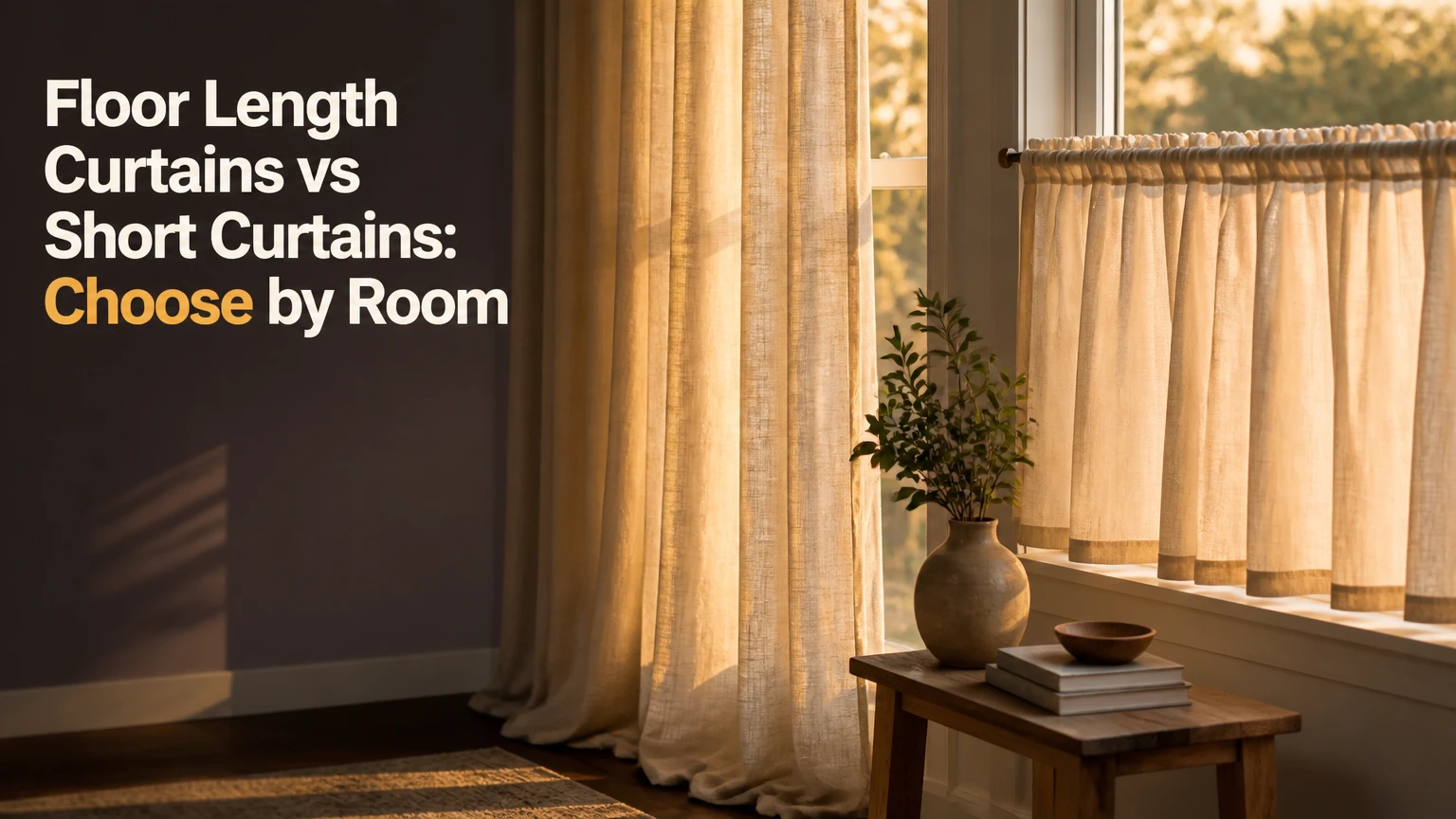
Floor length curtains win for bedrooms, formal living rooms, and small apartments because they add vertical scale, privacy, and window coverage. Short curtains win when children, pets, radiators, furniture, moisture, or a tight budget matter more than height. The correct choice depends first on clearance and safety, then on light control, appearance, maintenance, and total cost.
Quick Verdict
- For a low-ceiling apartment: Choose floor-length curtains mounted close to the ceiling.
- For toddlers or pets: Choose sill or apron-length curtains, or cordless shades.
- For a dark bedroom: Choose floor-length curtains with blackout lining.
- For a kitchen or bathroom: Choose café curtains, Roman shades, or roller shades.
- For a desk, bed, or radiator below the window: Choose short curtains only when heat and clearance are safe.
- For the lowest purchase price: Choose ready-made short curtains.
- For a formal living room: Choose floor-length curtains with a hover finish.
Floor Length Curtains vs Short Curtains at a Glance
The table uses a five-point scale for subjective ratings, where 5 is strongest and 1 is weakest. Prices are typical retail ranges for one ready-made pair, not a universal market quote.
| Criterion | Floor-Length Curtains | Short Curtains |
|---|---|---|
| Visual height | 5/5, creates a continuous vertical line | 2/5, can divide the wall at the sill |
| Privacy coverage | 5/5, covers the window and lower wall area | 3/5, depends on sill or apron coverage |
| Blackout potential | 5/5 with lined, overlapping panels | 3/5 unless tightly fitted or layered |
| Furniture clearance | 2/5, needs fabric and stack space | 5/5, leaves the area below available |
| Child and pet safety | 2/5, reachable hems and pull risk | 4/5, less accessible when properly mounted |
| Cleaning burden | 2/5, collects floor dust and hair | 4/5, stays above most floor debris |
| Typical pair price | $100-$300 ready-made; $600-$1,500+ custom | $40-$150 ready-made; about $40-$200 broadly |
| DIY installation | 1-2 hours, with rod or track alignment | 1-2 hours, usually simpler |
| Custom lead time | 4-8 weeks is typical | Often ready to install immediately |
| Best finish | Hover, 0.5 inch above floor | Sill or apron, 2-4 inches below sill |
Visual Scale and Interior Style
Floor-length curtains make a room feel taller when the rod sits near the ceiling and the fabric falls in one uninterrupted line. This effect is strongest in rooms with 8-foot ceilings, narrow windows, or limited wall decoration because the eye reads the fabric as added height rather than as a separate window covering.
Short curtains emphasize the window opening. Sill-length panels look neat inside a recessed window, while apron-length panels cover the lower casing and appear more finished when open. Café curtains expose the upper glass and cover the lower half, so they suit rooms that need daylight above eye level.
A floor-length curtain does not automatically make a room look expensive. A badly measured panel stopping 2-4 inches above the floor looks accidental, while a short panel installed over a radiator can look careless and operate unsafely. Fabric weight, heading style, rod placement, and fullness affect the result.
Winner for visual scale and formal style: Floor-length curtains win when the window wall is unobstructed and the rod can be mounted high.
Choose the Right Hem
A hover or float finish ends about 0.5 inch above the floor and is the safest default for vacuuming. A break extends 0.5-1 inch onto the floor and disguises minor measuring errors. A puddle extends 2-6 inches onto the floor, but it collects dust, pet hair, and moisture.
For short curtains, sill length ends at the sill. Apron length extends about 2-4 inches below it. Café curtains cover the lower half of the window and offer privacy without sacrificing upper daylight.
Light, Privacy, and Insulation
Floor-length curtains usually provide superior coverage because they can overlap the window, extend beyond both jambs, and reach the floor. A blackout liner also reduces side light, which matters in bedrooms where a narrow uncovered strip can brighten the room before sunrise.
Short curtains can provide excellent privacy when the concern is eye-level visibility rather than total darkness. Café curtains are especially effective on street-facing kitchen windows because they block direct sightlines while leaving upper glass open for daylight.
Curtain length alone does not guarantee insulation. The U.S. Department of Energy recommends tight-fitting window treatments for reducing heat loss, and the Energy Saving Trust notes that closed curtains can reduce drafts around windows, but the result depends on fit, lining, fabric, and the window itself.
A floor-length panel can reduce perceived drafts at the window plane, yet a thin unlined panel mounted far from the glass may insulate less than a properly fitted cellular shade. Short curtains leave the lower wall area uncovered, but that is not the same as allowing all window heat to escape.
| Light-control setup | Typical result | Best use |
|---|---|---|
| Unlined floor panels | Soft daylight, moderate privacy | Living rooms |
| Blackout-lined floor panels | Strong darkness, reduced side light | Bedrooms and media rooms |
| Sill-length short panels | Daylight with basic privacy | Recessed windows |
| Apron-length lined panels | Moderate privacy and light reduction | Bedrooms with furniture below |
| Café curtains | Eye-level privacy, maximum upper daylight | Kitchens and bathrooms |
| Cellular or roller shade | Precise coverage, compact stack | Tight clearances |
Winner for blackout and draft control: Floor-length curtains win with a blackout or thermal lining and adequate overlap; an unlined long panel is not automatically superior.
Furniture, Radiators, and Clearance
Short curtains are the practical winner when a desk, bed, bench, cabinet, or radiator sits directly below the window. The fabric stops above the obstruction, so it cannot bunch behind furniture or become trapped when the furniture moves.
Floor-length curtains require a clear drop from the rod to the floor and enough side space for the panels to stack when open. A desk can sit in front of a long curtain, but the fabric may catch on chair arms, rub against the desktop, or prevent the panel from closing cleanly.
Heating requires special care. A curtain that covers a radiator or baseboard heater may restrict warm-air circulation, discolor the fabric, or create a safety concern. Follow the heater manufacturer’s clearance instructions rather than assuming every short curtain is safe. If the heater occupies the full sill area, use an inside-mount Roman shade, roller shade, or café curtain that ends above it.
A window air-conditioning unit, convector, or ventilation grille creates a similar obstruction. Measure the equipment first. The attractive option is not the safe option if fabric covers airflow.
Winner for obstructed windows: Short curtains win when furniture occupies the drop; an inside-mount shade wins when a heater occupies the full opening.
Safety, Cleaning, and Longevity
Floor-length curtains place fabric within reach of toddlers and pets. A child can pull the hem, climb on a low panel, or tug the rod from drywall. Cats may climb the fabric, dogs may sleep on the hem, and long panels collect hair near the floor. Use secure hardware, keep cords inaccessible, and follow current window-covering safety guidance from the Window Covering Safety Council.
Short curtains reduce those risks, but they do not eliminate them. A low-mounted rod, dangling cord, loose tieback, or climbable furniture can still create a hazard. Cordless Roman shades and roller shades are safer where children sleep or play.
Cleaning costs are easy to underestimate. A typical floor panel may need vacuuming every 1-2 weeks in a pet home, gentle washing or dry cleaning according to the care label, and steaming after laundering. A short panel usually avoids floor grime, but kitchen curtains may need monthly washing because grease and cooking vapor settle on fabric.
Longevity depends on more than length. Sun exposure fades both styles, cheap polyester can retain odors, and natural fibers may shrink if washed incorrectly. Check whether a panel is preshrunk, lined, washable, and compatible with the rod weight before buying.
Winner for low maintenance and household safety: Short curtains win in homes with pets, toddlers, frequent spills, or heavy traffic.
Cost, Hardware, and Total Ownership
Short curtains usually cost less because they use less fabric. Typical ready-made prices are about $40-$150 per pair, although specialty café panels and lined designer options can approach $200.
Ready-made floor panels commonly cost $100-$300 per pair. Custom work can reach $600-$1,500 or more once fabric, lining, labor, tracks, and installation are included. Heavy velvet, interlining, extra fullness, and tall ceilings increase the amount of fabric required.
The purchase price is only the first cost. Floor-length curtains may require stronger rods, center supports, professional steaming, dry cleaning, hemming, and a larger return if the first measurement is wrong. Short curtains generally reduce fabric and cleaning costs, but custom short panels can still become expensive when the window has an unusual shape.
| Cost item | Floor-length curtains | Short curtains |
|---|---|---|
| Ready-made pair | $100-$300 typical | $40-$150 typical |
| Broad retail range | $100-$600+ | $40-$200 |
| Custom pair | $600-$1,500+ | Often $250-$800, depending on fabric |
| Rod or track | $30-$250 typical | $20-$150 typical |
| Professional installation | About $100-$500 | About $75-$300 |
| Hem correction | About $20-$100 per panel | About $15-$75 per panel |
| Custom lead time | 4-8 weeks typical | Often 2-6 weeks |
| DIY setup | 1-2 hours | About 1-2 hours |
These figures are typical planning ranges, not guaranteed quotes. A local seamstress, fabric choice, window width, and installation height can move the final total substantially.
Winner for initial price and lower ownership cost: Short curtains win in most ready-made purchases, while floor-length curtains justify extra cost when visual height, blackout, or formal design carries high value.
Measuring and Installing Each Style
Measure from the actual rod position, not from the top of the window, when ordering floor-length curtains. For a clean float, measure rod to floor and subtract about 0.5 inch. For a soft break, add approximately 0.5-1 inch. A puddle requires an additional 2-6 inches, but it demands more cleaning.
For an apron-length panel, measure from the rod to approximately 3 inches below the window casing. For sill length, measure to the sill surface and confirm whether the sill projects into the room.
For both styles, multiply the window width by 2-2.5 for attractive fullness when closed. A 60-inch window therefore needs approximately 120-150 inches of total fabric width. Split that width across two panels when you want symmetrical opening.
Extend the rod 6-12 inches beyond each side of the window where wall space allows. This lets opened panels stack clear of the glass and prevents the rod from blocking daylight. Use a center bracket for wide or heavy panels, but place it so the curtain rings can still pass across the full opening.
| Measurement | Recommended figure |
|---|---|
| Floor float | 0.5 inch above floor |
| Soft break | 0.5-1 inch on floor |
| Puddle | 2-6 inches on floor |
| Apron drop | 2-4 inches below sill |
| Rod extension | 6-12 inches per side |
| Fullness | 2-2.5 times window width |
| Typical DIY installation | 1-2 hours |
The most common floor-curtain error is a high-water hem 2-4 inches above the floor. Lower the rod if possible, use elongated drapery clips, or ask a tailor whether a deep bottom hem can be released. The most common short-curtain error is covering a heater without checking its clearance instructions.
Winner for measuring simplicity: Short curtains usually win, but floor-length curtains are straightforward when the rod position and floor height are measured precisely.
Privacy, Sleep, and Room Function
Bedroom curtains should be selected around the sleeper’s actual need. Floor-length blackout curtains are the strongest conventional curtain solution when the bed does not block the wall and the panels can overlap beyond the window. Choose a blackout lining, mount the rod above the casing, and extend it beyond both sides to reduce edge leakage.
Short curtains work in bedrooms with a bed, dresser, or radiator beneath the window. Apron panels can cover the glass without dragging behind furniture, but they leave more wall and lower-window leakage than full panels. For maximum darkness in a tight space, an inside-mount blackout roller shade often outperforms a short decorative curtain.
Living rooms tolerate more variation. Floor panels suit formal architecture, tall windows, and rooms where the rod can span the wall. Short panels suit breakfast nooks, bay windows with seating, and windows above built-in cabinets.
Bathrooms need privacy and moisture tolerance. Polyester café curtains or moisture-resistant roller shades are more practical than heavy floor fabric. Kitchens have the added problem of grease, steam, and splashes.
Winner for sleeping and formal privacy: Floor-length curtains win when a lined panel can cover the whole opening; short curtains win when furniture or heating prevents that installation.
Which Should You Choose?
Choose Floor-Length Curtains for a Small Apartment
Floor-length curtains are the best choice for a renter with low ceilings when the window wall is clear. Mount the rod near the ceiling, select panels long enough to hover 0.5 inch above the floor, and extend the rod 6-12 inches beyond the window where possible.
This installation creates a taller vertical line without structural renovation. Avoid puddling in a rental because moving furniture and cleaning become harder. Use lightweight polyester or cotton-blend panels if the rod and wall anchors cannot support heavy velvet.
Choose Short Curtains for Toddlers and Pets
Short curtains are the safer default for a home with toddlers, cats, or dogs, especially in playrooms and ground-floor rooms. Choose sill or apron length, secure the rod into suitable anchors, and remove looped cords or dangling tiebacks.
If a child can still reach the fabric, choose a cordless cellular, roller, or Roman shade instead. Short length reduces floor contact and pulling opportunities, but safe hardware matters more than hem length alone.
Choose Floor-Length Curtains for a Dark Bedroom
Floor-length curtains win for a bedroom with an unobstructed window wall. Use blackout-lined panels, adequate fullness, and side overlap to reduce morning light. A ceiling-mounted track can improve coverage when the window is wide or close to the ceiling.
Choose an apron curtain or blackout roller shade instead when the bed, radiator, or built-in furniture sits directly below the window. The shade may deliver better darkness than a short decorative panel.
Choose Café Curtains for a Kitchen or Bathroom
Café curtains are the best curtain-length choice for many kitchens and bathrooms because they preserve upper daylight while covering eye-level views. Use washable polyester or a moisture-resistant fabric, and keep the hem clear of sinks, burners, and heaters.
A roller shade or faux-wood blind may be better where grease, water, or frequent wiping is severe. Floor-length fabric is usually the wrong choice beside cooking surfaces, wet floors, or bathroom fixtures.
Choose Short Curtains Around Furniture or Heaters
Short curtains suit windows above desks, beds, benches, and cabinets because they leave the lower area usable. Measure the furniture and window hardware together, then check the heater manufacturer’s clearance rules before selecting an apron drop.
If a baseboard heater runs across the whole wall, use an inside-mount shade rather than allowing fabric to hang over it. The safest answer is determined by airflow and heat clearance, not by appearance.
Choose Floor-Length Curtains for a Formal Living Room
Floor-length curtains are the stronger design choice for a formal living room without obstructions. Use a hover finish for a tailored look, a break for a softer finish, and a lined fabric when privacy and evening comfort matter.
Open the panels fully during the day so they do not cover the glass. A rod that stops at the frame wastes daylight and makes the window appear narrower.
Where Each Choice Disappoints
Floor-length curtains disappoint when the room has pets, a crawling child, a narrow walkway, or a heater beneath the window. They also disappoint when the fabric is too short, the rod is too narrow, or the hem requires frequent washing.
Short curtains disappoint when the room needs a taller appearance, full blackout, or a polished formal finish. A short panel can visually cut across a wall, expose lower-window light, and look undersized on a tall or expansive window.
The thermal comparison needs an honest correction. Long curtains often cover more of the window plane, but length does not create insulation by itself. A lined short curtain can outperform an unlined long curtain if it fits the opening better. Cellular shades, layered Roman shades, and properly sealed roller shades may be more efficient in specific windows.
No curtain length solves a poor installation. A rod fixed only into drywall, a panel narrower than the window, or fabric washed against its care label can shorten the life of either option.
Alternatives Beyond Curtain Length
Roman shades are strong alternatives when you want fabric softness without a floor-level hem. They work above desks, beds, and radiators, especially as inside mounts.
Cellular shades provide compact operation, strong light control, and a low-profile fit. They are often better for nurseries, narrow windows, and rooms where furniture reaches the sill.
Roller shades offer simple cleaning and precise privacy. Solar shades reduce glare while preserving outward visibility, but they provide less nighttime privacy when interior lights are on.
Shutters and faux-wood blinds suit kitchens and bathrooms because they tolerate splashes better than many textile panels. Café curtains remain useful when upper daylight is a priority.
The best combination is often a shade plus side panels. The shade handles privacy and light, while floor-length panels provide the vertical scale and softness that a compact blind cannot create.
Frequently Asked Questions
Do floor-length curtains make a room look bigger?
Floor-length curtains can make a room feel taller when the rod is mounted near the ceiling and the panels form an uninterrupted vertical line. They do not increase floor area. Use a hover finish, adequate fullness, and a rod extending 6-12 inches beyond the window to preserve glass and avoid a cramped appearance.
Are short curtains outdated?
Short curtains are not outdated when the window has furniture, a radiator, a recessed sill, or a practical room function. Sill, apron, and café styles remain appropriate in kitchens, bathrooms, breakfast areas, and children’s rooms. They look intentional when the hem aligns with the sill or casing rather than stopping at an arbitrary point.
Should curtains touch the floor?
Floor-length curtains should usually hover about 0.5 inch above the floor for easy cleaning. A 0.5-1-inch break creates a softer hem, while a 2-6-inch puddle creates a formal effect with higher dust and pet-hair exposure. Avoid stopping 2-4 inches above the floor because that gap usually looks mismeasured.
Can short curtains help with insulation?
Short curtains can reduce drafts only when they cover the window opening effectively and use a dense or lined fabric. They leave more of the wall and lower window area uncovered than floor panels. A fitted cellular shade or lined Roman shade may insulate better than either curtain length in a window with significant air leakage.
How wide should curtains be for a window?
Plan total curtain fabric at about 2-2.5 times the window width for fullness when closed. A 60-inch window therefore needs approximately 120-150 inches of combined panel width. Extend the rod 6-12 inches beyond each side when possible, so opened fabric stacks away from the glass.
Are café curtains suitable for bedrooms?
Café curtains suit bedrooms when privacy is needed at eye level but full darkness is unnecessary. They leave upper glass exposed, so streetlights and early sunlight can enter. For sleeping, pair a café curtain with a blackout roller shade or choose full-length blackout panels where the window wall has enough clearance.