
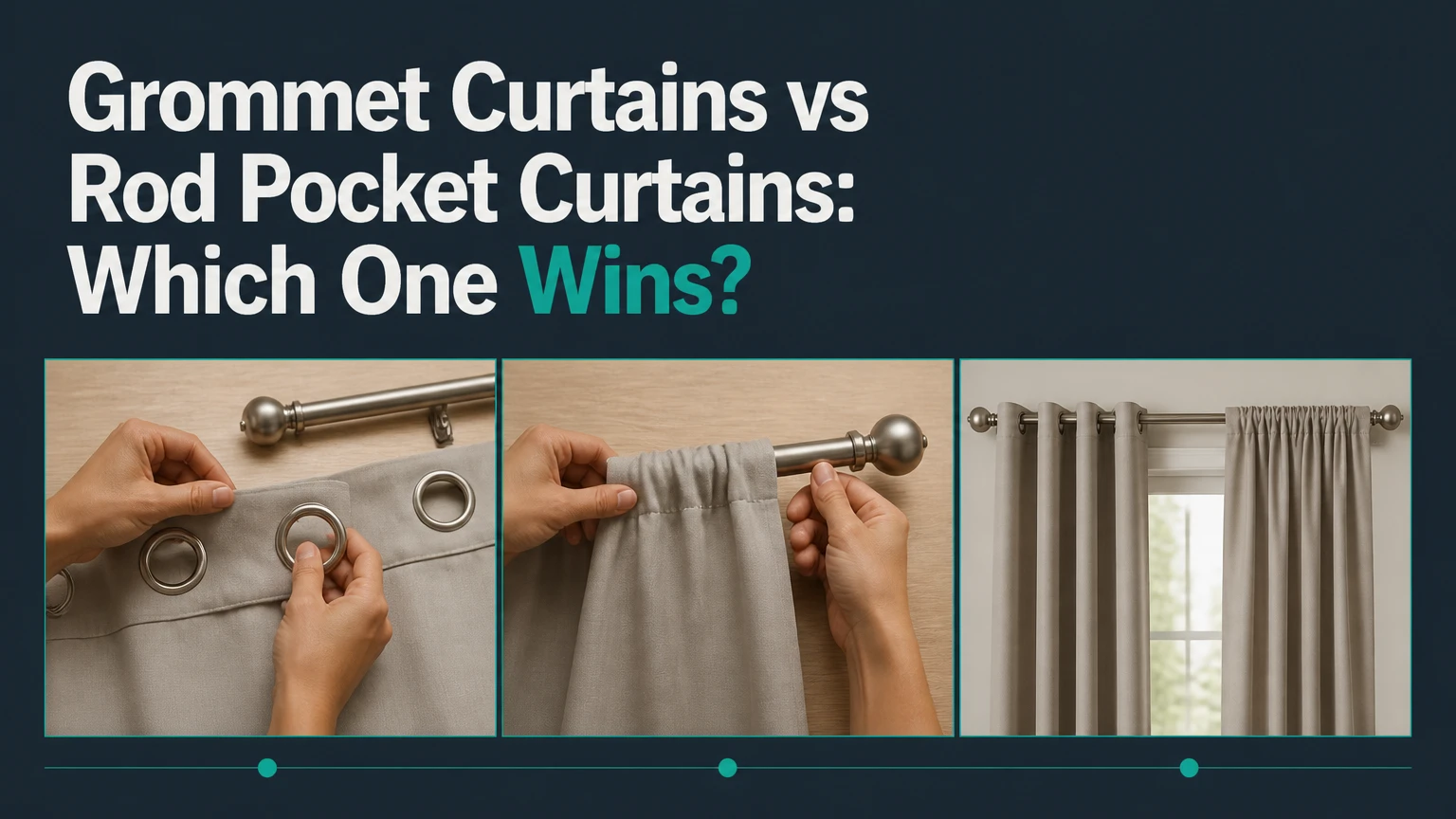
Grommet curtains win for daily opening, sliding doors, wide windows, and modern rooms because the rings reduce friction and stack compactly. Rod pocket curtains win for stationary panels, traditional décor, rentals using tension rods, and the lowest upfront cost. The deciding factor is how often the fabric must move, not simply which header looks better.
Quick Verdict
- For daily opening and closing: Grommet curtains.
- For traditional, mostly fixed décor: Rod pocket curtains.
- For renters using tension rods: Rod pocket curtains.
- For sliding glass doors: Grommet curtains.
- For wide windows: Grommet curtains.
- For the lowest purchase price: Rod pocket curtains.
- For modern minimalist rooms: Grommet curtains.
- For classic or romantic rooms: Rod pocket curtains.
Grommet Curtains vs Rod Pocket Curtains Compared
Grommet curtains use reinforced rings, usually metal or ABS plastic, punched into the top header. The rod passes through each ring, forcing the fabric into regular front-to-back folds. Rod pocket curtains use a sewn fabric tunnel, so the rod passes through a continuous casing and gathers the panel into a dense ruffle.
The practical difference is friction. A grommet panel moves on several separate contact points around the rod, while a rod pocket drags a long fabric tunnel across it. That makes grommets the stronger choice for repeated movement, even though rod pockets can cost less and look softer.
| Criterion | Grommet curtains | Rod pocket curtains |
|---|---|---|
| Best operating frequency | Several movements daily | Static, tied back, or occasional movement |
| Typical visual effect | Deep, regular S-waves | Dense, soft, gathered folds |
| Recommended fullness | 2-2.5 times window width | 2.5-3 times window width |
| Typical header clearance | Rod at least 0.5 inches smaller than ring opening | Pocket flat measurement at least 1 inch wider than rod diameter |
| Typical ready-made price | $15-$80 per panel, sometimes 5-10% more | $15-$80 per panel |
| Typical installation time | 15-20 minutes per window | 20-30 minutes per window |
| Side stackback | More compact, usually | Wider and more bunched |
| Best hardware | Visible decorative rod | Tension, utility, or decorative rod |
| Strongest room fit | Living room, patio door, contemporary bedroom | Guest room, dining room, traditional bedroom |
| Main failure risk | Scraping, exposed hardware, visible lining | Binding, uneven gathers, sagging pocket |
Overall verdict: Grommet curtains are the better functional choice, while rod pocket curtains are the better stationary and traditional choice.
Daily Operation and Friction
Grommet curtains win daily operation because the rod touches individual ring interiors rather than an entire fabric channel. A panel can usually be threaded in under two minutes, and opening or closing it requires a steady horizontal pull instead of repeated tugging.
Rod pocket curtains create substantially more drag. The pocket fabric bunches against the rod, particularly when the curtain is lined, wide, or made from velvet, canvas, or thermal material. Pulling the panel every morning and evening can distort the gathers, loosen brackets, and eventually stress the seams.
A rod pocket panel can still move acceptably when it is narrow, lightly lined, and rarely adjusted. A smooth metal rod, silicone spray designed for curtain hardware, or curtain clip rings can reduce resistance, but those fixes change the original operating method.
| Use pattern | Grommet result | Rod pocket result |
|---|---|---|
| Open once daily | Smooth, low effort | Usable, but slower |
| Open 2-4 times daily | Strong fit | High friction and gather disruption |
| Closed permanently | Works, but hardware remains visible | Strong fit |
| Tied back most days | Works | Strong fit |
| Heavy blackout fabric | Usually manageable | Often difficult to pull |
| Child or pet traffic | Easier to reposition | More likely to shift unevenly |
Winner for daily operation: Grommet curtains, because the ring-and-rod interface creates less fabric-on-rod friction.
Appearance and Fold Shape
Grommets produce architectural folds with a modern, crisp, or industrial character. The alternating front-to-back path through the rings creates relatively uniform S-waves, although the result depends on panel width, fabric stiffness, and the spacing between grommets.
Rod pockets create a fuller, softer, more traditional header. A standard pocket gathers tightly below the rod. A pocket with a header adds a fabric ruffle above the rod, which can suit cottage, romantic, farmhouse, or classic interiors.
The visual distinction is significant at the top of the window. Grommets expose the rod and its finish, so brushed nickel, matte black, antique brass, and oil-rubbed bronze become part of the room. Rod pockets hide most of the rod, making inexpensive hardware less noticeable.
Winner for contemporary design: Grommet curtains.
Winner for traditional softness: Rod pocket curtains.
Fabric, Light, and Privacy
Neither header automatically blocks more light. Light control depends primarily on fabric density, lining, color, side coverage, and how closely the panel meets the wall. A lined rod pocket curtain can outperform an unlined grommet curtain, while a properly lined grommet panel can provide strong blackout performance.
Grommet panels generally need 2-2.5 times the window width. Excessive fullness can prevent the rings from stacking neatly and can make the folds lose their shape. Rod pocket panels usually need 2.5-3 times the window width because insufficient fabric produces a flat, sparse gathering.
Grommet construction can create small light gaps around the ring area, particularly on inexpensive blackout panels where the white lining peeks through the folds. Rod pockets can reduce top-edge light leakage because the fabric casing covers the rod, but the dense gathering may leave uneven side gaps.
| Goal | Better starting point | Specification to prioritize |
|---|---|---|
| Maximum blackout | Either style | Lined or layered panel, overlapping center closure |
| Daytime privacy | Either style | Medium-weight tightly woven fabric |
| Compact side opening | Grommet curtains | 2-2.5x fullness |
| Soft decorative fullness | Rod pocket curtains | 2.5-3x fullness |
| Concealed rod | Rod pocket curtains | Pocket with suitable header height |
| Clean geometric folds | Grommet curtains | Even ring spacing and stable fabric |
Winner for compact coverage: Grommet curtains.
Winner for concealed, soft presentation: Rod pocket curtains.
Hardware and Installation
Grommet curtains require a rod that looks intentional because the hardware remains visible. Standard grommet inner diameters range from 1.5-2 inches, and the rod should be at least 0.5 inches smaller than the opening. A 1-inch rod normally fits a 1.5-inch grommet, but the manufacturer’s inside measurement should control the purchase.
Rod pocket curtains are more forgiving about appearance. A basic utility rod or no-drill tension rod can sit inside the pocket, which makes the style useful in rental apartments. The pocket’s flat measurement should be at least 1 inch wider than the rod diameter, allowing the fabric to slide over the hardware.
For either style, mounting brackets 4-6 inches above the window frame usually improves perceived height. Grommet height is measured from the top of the rod to the floor, with approximately 1-1.5 inches added for the distance from the ring’s inner top to the fabric edge. Rod pocket measurements should include any ruffle that rises above the rod.
| Installation task | Grommet curtains | Rod pocket curtains |
|---|---|---|
| Prepare hardware | Mount decorative rod | Remove one finial or use tension rod |
| Threading | Push rod through each ring | Scrunch fabric and feed through tunnel |
| Styling | Usually automatic | Manually distribute gathers |
| Typical time | 15-20 minutes | 20-30 minutes |
| Common adjustment | Correct ring orientation | Correct uneven bunching |
| Center support need | For very wide or heavy panels | Especially important with heavy pockets |
Grommet installation is mechanically simpler. Rod pocket installation can take 5-10 minutes just to feed and redistribute a tightly gathered panel.
Winner for installation speed and repeatability: Grommet curtains.
Price and Ownership Cost
Ready-made panels commonly cost $15-$80 per panel for either header style, depending on fabric, lining, width, and brand. Custom curtains can exceed $150 per panel. Grommet panels may carry a 5-10% manufacturing premium because the rings require additional materials and installation.
Rod pockets often have the lowest initial hardware cost. A tension rod can eliminate drilling, while grommets usually need a visible decorative rod and suitable brackets. That difference can exceed the header premium, especially across several windows.
Long-term cost changes the calculation. A rod pocket panel that must be replaced after repeated pulling can cost more than a slightly pricier grommet panel. Conversely, a decorative grommet rod may be unnecessary when the curtain will remain closed for years.
| Purchase scenario | Rod pocket estimate | Grommet estimate |
|---|---|---|
| One ready-made panel | $15-$80 | $15-$80, sometimes 5-10% higher |
| Two-panel window | $30-$160 | $30-$160, sometimes higher |
| Custom panel | $150+ | $150+ |
| Basic rod option | Tension or utility rod | Decorative exposed rod |
| Replacement risk with daily movement | Higher | Lower |
| Lowest initial setup cost | Usually | Rarely |
These are typical retail ranges, not fixed market prices. Fabric weight, width, lining, and local availability can shift the final bill.
Winner for minimum upfront spending: Rod pocket curtains.
Winner for lower operating replacement risk: Grommet curtains.
Durability and Maintenance
Grommets concentrate movement around reinforced holes. Quality metal rings fitted into a stable header can tolerate frequent repositioning, but cheap rings may scratch, loosen, or pull against thin fabric. Plastic or ABS rings resist rust and suit washable or outdoor curtains, although they may feel less substantial.
Rod pockets avoid ring failure, but the continuous casing carries the stress of every movement. Heavy fabric can cause the pocket to sag between brackets, especially on a wide window. Buckram tape inside the header or a center support bracket can improve shape and load distribution.
Cleaning also matters. Grommet curtains may need careful laundering because metal hardware can strike the washer drum or deform the panel. Removable plastic rings and manufacturer-approved washing instructions reduce that risk. Rod pockets are simpler to launder, but pressing or steaming may be needed to restore even gathers.
Winner for frequent mechanical stress: Grommet curtains with reinforced headers and quality rings.
Winner for simple fabric construction: Rod pocket curtains.
Wide Windows and Daily Traffic
Grommet curtains are the stronger choice for sliding glass doors, patio doors, and wide windows because compact stackback preserves more usable glass. Their low-friction movement also matters when the panel crosses a long rod several times each day.
Rod pockets lose practical space at the sides. Their dense bunching can occupy a wider section of the rod, and the friction becomes more noticeable as panel width and fabric weight increase. A center-opening rod pocket arrangement is particularly inconvenient when both panels must move independently.
For a wide opening, use a center support bracket with either style when the rod span or fabric weight requires it. The bracket must not block movement, so select a bypass-compatible system or position the panels to avoid the support.
Winner for wide windows and sliding doors: Grommet curtains.
Measuring and Switching Styles
Measure the installed rod, not merely the glass. For a single panel, calculate the desired coverage width and divide it by the panel count. Then choose fullness based on the header style rather than buying the narrowest panel that technically covers the opening.
To replace rod pockets with grommets, measure from the rod top to the finished floor, then account for the grommet header’s rise. The new exposed rod may need to move higher or wider, and its finish becomes visible. To replace grommets with rod pockets, allow for the pocket’s taller top edge and the extra fabric needed for 2.5-3 times fullness.
Clip rings offer a lower-cost conversion. They attach to a rod pocket’s top edge and create a sliding curtain, but the clips alter the appearance, expose the top edge, and may damage delicate fabric. A drapery wand can improve control without changing the header, although it will not remove pocket friction.
| Switching goal | Practical solution | Main compromise |
|---|---|---|
| Rod pocket to smoother movement | Curtain clip rings | Visible clips and altered header |
| Rod pocket to permanent display | Leave panel fixed or tie back | No daily flexibility |
| Grommet to hidden hardware | Replace with rod pocket panels | New panels and lower mobility |
| Improve heavy rod pocket support | Center bracket or buckram tape | More hardware or sewing |
| Improve grommet fold shape | Steam and train folds | Requires periodic restyling |
Winner for future flexibility: Grommet curtains, unless hidden hardware is a primary requirement.
Alternatives Beyond the Two Styles
Back-tab curtains create a softer hidden-loop appearance than grommets while moving more easily than a rod pocket. The tabs can still drag under heavy fabric, but they suit bedrooms and casual living rooms.
Clip-ring curtains attach directly to rings, making them easy to open and remove for washing. They expose clips and can look less tailored, but they are practical for renters and temporary installations.
Pinch-pleat curtains use sewn pleats with traverse rods or rings. They offer a formal appearance and controlled fullness, but they cost more and require more precise hardware.
Ripple-fold curtains use carriers and snaps on a dedicated track. They are excellent for wide windows and frequent movement, but the track, carriers, and custom panels raise the installation cost.
Roman shades are a better alternative when side stackback is unacceptable. They preserve wall space, but they operate vertically and do not provide the same full-height softness as curtains.
Alternative verdict: Choose clip rings for low-cost mobility, ripple-fold for premium wide-window operation, and Roman shades when side space matters more than curtain fullness.
Which Should You Choose?
Choose Grommet Curtains for Daily Use
Choose grommet curtains if the panels open and close at least once each day, especially in a living room, kitchen, nursery, or patio doorway. The rings reduce drag, preserve more side opening, and keep the folds visually consistent after repeated movement.
Use a sturdy decorative rod, verify the ring diameter, and avoid overfilling the rod. A 2-2.5 times fullness ratio usually balances coverage with compact stackback.
Recommendation: Daily operators should choose grommet curtains because reduced friction prevents the pulling and gather distortion associated with rod pockets.
Choose Rod Pocket Curtains for Traditional Rooms
Choose rod pocket curtains for a guest bedroom, formal dining room, or traditional sitting room where the panels remain closed or tied back. The gathered header creates a softer appearance, hides inexpensive hardware, and supports classic, romantic, farmhouse, and casual décor.
Avoid rod pockets when occupants need to adjust light and privacy repeatedly. The style is decorative first and mobile second.
Recommendation: Traditional-style homeowners should choose rod pocket curtains when appearance matters more than daily movement.
Choose Rod Pockets for Rental Apartments
Choose rod pocket curtains when a tension rod must sit inside the window frame and drilling is prohibited. The hidden hardware avoids the visual problem of placing a basic tension rod above a grommet panel, where the rod would remain conspicuous.
This recommendation applies mainly to narrow windows or panels that stay in one position. For a rental balcony door or frequently used window, clip rings or grommets on a removable decorative rod may work better.
Recommendation: Renters with interior tension rods should choose rod pocket curtains for stationary or lightly used windows.
Choose Grommets for Wide Windows
Choose grommet curtains for sliding glass doors, picture windows, and openings that need frequent access. Compact stackback leaves more glass exposed, while the lower operating friction reduces the effort required to move long panels.
Use multiple panels instead of one oversized panel when possible. Confirm that the center support bracket will not interrupt the ring path.
Recommendation: Wide-window owners should choose grommet curtains because movement and stackback outweigh the softer look of rod pockets.
Choose Rod Pockets for the Lowest Initial Cost
Choose rod pocket curtains when the immediate budget is the main constraint and the panels will remain mostly stationary. The style can use inexpensive tension or utility rods, and its header usually does not justify a decorative hardware upgrade.
Do not select rod pockets solely because the panel price is lower if the window is used every day. Repeated pulling can create replacement and repair costs.
Recommendation: Budget shoppers should choose rod pocket curtains for fixed installations, but grommets may cost less over time in high-use rooms.
Honest Limitations and Hidden Trade-Offs
Grommets disappoint in rooms where visible hardware conflicts with the design. The rod, brackets, and ring finish become part of the composition, so mismatched metal can make an otherwise polished room look unfinished. Cheap grommets can also scrape on oversized or rough rods.
Rod pockets disappoint when buyers expect drapery-like movement. The header is not a glide system. Heavy blackout fabric, extra-wide panels, and frequent adjustment expose that limitation quickly.
The market also hides the importance of fabric structure. A stable woven fabric can make either header look tailored, while thin slippery fabric can create weak folds, lining exposure, or an unstable pocket. Header style cannot compensate for inadequate width.
The final hidden cost is switching. Moving from rod pockets to grommets usually means buying new panels and possibly a new rod because the mounting height, hardware visibility, and finished length change. Measure before purchasing.
FAQ
Are grommet curtains easier to open than rod pockets?
Yes. Grommet curtains usually move with less effort because the rod passes through separate reinforced rings rather than a continuous fabric tunnel. Rod pockets can work for occasional adjustment, but lined or heavy panels often bind. A smooth rod and a drapery wand help, yet neither removes the pocket’s basic friction.
Can rod pocket curtains go on a tension rod?
Yes. Rod pocket curtains are usually the better match for tension rods because the hardware stays hidden inside the fabric casing. Check the pocket’s flat measurement, confirm that the rod fits with at least 1 inch of clearance, and avoid using heavy panels on a lightly rated tension rod.
Do grommet curtains need more fabric than rod pockets?
No. Grommet curtains generally use 2-2.5 times the window width, while rod pocket curtains usually need 2.5-3 times the width for a full gathered appearance. Grommet panels need enough fabric for attractive waves, but excessive fullness can prevent compact ring stackback.
Which style is better for blackout curtains?
Neither style automatically wins. Blackout performance depends on lining, fabric density, side overlap, and installation gaps. Grommets are easier to operate on heavy blackout panels, while rod pockets can hide the rod and reduce top-edge light leakage. For a frequently used blackout curtain, choose a lined grommet panel.
Can grommet curtains look traditional?
Yes, if the fabric, color, and hardware support that direction. Linen-look fabric, warm colors, antique brass grommets, and a substantial rod can soften the modern geometry. However, the exposed rings still create a more tailored appearance than the gathered ruffle associated with a traditional rod pocket.
Can rod pocket curtains be made easier to move?
Yes, but each solution changes the original design. Clip rings create a sliding attachment, a smooth rod reduces resistance, and a wand improves pulling control. For wide or heavy curtains, replacing the header with grommets, back tabs, or a ripple-fold system usually provides a more reliable long-term result.