
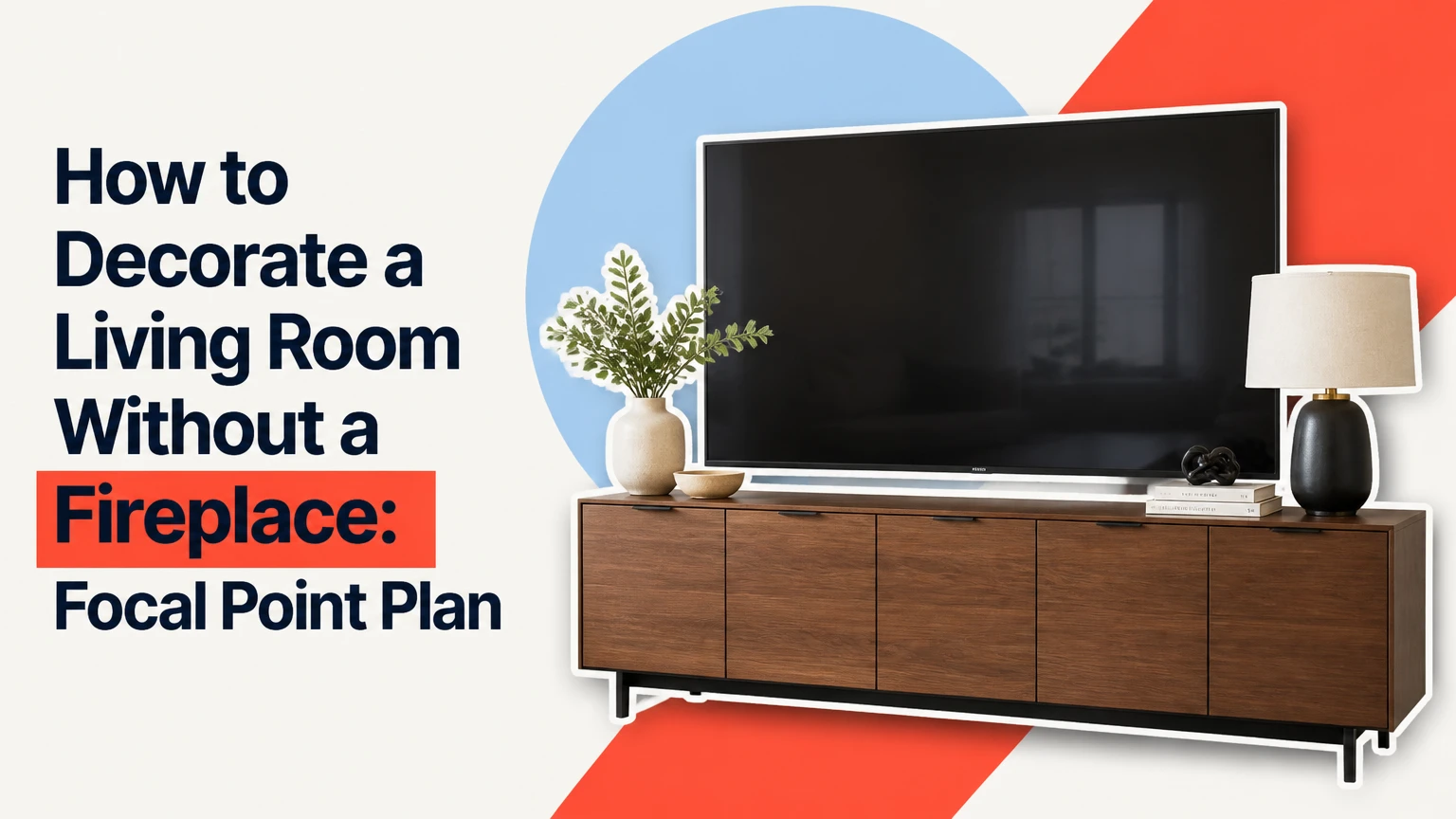
To decorate a living room without a fireplace, replace the hearth with one deliberate focal point, then orient the seating, rug, lighting, and wall treatment toward it. The strongest alternatives are a large artwork, a window view, a substantial storage piece, a media console, or a styled bookcase sized to the room.
What Should Anchor a Living Room Without a Fireplace?
A living room without a fireplace needs one dominant visual anchor, usually located on the longest uninterrupted wall or along the first sightline from the entrance. The anchor should combine visual weight with a practical role, such as storage, light control, seating, or media organization.
A fireplace naturally supplies vertical emphasis, symmetry, warmth, and a gathering direction. A replacement focal point must provide at least two of those functions. An oversized painting adds height and color, while a sideboard adds horizontal weight and storage. A window supplies light and a view, but furniture placement must preserve access and avoid blocking the glass.
William Morris’s design principle, “Have nothing in your houses that you do not know to be useful, or believe to be beautiful,” works particularly well here. A focal point should earn its visual prominence.
| Focal point | Typical width or size | Main benefit | Main limitation |
|---|---|---|---|
| Oversized artwork | 60-84 inches wide | Color, height, personality | Requires a piece that suits daily viewing |
| Sideboard or console | 60-84 inches wide, 28-34 inches high | Storage and horizontal balance | Needs wall styling above it |
| Bookcase wall | 72-144 inches wide | Storage, texture, visual depth | Can look crowded without editing |
| Large window | 48-96 inches wide | Natural light and outdoor view | Cannot always support a furniture arrangement |
| Media console | 60-84 inches wide | Entertainment and cable control | Television can dominate the room |
| Faux mantel | 48-72 inches wide | Traditional symmetry and display | Decorative only unless properly rated |
How Do You Choose the Focal Point?
Choose the focal point by standing at the room entrance and recording the first uninterrupted wall, window, or architectural feature you see. Select one anchor for that sightline, rather than placing equal-size attractions on opposing walls and forcing the eye to compete between them.
Use this five-minute test before buying furniture:
- Stand in the doorway and take three photographs from eye level.
- Mark the first feature visible without turning your head.
- Measure the available wall width and the distance to adjacent doors.
- Identify fixed constraints, including radiators, outlets, vents, windows, and traffic paths.
- Choose an anchor that occupies about 60-75% of the usable wall width.
A 72-inch sideboard usually needs at least 84 inches of clear wall to avoid looking cramped. A 60-inch artwork can work above a 72-inch sofa, while a 24-inch print will appear undersized and disconnected.
The two-thirds rule is a useful starting point, not a rigid law. Artwork commonly looks balanced at roughly two-thirds to three-quarters of the sofa width, but a narrow console may need a wider composition above it.
Step 1: Map the Sightlines and Traffic Paths
Map the sightlines before arranging furniture, because a focal point fails when a doorway, television reflection, or blocked window interrupts the intended view. Use painter’s tape to mark the proposed anchor and observe the room from the entrance, hallway, and primary seat.
Keep the principal walkway approximately 30-36 inches wide. Leave 18 inches between a sofa and a coffee table for comfortable legroom, and allow 24-30 inches where people frequently pass between seating and a door.
| Room condition | Preferred focal point | Furniture orientation | Clearance target |
|---|---|---|---|
| Window on the longest wall | Window treatment or view | Sofa faces window at an angle | 30 inches from curtain path |
| Blank wall opposite entry | Artwork or sideboard | Sofa and chairs face blank wall | 30-36 inch walkway |
| Television required | Low media console | Seating faces screen | 18 inches table gap |
| Two equal windows | Centered console below windows | Seating faces the console | 36 inches between furniture and glass |
| Narrow room | Vertical artwork or slim cabinet | Sofa runs along long wall | 24 inches minimum passage |
| Corner entry | Corner bookcase or tall plant | Seating faces diagonal anchor | 30 inches around corner |
You will know the plan works when the anchor is visible from the doorway and every seat has a reasonable relationship to it. The common mistake at this step is centering furniture on the wall instead of centering it on the room’s usable geometry.
Step 2: Size the Anchor Against the Room
Size the anchor before selecting accessories, because proportion determines whether a room feels composed or scattered. Measure the sofa, wall, rug, and ceiling height, then keep the principal artwork or storage piece within a predictable visual range.
For artwork above a sofa, leave 6-10 inches between the sofa back and the bottom of the frame. Hang the center of artwork approximately 57-60 inches above the floor when viewed independently, but lower it when the furniture relationship requires a tighter grouping.
| Element | Small living room | Medium living room | Large living room |
|---|---|---|---|
| Sofa width | 60-78 inches | 78-96 inches | 90-120 inches |
| Area rug | 5 x 7 feet | 8 x 10 feet | 9 x 12 feet |
| Artwork above sofa | 36-54 inches wide | 54-72 inches wide | 72-96 inches wide |
| Coffee table | 36-48 inches long | 48-60 inches long | 60-72 inches long |
| Sideboard depth | 12-16 inches | 15-18 inches | 18-20 inches |
| Ceiling fixture diameter | 18-24 inches | 24-32 inches | 30-40 inches |
You will know the anchor is correctly scaled when it occupies attention without touching nearby doors, trim, or ceiling lines. The common mistake is using several small objects to imitate one large statement, which creates visual noise unless the arrangement has a clearly measured outer boundary.
Step 3: Install Art, a Gallery Wall, or a Statement Surface
Install one large artwork, a measured gallery wall, or a statement surface when the room lacks architectural character. Large-scale art is usually the fastest transformation because it creates color, vertical emphasis, and a clear destination for the seating arrangement without construction.
For a single piece, choose artwork about 66-75% of the sofa width. For a gallery wall, keep the outer composition near the same width and use 2-4 inches between frames. A painted accent wall typically requires 1 gallon of paint for 350-400 square feet per coat, although textured surfaces absorb more.
| Wall treatment | Typical material cost | Typical installation time | Best room condition |
|---|---|---|---|
| Large framed artwork | $150-$1,200 | 30-90 minutes | Blank wall above sofa |
| Gallery wall, 6 frames | $120-$700 | 2-4 hours | Collector or eclectic interior |
| Accent paint wall | $35-$120 | 4-8 hours | Rental-permitted or smooth wall |
| Peel-and-stick wallpaper | $100-$500 | 3-8 hours | Flat wall needing pattern |
| Slatted wood panel | $300-$1,500 | 1-2 days | Modern room needing texture |
| Fabric wall hanging | $80-$600 | 30-60 minutes | Soft, low-commitment scheme |
You will know the wall treatment works when its outside edges align with the furniture below it and its strongest color appears at least twice elsewhere in the room. The common mistake is selecting a bold wall treatment without repeating its color in a cushion, rug, lamp, or small object.
Step 4: Use Storage or a Media Unit as a Functional Anchor
Use a sideboard, console, bookcase, or media unit when the living room needs storage as well as decoration. A functional anchor gives the wall enough mass to replace the visual authority of a fireplace, but its depth and height must match the room’s circulation.
Choose a sideboard 28-34 inches high for artwork, lamps, and objects above it. Keep a television’s center near seated eye level when possible, and avoid placing a screen so high that viewers must tilt their heads. For a 55-inch television, a viewing distance of approximately 7-11 feet is a common comfortable range, depending on resolution and personal preference.
Bookshelves need editing. Fill roughly 60-75% of the available shelf space, then leave intentional gaps for framed photographs, ceramics, and plants. Heavy books belong on lower shelves, and tall objects should not repeat at every level.
A media wall is not good for households that want the television visually absent. In that case, choose closed storage, a projector with a concealed screen, or a large artwork that remains the primary focal point when the screen is off.
Step 5: Create Warmth Through Layered Lighting
Create warmth through three lighting layers: ambient light for general visibility, task light for reading, and accent light for the focal point. A fireplace’s glow is atmospheric rather than necessary, so a room without a hearth can feel equally intimate when light sources sit at different heights.
Use warm-white bulbs around 2,700-3,000 Kelvin for a residential living room. A typical medium room may need 2,000-3,000 total lumens across ceiling fixtures, floor lamps, table lamps, and wall lighting, with dimmers reducing output at night.
The U.S. Department of Energy states that LED bulbs use at least 75% less energy and last up to 25 times longer than incandescent bulbs. That makes multiple lamps more practical than relying on a single bright ceiling fixture.
| Lighting layer | Typical fixture | Typical output | Placement |
|---|---|---|---|
| Ambient | Ceiling fixture | 1,000-2,000 lumens | Center or main junction box |
| Task | Floor reading lamp | 450-1,000 lumens | Beside chair or sofa |
| Side illumination | Table lamp | 400-800 lumens | On console or side table |
| Accent | Picture light | 200-500 lumens | 6-12 inches above artwork |
| Architectural | Wall sconce | 300-800 lumens | Either side of art or cabinet |
| Low glow | LED strip | 150-500 lumens per metre | Behind shelves or console |
You will know the lighting is balanced when the focal wall remains visible without glare on artwork or television glass. The common mistake is choosing bulbs by wattage alone instead of checking lumens, color temperature, beam direction, and dimmer compatibility.
Step 6: Arrange Seating Around the New Center
Arrange seating toward the focal point while preserving conversation distances, because a beautiful anchor cannot repair furniture that points toward walls or blocks circulation. Place the sofa first, then add chairs or stools to create a loose U shape, L shape, or parallel arrangement.
Keep the front legs of major seating on the area rug in a small room, or place all seating entirely on a sufficiently large rug in a larger room. Aim for 42-96 inches between seats for conversation, adjusting for the room’s width and furniture scale.
A television should not automatically receive every seat’s direct orientation. If artwork or a window is the decorative anchor, angle the television slightly or place it inside closed cabinetry so the room has a second-use mode.
You will know the arrangement works when at least two people can converse without twisting and every seat can see the focal point. The common mistake is pushing every item against the perimeter, which produces a hollow center and weakens the gathering function.
Which Fireplace Alternative Fits Your Room?
The best fireplace alternative depends on whether the room needs storage, visual impact, technology, or architectural emphasis. Oversized art is the fastest decorative solution, a sideboard is the most useful, a bookcase creates the greatest depth, and an electric fireplace provides hearth imagery without requiring a chimney.
| Alternative | Typical cost | Floor depth | Setup time | Suitable for renters |
|---|---|---|---|---|
| Oversized art | $150-$1,200 | 1-4 inches | 30-90 minutes | Yes, with approved hardware |
| Sideboard | $300-$2,000 | 15-20 inches | 1-3 hours | Usually |
| Modular bookcase | $250-$2,500 | 10-16 inches | 3-8 hours | Usually |
| Electric fireplace mantel | $400-$1,500 | 12-20 inches | 2-6 hours | Sometimes |
| Built-in shelving | $2,000-$8,000 | 12-18 inches | 1-3 days | No |
| Slatted feature wall | $300-$1,500 | 1-3 inches | 1-2 days | Rarely |
Electric fireplace costs vary by model, finish, installation, and local labor. A plug-in unit can work in a few hours, while a hardwired insert or built-in surround may require an electrician, permitting, and a dedicated circuit.
Electric flame effects are decorative and do not replace central heating. Heat-producing models need manufacturer-specified clearances, stable placement, and an outlet that is not overloaded by other high-draw appliances.
How Can You Make a Small Room Feel Cozy?
Make a small living room cozy with a slim anchor, a correctly sized rug, vertical storage, and warm layered lighting rather than a deep faux mantel. A 12-16-inch-deep console, 5 x 7-foot rug, and one 24-36-inch artwork can establish a center without consuming the room.
Choose one strong color for the focal wall and repeat it in two smaller locations. Use closed storage below eye level, reflective glass or a mirror opposite a window, and furniture with visible legs to preserve floor sightlines.
A large mirror is useful when it reflects a window or lamp, but it is counterproductive when it reflects clutter, a television, or a blank wall. Test the reflection from the main seat before mounting it.
For low ceilings, use vertical artwork, tall curtains mounted 2-4 inches below the ceiling, and a compact flush-mount fixture. Avoid a wide, heavy chandelier that lowers the perceived ceiling.
How Do You Decorate a Room With No TV?
Decorate a living room with no television by making artwork, a bookcase, a window, or a conversation grouping the primary destination. A reading chair angled toward a lamp and side table can create a stronger daily-use center than a decorative cabinet that nobody approaches.
Place the main artwork where a television might otherwise go, then add a narrow console beneath it for books, games, or concealed electronics. A pair of matching lamps creates symmetry, while one sculptural lamp gives a more relaxed asymmetrical composition.
This approach is not ideal when the room must support frequent screen viewing. In that situation, treat the media unit as a functional requirement and use artwork, lighting, and closed storage to prevent the television from becoming the only visual element.
What Are the Typical Costs and Timeframes?
A no-fireplace living room update can cost $35-$120 for an accent wall, $150-$1,200 for large art, $300-$2,000 for a sideboard, or $2,000-$8,000 for built-in shelving. Portable furniture and wall decor usually take less than one day, while paneling and custom cabinetry take one to three days.
| Project | Typical total cost | DIY time | Professional time |
|---|---|---|---|
| Paint one focal wall | $35-$120 | 4-8 hours | 2-4 hours |
| Hang six-piece gallery wall | $120-$700 | 2-4 hours | 1-2 hours |
| Add sideboard and styling | $350-$2,300 | 1-3 hours | 1-2 hours |
| Install modular shelving | $250-$2,500 | 3-8 hours | 2-6 hours |
| Add electric mantel | $400-$1,500 | 2-6 hours | 3-8 hours |
| Build wall-to-wall shelving | $2,000-$8,000 | 2-5 days | 1-3 days |
Typical prices vary by region, finish, material, and whether electrical work is required. Budget for mounting hardware, paint supplies, delivery, wall repair, and electrician fees rather than pricing only the visible centerpiece.
Common Mistakes and How Do You Fix Them?
The most common mistakes are an undersized focal point, competing walls, blocked circulation, harsh lighting, and decorative clutter. Each problem has a specific correction, and replacing the entire room is rarely necessary.
- Small art above a large sofa: Add a wider frame, combine several pieces into one measured composition, or use a textile panel.
- Furniture scattered around the room: Pick one focal wall and rotate the sofa and chairs toward it.
- Curtains stopping at the window sill: Mount full-length panels near the ceiling to add height and frame the glass.
- Television mounted too high: Lower the screen or use a low console so the center sits nearer seated eye level.
- Bookcase filled edge to edge: Remove 25-40% of the objects and group remaining items by height and material.
- Cold evening atmosphere: Add two 2,700-K lamps, a textured rug, curtains, and a wood or woven accent.
A focal point should not overwhelm the room. If the anchor dominates every photograph and leaves no quiet surface, reduce its contrast or scale before adding more decoration.
A Practical Weekend Installation Plan
Complete the transformation over one weekend by separating planning, wall work, furniture placement, and lighting adjustment. A typical renter-friendly project takes 6-10 hours of active work across one or two days, excluding delivery.
On the first morning, photograph sightlines, measure walls, and mark the seating footprint with painter’s tape. On the first afternoon, paint or mount the main wall element, allowing paint to dry according to the label before returning furniture.
On the second day, place the rug, sofa, chairs, anchor furniture, and lamps. Finish by viewing the room at night, because a composition that works in daylight may need a floor lamp or picture light after sunset.
The practitioner rule is to make one change at a time. If the room still feels wrong, remove accessories before buying another focal point.
FAQ
Can a living room have two focal points?
A living room can have two focal points when one is primary and the other supports a different activity. For example, a window may anchor the seating area while a bookcase defines a reading corner. Two equally dominant features on opposite walls often make furniture orientation feel indecisive.
Should a sofa face the largest wall?
A sofa should face the largest wall when that wall contains the room’s strongest focal point and does not block a major passage. A large blank wall is not automatically the correct destination. Add artwork, storage, or paneling first, then orient seating toward the finished composition.
How high should curtains hang without a fireplace?
Hang living room curtains 2-4 inches below the ceiling or crown molding, and extend the rod 6-12 inches beyond each side of the window when wall space allows. Floor-length panels create vertical emphasis and make a window a stronger architectural anchor.
Is a mirror a good replacement for a fireplace?
A mirror is a good fireplace replacement when it reflects daylight, greenery, or layered lighting. A mirror is a poor choice when it reflects clutter, a television, or a blank wall. Position the mirror from the main seating angle before drilling, then check glare during both day and evening.
Can a bookcase replace a fireplace visually?
A bookcase can replace a fireplace visually when it occupies sufficient width and has a controlled composition. A narrow shelf with crowded objects will not create the same anchoring effect. Use a unit at least 60-72 inches wide in a medium room, or combine modular sections into a broader wall.
How do you decorate a living room without a fireplace on a tight budget?
To decorate a living room without a fireplace on a tight budget, paint one wall, source one large artwork, reposition the rug, and add two warm lamps before buying major furniture. A $35-$120 paint project plus $80-$300 in lighting can establish a focal point without construction or custom shelving.
The Bottom Line
To decorate a living room without a fireplace, identify the first sightline, choose one properly scaled anchor, and arrange every major piece toward it. Oversized art offers the fastest change, a sideboard adds useful storage, bookcases supply depth, and a window creates a naturally bright center. Finish with a correctly sized rug, 2,700-3,000-K layered lighting, and clear 30-36-inch walkways. A deliberate focal point makes a living room without a fireplace feel balanced, functional, and warm.