
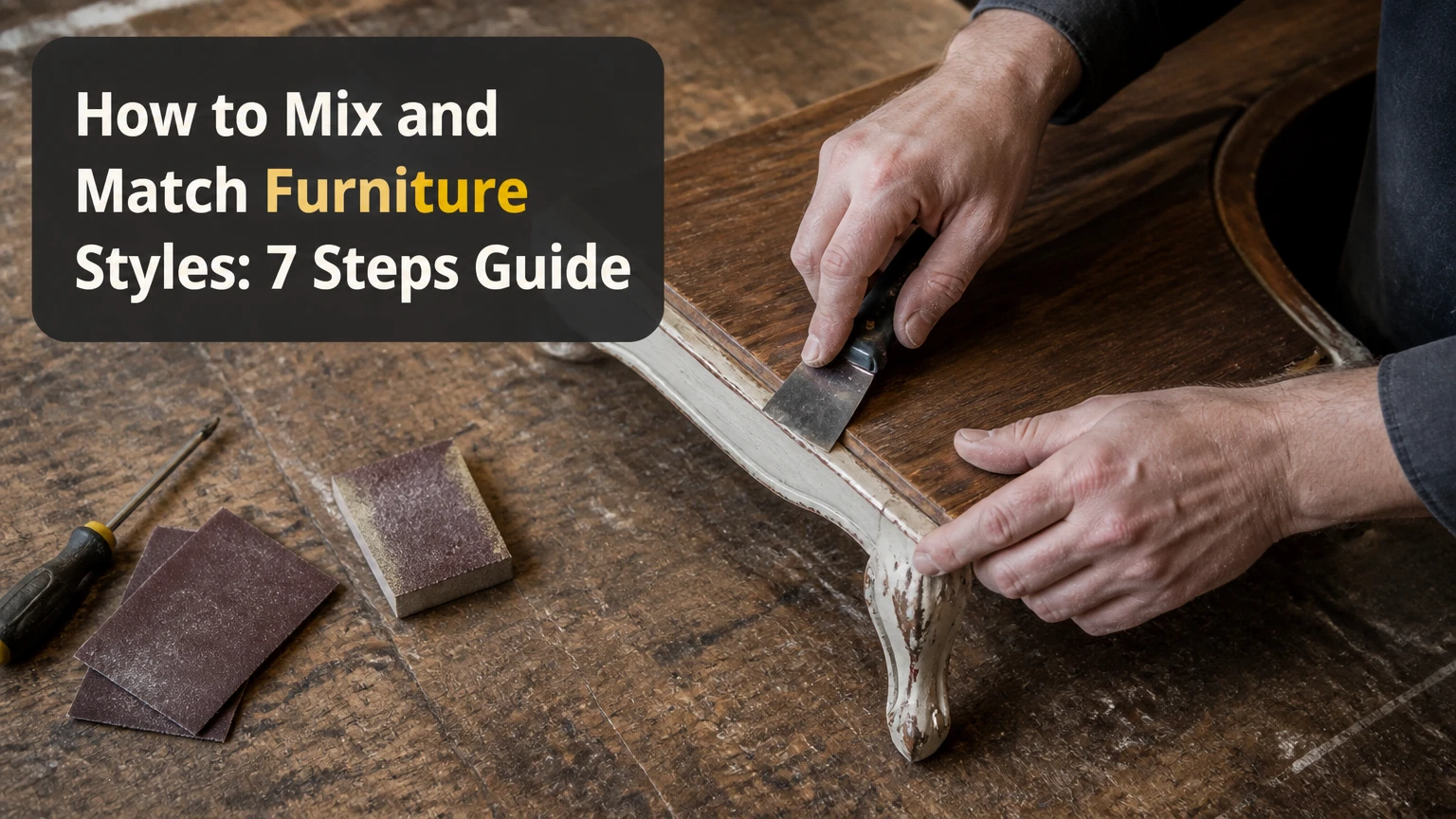
To mix and match furniture styles, choose one dominant visual direction, add a smaller accent style, then connect both through color, scale, shape, material, and spacing. A cohesive eclectic room usually takes 4-7 deliberate decisions: anchor piece, style ratio, color bridge, proportion check, texture layer, repetition, and final editing.
Key Facts at a Glance
- Eclectic furniture design combines different eras or styles through repeated visual relationships.
- The 80/20 rule usually means one dominant style occupies about 80% of the room and an accent style occupies about 20%.
- A room can contain several wood species, but three or fewer closely managed undertones usually produce a calmer result.
- Furniture scale matters more than matching labels: seat height, table height, depth, and visual mass must relate.
- A large rug, repeated upholstery color, or consistent metal finish can connect furniture that does not share a design era.
- Typical room budgets range from $1,500-$4,000 for thrifted and entry-level pieces to $20,000 or more for custom and premium furnishings.
What Does Mixing Furniture Styles Actually Mean?
Mixing furniture styles means combining pieces from different design periods or visual traditions while repeating enough attributes to create unity. A mid-century modern chair can work beside a traditional cabinet when color, proportion, wood temperature, or shape gives the two pieces a recognizable relationship.
The goal is not symmetry or identical furniture. The goal is hierarchy. One style should establish the room’s baseline, while contrasting pieces provide emphasis and personality.
Interior designer Billy Baldwin often advised that “be faithful to your own taste, because nothing you really like is ever out of style.” The practical implication is important: a room should express the occupant’s preferences, but every selected piece still needs a job in the composition.
A mixed room fails when each object competes for attention. It succeeds when the eye can identify a primary structure, secondary accents, and repeated details that guide movement around the room.
How Many Furniture Styles Can You Mix?
Most rooms can handle two major furniture styles and one minor accent language without losing clarity. A large open-plan room may support three styles if each zone has a dominant identity and a shared palette.
| Room condition | Recommended style count | Typical dominant split | Main control |
|---|---|---|---|
| Small bedroom, under 120 square feet | 2 styles | 75/25 | Matching scale and light colors |
| Average living room, 150-250 square feet | 2-3 styles | 80/20 or 70/20/10 | Repeated color and rug boundaries |
| Open-plan living area, 300-500 square feet | 3 styles | 60/25/15 | Zoning and consistent flooring |
| Collector’s room, over 250 square feet | 3-4 styles | 50/30/20 | Strong anchor pieces and editing |
The 80/20 ratio is a design tool, not a mathematical requirement. A room with a neutral sofa, antique cabinet, sculptural lighting, and patterned chairs may need a 70/30 balance because the accent furniture has more visual weight.
How Do You Mix and Match Furniture Styles in Seven Steps?
A reliable furniture-mixing process takes about 2-6 weeks when most pieces are available locally and 2-6 months when vintage sourcing is involved. The factor that most determines success is the relationship between visual weight and repetition, not the age or retail source of each piece.
Step 1: Choose the Anchor Piece
Choose the largest or most expensive furniture item as the anchor, such as a sofa, bed, dining table, or sectional. The anchor establishes the room’s dominant scale, silhouette, and usually its primary style.
For a living room, begin with the sofa because it controls seating capacity, depth, and traffic flow. For a bedroom, begin with the bed frame because its height and material influence nightstands, benches, and storage.
Write down four attributes of the anchor:
- Overall width and depth.
- Seat or mattress height.
- Dominant material and undertone.
- Visual character, such as curved, linear, carved, or minimal.
You will know Step 1 worked when every prospective purchase can be described as either supporting or intentionally contrasting the anchor. The common mistake is starting with small decorative items before deciding whether the main furniture is modern, traditional, rustic, or transitional.
Step 2: Set a Dominant and Accent Style
Assign approximately 80% of the room to a dominant style and 20% to an accent style. Count visual impact rather than objects, because one large carved armoire can carry more stylistic weight than four simple side tables.
A contemporary sofa with plain linen upholstery can support traditional accents through an antique mirror, turned-leg table, or framed oil painting. A traditional sofa can support modern accents through a metal floor lamp, low-profile coffee table, or geometric rug.
Use a 70/30 split when the accent pieces are medium or large. Use a 90/10 split when the contrast comes from one powerful object, such as a sculptural chair or brightly patterned cabinet.
You will know Step 2 worked when one style reads first from the doorway and the second style appears during closer inspection. The common mistake is giving every furniture piece equal visual authority.
Step 3: Build a Color Bridge
Select one dominant neutral and one or two repeating colors that appear in at least three locations. A color bridge can connect upholstery, a rug, artwork, curtains, painted cabinetry, or small accessories.
The repeated color does not need to match exactly. A muted olive chair, a darker olive thread in the rug, and a pale green ceramic object can form one visual family because their hue and saturation relate.
| Bridge element | Example value | Suitable furniture connection | Avoid |
|---|---|---|---|
| Warm neutral | Ivory, mushroom, camel | Oak, walnut, brass, traditional upholstery | Blue-gray walls with orange wood |
| Cool neutral | Stone, gray, soft white | Black metal, ash, chrome, concrete | Too many yellow creams |
| Earth accent | Olive, terracotta, rust | Rattan, leather, antique wood | Four unrelated saturated colors |
| Deep contrast | Navy, charcoal, forest green | Pale wood, linen, polished metal | Equal amounts of every dark tone |
You will know Step 3 worked when the eye can travel from one furniture group to another without stopping at a color clash. The common mistake is selecting colors from isolated swatches instead of viewing them beside flooring and natural light.
Step 4: Match Scale, Height, and Visual Weight
Match furniture by proportion before matching it by style. A low 30-inch sofa can look awkward beside a 42-inch formal chair, even when both share navy upholstery.
Use these typical measurement relationships:
- Keep coffee-table height within 2-4 inches of the sofa seat.
- Leave 16-18 inches between a sofa and coffee table for comfortable reach.
- Choose an area rug large enough for at least the front legs of every major seat.
- Keep dining-chair seat height near 17-19 inches for a standard 28-30-inch table.
- Place side tables within 2-3 inches of the arm height beside them.
- Allow approximately 30-36 inches for primary walking paths.
| Furniture relationship | Typical target | Why it matters | Correction |
|---|---|---|---|
| Sofa seat to coffee table | 2-4 inch height difference | Keeps reach comfortable | Replace legs or use a lower table |
| Chair seat to sofa seat | Within 2 inches | Makes conversation feel balanced | Add a firm cushion or choose another chair |
| Dining table to seat | 9-12 inch vertical gap | Preserves knee clearance | Use thinner cushions or taller chairs |
| Rug edge to wall | 8-24 inches in living rooms | Frames the arrangement | Rotate or resize the rug |
You will know Step 4 worked when the furniture feels conversational rather than hierarchical by accident. The common mistake is judging size from a showroom photograph, where ceiling height and camera perspective distort proportion.
Step 5: Layer Materials and Textures
Combine materials with different tactile and reflective properties, such as linen, wool, polished wood, cane, glass, metal, and leather. Texture gives unlike styles a shared sensory language when their silhouettes differ.
A useful sequence is one soft upholstery, one substantial natural material, one hard reflective finish, and one irregular or woven surface. For example, a linen sofa, walnut cabinet, black steel lamp, and wool rug create contrast without requiring identical design periods.
Do not confuse more texture with more clutter. A shag rug, heavily patterned curtains, carved furniture, and woven baskets may each be attractive, but together they can obscure the anchor.
You will know Step 5 worked when the room remains interesting under low evening light and when no single material occupies every major surface. The common mistake is adding texture only through accessories while the furniture itself remains visually flat.
Step 6: Repeat Shapes and Group Accents
Repeat one or two shapes across unrelated pieces. Rounded chair backs, arched mirrors, cylindrical lamps, and oval tables can connect furniture from different decades more subtly than matching wood.
The rule of threes works best for accessories and small occasional furniture, not for every major item. Three related objects create rhythm when they vary in height or exact finish, while three identical accent chairs can look like a new matching set.
Use shape repetition in controlled locations:
- Curves in two seating pieces and one mirror.
- Rectangles in a cabinet, rug, and artwork grouping.
- Vertical lines in chair backs, lamps, and curtains.
- Circular forms in a table, pendant, and wall object.
You will know Step 6 worked when repeated shapes appear across the room without forming a theme park effect. The common mistake is repeating a motif literally, such as using six identical round objects.
Step 7: Edit From the Doorway
Stand at the room entrance and identify the first three objects that attract attention. If the accent style dominates all three, remove, relocate, or visually quieten one piece.
Editing is where an eclectic room becomes deliberate. William Morris’s 1880 advice, “Have nothing in your house that you do not know to be useful, or believe to be beautiful,” provides a practical test, but usefulness also includes circulation, storage, comfort, and maintenance.
You will know Step 7 worked when the room has a clear focal point, usable paths, and no item that exists only because it was expensive. The common mistake is solving visual imbalance by buying another object instead of removing one.
Which Furniture Styles Combine Most Successfully?
Mid-century modern pairs especially well with traditional furniture because tapered legs and clean lines reduce the heaviness of carved or dark wood pieces. Industrial furniture combines effectively with Scandinavian forms when warm textiles and pale timber prevent the metal from feeling severe.
| Style combination | Best room | Shared bridge | Main risk |
|---|---|---|---|
| Mid-century modern plus traditional | Living room or study | Walnut, curved profiles, muted upholstery | Competing wood finishes |
| Industrial plus Scandinavian | Loft or open-plan apartment | Black metal, light wood, wool | Cold lighting and hard surfaces |
| Contemporary plus bohemian | Bedroom or casual lounge | Neutral base, woven texture, low furniture | Pattern accumulation |
| Traditional plus coastal | Dining room or entry | Natural fibers, pale paint, classic shapes | Theme-like accessories |
| Rustic plus modern | Kitchen or family room | Stone, simple lines, aged timber | Excessive brown and black |
| Art Deco plus contemporary | Formal living room | Brass, velvet, geometric silhouettes | Too many glossy finishes |
Can Modern and Traditional Furniture Work Together?
Modern and traditional furniture work together when one shared attribute, such as color, height, or material, bridges their different silhouettes. A modern cream sofa beside a dark traditional cabinet is more convincing when both relate to a walnut frame, brass lighting, or a patterned rug containing both tones.
Avoid placing two highly ornate pieces beside each other unless the room is large enough to give each a separate visual zone. Traditional furniture already carries detail through carving, turned legs, or patterned upholstery, so modern pieces should usually provide visual relief.
Is Industrial Furniture Compatible With Soft Interiors?
Industrial furniture is compatible with soft interiors when black metal or reclaimed timber is balanced by upholstery, rugs, curtains, and warm light. In a 180-square-foot living room, one metal coffee table and one steel lamp usually add enough industrial character without making the room feel commercial.
Industrial style is a poor choice for households that dislike visible wear, sharp corners, hard seats, or frequent dusting around open shelving. The raw finish is part of the design, so disguising every imperfection defeats the purpose.
How Should You Apply Mixed Furniture in Each Room?
Room function determines which furniture differences are useful and which become inconvenient. Living rooms tolerate stronger contrast, bedrooms benefit from calmer repetition, dining rooms require matching seat ergonomics, and home offices need stability before decoration.
| Room | Anchor | Safe contrast | Functional limit |
|---|---|---|---|
| Living room | Sofa or sectional | One antique case piece and mixed occasional tables | Maintain 30-36 inch walkways |
| Bedroom | Bed frame | Different nightstands with shared height | Keep both bedside surfaces practical |
| Dining room | Dining table | Mixed chairs with similar seat height | Preserve 9-12 inches of leg clearance |
| Home office | Desk | Vintage chair or modern storage | Keep desk height near 28-30 inches |
| Entryway | Console or bench | Mirror from another era | Maintain a 36-inch passage where possible |
How Do You Mix Furniture in a Small Room?
Mix furniture in a small room by limiting large silhouettes, using one dominant wood tone, and keeping the accent style to one or two pieces. A 100-square-foot room benefits from a compact sofa, open-leg table, wall-mounted storage, and a rug that visually unifies the seating footprint.
Choose furniture with exposed legs when the floor needs to remain visible. Avoid placing a deep traditional chair, a bulky cabinet, and a low modern sofa in the same small seating area because their combined mass reduces circulation.
How Do You Mix Furniture in an Open-Plan Home?
Create separate furniture zones in an open-plan home, then connect them with a shared palette, flooring relationship, and repeated metal or wood finish. The living area can use mid-century forms while the dining zone uses traditional pieces, provided both share one neutral and one accent color.
Do not force every zone into an identical style. An open plan needs continuity, not repetition. Use a large rug, pendant shape, or cabinet finish to signal that the areas belong to one home.
How Do Wood Tones, Metals, and Architectural Finishes Relate?
Wood tones mix successfully when their undertones are identified before purchase. Warm woods such as cherry, orange oak, and honey pine contrast with cool gray-washed oak, while walnut sits closer to neutral brown and can bridge both groups.
The practical three-undertone limit reduces visual noise, but it is not an absolute design law. A room may contain four woods when one is painted, one is a small accent, or the area rug separates the floor from the furniture.
| Finish | Undertone | Works beside | Typical problem |
|---|---|---|---|
| Walnut | Neutral to warm brown | Brass, cream, olive, black | Can look heavy with dark flooring |
| Natural oak | Warm yellow to neutral | Linen, terracotta, matte black | Clashes with orange cherry |
| Ash | Cool pale beige | Gray, blue, chrome | Looks washed out under cool bulbs |
| Reclaimed pine | Warm, irregular yellow | Leather, stone, iron | Grain competes with carved wood |
| Painted furniture | Variable by paint | Nearly any controlled palette | Chips require regular touch-up |
Match metal temperature with the room’s strongest finish. Brass and bronze support warm woods, while chrome and stainless steel reinforce cool modern settings. Matte black can bridge either group because its color is visually neutral, although repeated black should appear in at least two locations.
Flooring, trim, and doors are permanent design participants. A walnut table may appear red against yellow oak flooring, but a large neutral rug can reduce direct comparison and let both pieces remain.
What Does a Mixed-Furniture Room Typically Cost?
A mixed-furniture room typically costs $1,500-$4,000 with thrifted, refurbished, and entry-level items, $5,000-$15,000 at a mid-tier level, and $20,000 or more when custom upholstery, premium case goods, and authenticated antiques are included.
| Budget tier | Typical room cost | Sourcing period | Typical contents |
|---|---|---|---|
| Thrifted and DIY | $1,500-$4,000 | 2-6 months | Used sofa, vintage chairs, retail rug |
| Mid-tier curated | $5,000-$15,000 | 1-3 months | Quality sofa, vintage cabinet, new lighting |
| Premium retail | $15,000-$25,000 | 1-4 months | Designer upholstery and hardwood case goods |
| High-end custom | $20,000-$50,000+ | 3-6 months | Custom fabric, antique restoration, art |
Budget for delivery, repair, reupholstery, rug pads, and lighting separately. A $600 secondhand chair may require $800-$1,500 in professional upholstery, while a structurally sound chair with removable covers may need only cleaning and new webbing.
What Should You Buy First?
Buy the anchor furniture first, then the rug, followed by secondary seating, tables, lighting, and accessories. This order prevents small purchases from dictating the room before the largest measurements and colors are known.
Use this purchasing sequence:
- Measure the room, doors, stairs, and lift access.
- Select the sofa, bed, table, or desk.
- Choose a rug that fits the complete furniture arrangement.
- Add one contrasting piece with a clear purpose.
- Match side tables and lighting to height and circulation.
- Add textiles, art, and small objects last.
The rug deserves early attention because it often carries the color bridge and defines the furniture grouping. Buying it last can leave the room with incompatible undertones or a size that forces furniture against the walls.
When Is a Coordinated Set Better Than Eclectic Mixing?
A coordinated furniture set is better when a room needs rapid completion, predictable dimensions, warranty consistency, or strong visual calm. Eclectic mixing is better when the homeowner values individuality, vintage character, gradual purchasing, or contrast between eras.
| Approach | Typical completion time | Cost control | Visual result | Best user |
|---|---|---|---|---|
| Matching set | 1-4 weeks | Predictable package pricing | Uniform and calm | Fast-moving professional |
| Complementary pair | 2-8 weeks | Moderate flexibility | Coordinated with mild contrast | First-time decorator |
| Eclectic mix | 2-6 months | Variable by sourcing | Layered and personal | Collector or vintage buyer |
| Custom hybrid | 3-9 months | Highest variability | Precisely tailored | Long-term homeowner |
A matching set is not inherently poor design. Its weakness appears when every surface shares the same finish, profile, and upholstery, leaving no focal hierarchy. Break a set with one vintage object, different lighting, or contrasting textiles rather than replacing every item.
What Are the Most Common Mixing Mistakes?
The most common mistakes are ignoring scale, treating color as an afterthought, collecting too many unrelated woods, and adding accent pieces without removing weaker ones. Each failure can usually be corrected without replacing the entire room.
The Furniture Has Different Heights
Lower the visual difference by changing the table, adding a firm seat cushion, or placing the taller item against a wall where it can function as a vertical anchor. Do not raise a sofa with unstable risers or alter a chair without checking structural safety.
The Room Looks Like a Furniture Showroom
Remove duplicate occasional tables and identical accessories first. Add variation through one older piece, a different lamp silhouette, or an art grouping rather than buying a second complete style.
The Colors Feel Random
Choose one textile, such as a rug or curtain, as the color source. Repeat two of its colors across at least three furniture or accessory locations, then remove accents that introduce unrelated saturation.
The Wood Tones Clash
Separate competing woods with upholstery or a rug, repeat the strongest wood once, and consider painting the smallest offender. Do not refinish valuable antique furniture merely to force a match with a newer table.
The Room Feels Flat
Add contrast in sheen and texture before adding more color. A wool rug, woven shade, aged metal lamp, or textured upholstery can create depth without changing the entire palette.
The Room Is Attractive but Uncomfortable
Recheck seat depth, table reach, lighting glare, and walking paths. A room that photographs well but leaves less than 30 inches for the main route is poorly resolved, regardless of its style.
How Can Different Households Adapt the Method?
Renters should put style contrast into reversible elements, while families should prioritize cleanable upholstery and rounded edges. Collectors can support more variation, but each acquired object still needs a defined location, scale relationship, and maintenance plan.
| Household situation | Best strategy | Typical spend | Main limitation |
|---|---|---|---|
| Renter | Neutral anchor, removable rug, thrifted accents | $1,000-$4,000 | No permanent wall or floor changes |
| Family with children | Performance fabric, closed storage, rounded tables | $3,000-$12,000 | Durability limits delicate antiques |
| Pet household | Washable covers, tight-weave rugs, raised legs | $2,500-$10,000 | Hair and claw resistance matter |
| Vintage collector | One statement antique per zone | $5,000-$25,000+ | Restoration and sourcing time |
| Small-space owner | Multifunctional furniture and open legs | $1,500-$7,000 | Depth and circulation constraints |
For renters, use lamps, artwork, slipcovers, rugs, and side chairs to introduce a second style. For families, reserve fragile carved pieces for low-contact areas such as an entry console or dining-room cabinet.
A mixed room is not good for every lifestyle. Households that need uniform replacement parts, stackable seating, or easy package ordering may prefer complementary retail collections with one or two independent accents.
The Bottom Line
How to mix and match furniture styles successfully comes down to controlled contrast: select one anchor, establish an 80/20 or 70/30 style balance, repeat colors and shapes, measure proportion, limit competing undertones, and edit before buying more. Eclectic furniture works when every contrasting piece supports the room’s function, scale, and visual hierarchy.
Frequently Asked Questions
Should All the Furniture in a Room Match?
No, all furniture does not need to match. Furniture should relate through at least two attributes, such as color, height, material, shape, or finish. A matching sofa and loveseat can anchor a room, while different chairs, tables, and cabinets add variation without making the seating arrangement look accidental.
What Color Goes With Different Wood Furniture?
Neutral colors such as ivory, mushroom, soft gray, and muted green work with many wood finishes because they reduce direct undertone conflict. Test paint and textiles beside the actual floor and furniture under daytime and evening lighting before committing to a large purchase.
How Do You Mix Furniture Styles in a Bedroom?
Start with the bed as the anchor, then choose nightstands with similar height even if their shapes differ. Use one rug, two bedside lights, and repeated bedding colors to connect modern, traditional, rustic, or vintage pieces while keeping the room restful.
Is It Acceptable to Mix Different Dining Chairs?
Different dining chairs are acceptable when their seat heights, seat depths, and overall comfort are compatible. Keep the vertical gap between the seat and table near 9-12 inches, and repeat one finish or upholstery color so the chairs look intentionally collected rather than randomly assembled.
How Do You Make Cheap and Expensive Furniture Look Consistent?
Give the room one well-proportioned anchor and use a large rug, cohesive lighting, and repeated textiles to connect different price levels. Improve inexpensive pieces through new hardware, professional cleaning, stable feet, and quality upholstery rather than adding more decorative objects.
How Do You Know When a Mixed Room Has Too Much Furniture?
A mixed room has too much furniture when primary walkways fall below roughly 30 inches, doors cannot open fully, or every sightline contains a competing focal point. Remove one low-value piece, reposition the rug, and reassess the room from its main entrance before purchasing anything else.