
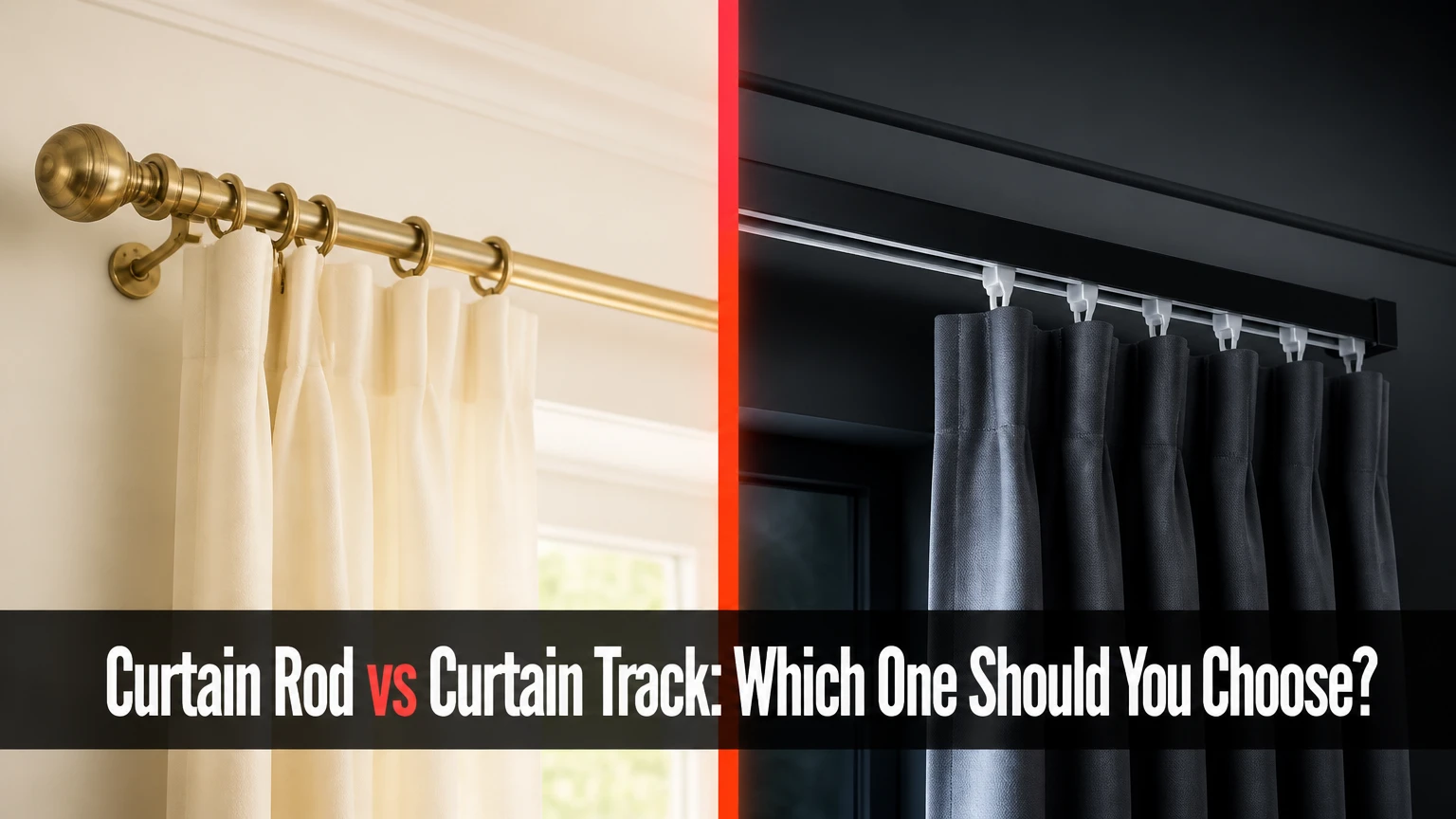
A curtain track is the better overall choice for wide, curved, tall, blackout, double-layer, or motorized window treatments because its internal gliders move continuously with fewer obstructions. A curtain rod wins for decorative rooms, lightweight curtains, renters, and anyone who wants inexpensive hardware with widely available eyelet or tab-top panels.
Quick Verdict
- For traditional décor: Choose a curtain rod with wood or metal finials.
- For wide windows: Choose an aluminum curtain track or traverse rod.
- For bay and corner windows: Choose a flexible or custom-bent track.
- For renters: Choose a tension rod for lightweight sheers, or a standard rod with minimal drilling.
- For blackout bedrooms: Choose a double track or a wraparound traverse system.
- For smart-home control: Choose a motorized curtain track.
- For the lowest purchase price: Choose a basic standard rod.
- For the simplest curtain shopping: Choose a rod, especially for eyelet or tab-top panels.
| Criterion | Curtain Rod | Curtain Track |
|---|---|---|
| Typical purchase price | $15-$50 basic; $120-$300+ premium | $20-$60 standard; $80-$200+ architectural; $150-$500+ motorized |
| Common installation time | 30-45 minutes per window | 1-2 hours for ceiling or custom systems |
| Support spacing | Usually every 4-6 feet | Commonly every 16-24 inches |
| Continuous movement | Centre brackets can interrupt travel | Gliders usually pass mounting points inside the channel |
| Suitable span | Practical sections often under 8-12 feet without special hardware | Continuous systems can exceed 12 feet when correctly supported |
| Curved windows | Requires joints and may leave gaps | Flexible or custom-bent profiles follow curves |
| Curtain headings | Eyelet, tab-top, rod pocket, rings, some pleats | Pinch pleat, tailored pleat, wave, ripple fold, hooks |
| Heavy blackout fabric | Needs strong pole, brackets, and wall fixing | Needs load-rated track, close supports, and structural fixing |
| Visual effect | Visible decorative feature | Recessed, discreet, or hotel-style finish |
| Motorization | Usually needs a separate traverse mechanism | Motor and belt drive are commonly integrated |
How Rods and Tracks Actually Work
A curtain rod is a visible cylindrical pole fixed to a wall or ceiling with brackets. Curtains slide over its outside surface using rings, fabric loops, tabs, grommets, or a rod pocket, so friction depends on both the pole finish and the curtain hardware.
A curtain track is a slim channel made from aluminum, steel, or engineered plastic. Small runners or gliders travel inside the channel, and curtain hooks attach to those runners. The mounting hardware can remain visible, sit close to the ceiling, or disappear inside a pelmet or recessed pocket.
That mechanical difference determines most of the buying decision. A pole makes the hardware part of the room’s design. A track makes the fabric the visual focus, while the enclosed runners reduce contact between the curtain and its support.
| Mechanical feature | Rod system | Track system |
|---|---|---|
| Moving component | Rings, tabs, or fabric over the pole | Runners or wheels inside a channel |
| Typical contact point | Outside surface of pole | Enclosed internal groove |
| Opening direction | Centre draw, one-way draw, or manual movement | Centre draw, one-way draw, cord, wand, or motor |
| Mounting obstruction | Centre bracket may block rings | Track brackets normally sit outside runner path |
| Visible hardware | Pole, brackets, and finials | Often only the curtain and end caps |
| Best curtain connection | Eyelets, tabs, rings, rod pocket | Hooks, pin tape, wave carriers |
Criterion verdict: Curtain tracks win for uninterrupted movement and discreet engineering, while curtain rods win when visible hardware is part of the desired design.
Cost Includes More Than the Hardware
A basic rod usually has the lowest entry price. A $15-$50 metal or wood set can include the pole, brackets, and finials, although extra rings and stronger anchors may cost more. Premium wrought iron, solid brass, or custom wood poles commonly reach $120-$300 or higher.
A standard track often costs about $20-$60. Heavy-duty aluminum and architectural systems commonly start around $80 and can exceed $200. Motorized systems frequently cost $150-$500 or more, before professional electrical work or installation.
The curtain itself can reverse the apparent saving. Eyelet panels work directly with a rod, while a track generally requires a compatible pinch-pleat, wave, or hook-based heading. Re-heading existing curtains can cost more than replacing inexpensive ready-made panels.
| Cost tier | Curtain rod | Curtain track |
|---|---|---|
| Basic hardware | $15-$50 | $20-$60 |
| Decorative or heavy-duty hardware | $120-$300+ | $80-$200+ |
| Motorized option | Usually $250+ for a separate traverse or motor solution | $150-$500+ typical |
| Extra connection hardware | $5-$40 for rings or clips | $5-$30 for gliders or hooks |
| Typical DIY installation time | 30-45 minutes | 1-2 hours |
| Likely professional complexity | Low for a straight window | Moderate for ceiling, curves, recesses, or motors |
| Hidden replacement cost | Stronger brackets or wall repairs | New gliders, compatible heading, or motor parts |
Prices are typical retail ranges rather than fixed market prices. Length, material, brand, local labor, and load rating can change the total substantially.
Criterion verdict: Curtain rods win on initial price and accessory availability, but curtain tracks can deliver better value when continuous movement, curves, or automation prevents a later replacement.
Span, Weight, and Long-Term Durability
A long curtain rod needs frequent support because the pole can bend under the fabric’s weight. Typical guidance places brackets every 4-6 feet, although the correct interval depends on pole diameter, material, wall fixing, and curtain weight.
The centre bracket creates a common failure. Two curtains can meet at the middle, but one wide curtain panel cannot usually slide across that bracket. A traverse rod solves the problem by routing carriers beneath or inside the decorative pole.
Tracks distribute support through multiple clips, commonly spaced 16-24 inches apart. That spacing reduces sagging, but it does not make every track suitable for velvet or lined blackout curtains. A lightweight PVC track may distort under heavy fabric, especially when fixed only into plasterboard.
| Use case | Rod recommendation | Track recommendation |
|---|---|---|
| Lightweight sheer under 6 feet | Standard pole or tension rod | Basic PVC or aluminum track |
| 6-12 foot decorative opening | Large-diameter pole with centre support | Aluminum track with close supports |
| Heavy blackout curtain | Heavy-duty pole fixed into studs | Load-rated aluminum track fixed into structure |
| Extra-wide single draw | Traverse rod without blocking centre support | One-way or centre-draw track |
| Commercial or very long run | Sectioned pole with connectors | Commercial-grade aluminum track |
| Ceiling-mounted fabric divider | Possible with structural brackets | Usually the better solution |
Installers should never rely on generic plastic plugs for heavy ceiling-mounted curtains. Toggle bolts, appropriate hollow-wall anchors, or direct fixing into joists and studs are safer choices, subject to the substrate and manufacturer’s load instructions.
Criterion verdict: A properly specified curtain track wins for long or heavy installations, but a heavy-duty traverse rod remains a strong choice when decorative hardware matters.
Daily Operation, Noise, and Maintenance
A rod feels smooth when its rings match the pole diameter, the pole is level, and the curtain is not overloaded. Metal rings can drag or scratch, while fabric tabs and rod pockets can bunch and resist movement. Pulling the fabric by hand also places stress on the heading.
Track gliders usually create less friction because they roll or slide inside a channel. The advantage is most noticeable with wide curtains, frequent opening, and one-way draws where a centre bracket would otherwise interrupt travel. Track operation is not automatically silent: inexpensive wheels, misaligned joints, and stiff fabric can produce noise.
Dust can make runners catch. Clean the channel with a microfiber cloth and use a small amount of dry silicone lubricant when the product permits it. WD-40 is a poor choice because its oily residue can attract dirt and reach the fabric.
| Operating factor | Curtain rod | Curtain track |
|---|---|---|
| Manual effort, lightweight fabric | Low to moderate | Low |
| Manual effort, heavy fabric | Moderate to high | Low to moderate if correctly rated |
| Likely snag point | Rings, centre bracket, finials | Joints, dirty channel, damaged gliders |
| Cleaning method | Wipe pole and rings | Vacuum or wipe channel and runners |
| Wand compatibility | Requires compatible rings or traverse hardware | Common with wand-operated systems |
| Cord operation | Usually requires traverse rod | Common on corded track systems |
| Motor integration | Less common | Widely available |
Criterion verdict: Curtain tracks win for frequent, wide, or heavy daily use, while rods remain sufficiently easy for small windows and lightweight curtains.
Window Shape, Light Control, and Stack-Back
Straight windows suit either system. The deciding factors are usually the desired look, curtain heading, and opening width.
A standard rod does not naturally bend around a bay or corner. Jointed poles can turn corners, but connectors may restrict rings and create small light gaps. A flexible track can be shaped by hand, while a custom-bent aluminum track provides a more controlled curve for demanding layouts.
Tracks also work well when the curtain must extend beyond the frame. The fabric can return close to the wall, reducing side gaps and improving blackout performance. A rod can achieve similar results with wraparound returns, extended brackets, or a return pole, but the shape becomes more visually prominent.
| Window condition | Better hardware | Reason |
|---|---|---|
| Straight, narrow window | Either | Geometry creates little challenge |
| Wide picture window | Track or traverse rod | Fewer movement obstructions |
| Bay window | Flexible or custom-bent track | Continuous curved route |
| Corner window | Track with corner joint or bend | Better corner coverage |
| Maximum blackout | Double track or wraparound system | Reduces top and side leakage |
| Low ceiling | Ceiling-mounted track | Places fabric higher and preserves wall space |
| Decorative exposed installation | Rod | Finials and finish add visual detail |
Criterion verdict: Curtain tracks win for complex geometry and light control, while curtain rods win for simple straight windows where decorative side returns are acceptable.
Curtain Headings and Switching Cost
Curtain headings are not interchangeable. Eyelet curtains need a pole, tab-top curtains need a pole, and rod-pocket curtains also need a pole. Rings with clips can broaden rod compatibility, but they change the appearance and hanging height.
Tracks normally use curtain hooks inserted into header tape. Pinch pleats and tailored pleats are traditional track choices, while wave or ripple-fold headings use specially spaced carriers and a dedicated track. A wave curtain placed on an ordinary track may lose its uniform folds.
This is the most overlooked switching cost. Moving from a rod to a track may require new curtains, hooks, carriers, or professional alterations. Moving from a track to a rod usually requires a pole-compatible heading or clip rings.
| Existing or preferred heading | Rod compatibility | Track compatibility |
|---|---|---|
| Eyelet or grommet | Direct | Usually unsuitable without alteration |
| Tab-top | Direct | Usually unsuitable without alteration |
| Rod pocket | Direct | Usually unsuitable |
| Clip-ring panel | Direct | Not normally used |
| Pinch pleat | Rings or hooks required | Direct with suitable runners |
| Tailored pleat | Rings or hooks required | Direct with suitable runners |
| Wave or ripple fold | Special wave rings possible | Direct with wave carriers |
Criterion verdict: Curtain rods win for ready-made eyelet, tab-top, and rod-pocket curtains, while curtain tracks win for tailored, pinch-pleat, and wave systems.
Installation, Mounting, and Learning Curve
A straight wall-mounted rod is usually the easier first installation. Typical steps include measuring 6-10 inches beyond the frame, marking the brackets 4-6 inches above the casing or higher toward the ceiling, drilling, levelling, and placing the pole.
A track requires more accurate alignment because a small deviation can affect runner movement. Installers typically mark a laser-level line, position wall or ceiling clips about 16-24 inches apart, add closer support near heavy curtain stacks, then load the gliders and hooks.
Curtain tracks also introduce a measurement issue: the installer must specify whether the stated width is the track length, finished curtain width, or fabric fullness. Wave systems may require a particular fullness ratio and carrier spacing.
| Installation task | Rod | Track |
|---|---|---|
| Marking and measuring | 10-15 minutes | 20-40 minutes |
| Drilling and fixing | 10-20 minutes | 30-60 minutes |
| Hardware assembly | 5-10 minutes | 10-20 minutes |
| Hanging and adjustment | 5-10 minutes | 15-30 minutes |
| Typical total | 30-45 minutes | 1-2 hours |
| Most important accuracy check | Level pole and bracket spacing | Level route, support spacing, and runner alignment |
Criterion verdict: Curtain rods win for beginner DIY installation on straight walls, while tracks are worth the extra setup when alignment, span, or ceiling mounting provides a functional advantage.
Smart Tracks and Alternatives
A motorized curtain track uses a motor and usually a belt or drive mechanism to move carriers. Remote controls, wall switches, timers, and smart-home integrations may be available, but compatibility varies by manufacturer. Confirm voltage, noise rating, maximum curtain weight, manual override, and whether the motor remains accessible.
A traverse rod is the main alternative when the homeowner wants decorative pole styling with internal carriers. It is useful for traditional rooms and wide openings, but its carrier mechanism can be more specialized than a standard rod.
Other alternatives include panel-track blinds for very wide sliding doors, Roman shades where fabric movement should stay inside the frame, roller shades for tight blackout control, and café rods for lightweight half curtains.
| Alternative | Best use | Main compromise |
|---|---|---|
| Traverse rod | Decorative wide-window treatment | More mechanical parts than a basic rod |
| Panel-track blind | Sliding doors and very broad glazing | Less traditional curtain appearance |
| Roller shade | Compact blackout or solar control | No soft side drape |
| Roman shade | Fabric inside a window recess | Limited width and stacking |
| Café rod | Lightweight privacy at lower window | Limited insulation and coverage |
| Motorized track | Accessibility, bedrooms, automation | Higher price and electrical complexity |
Criterion verdict: A motorized track is the strongest automation choice, while a traverse rod is the best compromise between traditional appearance and controlled movement.
Which Should You Choose?
For Renters and Lightweight Sheers
Choose a tension rod when the curtain is genuinely light, the opening is narrow, and drilling is not allowed. Tension rods are spring-loaded and sit inside the casing, but they are not suitable for lined curtains, wide spans, or frequent forceful pulling.
Choose a standard rod with removable anchors when the landlord permits small holes and the curtain needs more stability. A basic rod also gives renters more access to eyelet and tab-top ready-made curtains.
Verdict: Renters should choose a tension rod for lightweight sheers and a standard rod for anything heavier; a ceiling track is the wrong choice when permanent fixing is prohibited.
For Traditional or Historic Rooms
Choose a wood pole, wrought-iron rod, or solid metal pole with finials. The visible finish can coordinate with cabinet handles, lighting, and door hardware, while rings or decorative clips keep the treatment visually consistent.
A traverse rod becomes preferable when the opening is wide or the curtains are heavy, because it preserves a traditional appearance without forcing rings across a centre bracket.
Verdict: Traditional homeowners should choose a decorative curtain rod, upgrading to a traverse rod when ordinary rings cannot cross the opening reliably.
For Minimalist Rooms and Tall Windows
Choose a ceiling-mounted aluminum track with pinch-pleat or wave curtains. Mounting the track close to the ceiling creates a continuous vertical line and removes a visible horizontal pole from the room.
A recessed pelmet track provides the cleanest result, but it requires construction planning before plasterboard or a ceiling finish is completed. Surface-mounted tracks are easier to retrofit and still remain discreet.
Verdict: Minimalist rooms and tall windows should use a ceiling-mounted aluminum track because the hardware preserves uninterrupted fabric lines and maximizes visual height.
For Bay, Corner, and Curved Windows
Choose a flexible or custom-bent track. Flexible PVC can suit light curtains and modest curves, while custom-bent aluminum is the safer choice for heavy fabric, large bays, or precise corner returns.
Measure the full route, stack position, ceiling obstructions, and desired overlap before ordering. A pole assembled from corner connectors may look attractive but can restrict ring movement at every joint.
Verdict: Bay and corner windows should use a correctly supported flexible or custom-bent track, not a straight rod forced around multiple connectors.
For Bedrooms, Theaters, and Accessibility
Choose a double track when daytime privacy and nighttime blackout must coexist. The rear track carries a sheer, while the front track carries lined or insulated fabric.
Choose a motorized track when the curtains are large, difficult to reach, or used by someone with limited mobility. Check the manufacturer’s maximum curtain weight rather than assuming every motor can move velvet or thermal lining.
Verdict: Bedrooms, home theaters, and accessible rooms should use a double or motorized track when blackout coverage and low-effort operation matter more than decorative hardware.
Honest Limitations and Common Mistakes
Where Curtain Tracks Disappoint
A track can look unfinished if the curtain heading is poorly made or the end returns are not planned. Cheap plastic profiles may flex, noisy runners can annoy light sleepers, and ceiling fixing can become difficult when joists do not align with the desired route.
Tracks also hide the hardware, which removes the decorative detail some rooms need. A formal dining room with brass lighting and timber furniture may look colder with a plain white utility track.
When Curtain Rods Are the Better Choice
A rod is the better choice for a short, straight window with lightweight curtains and a strong decorative brief. It is also better when the existing curtains already use eyelets, tabs, or rod pockets, because conversion to a track may require replacement fabric.
A rod can be easier to clean visually because the pole is exposed. Finials and rings are also simple to replace without dismantling a ceiling-mounted channel.
What Product Listings Often Hide
Listings may omit the maximum supported curtain weight, recommended bracket spacing, carrier count, stack-back width, and whether corners are compatible with the chosen gliders. They may also quote track length without stating the required curtain fullness.
For any heavy or motorized project, request the load rating and installation substrate requirements. A low-priced track is not a bargain if it needs replacement after sagging or pulls away from the ceiling.
FAQ
Can I use eyelet curtains on a curtain track?
Usually no. Eyelet curtains are designed for a pole, because the metal or plastic eyelets slide over the outside diameter. A track requires hooks, carriers, or wave tape. Alterations are possible, but buying a compatible curtain heading is normally cheaper and produces a cleaner result.
Are curtain tracks better for blackout curtains?
Curtain tracks are usually better for blackout coverage when they extend beyond the frame, return toward the wall, or run continuously around a bay. The track does not eliminate top and side light gaps by itself. Correct overlap, ceiling height, lining, and a pelmet still determine the final result.
Can a curtain rod hold heavy curtains?
Yes, if the pole diameter, material, brackets, and wall fixings match the curtain weight. Heavy blackout or velvet curtains need strong brackets fixed into studs or suitable anchors. A long rod with supports every 4-6 feet is safer than a thin pole spanning the entire opening.
Do curtain tracks make more noise than rods?
Neither system is always quieter. A clean aluminum track with quality gliders usually needs less pulling force than rings on a rod, but damaged wheels, dirty channels, and stiff fabric can create noise. A smooth metal pole with properly sized rings can be quieter on a small, lightly used window.
Can I install a curtain track without drilling?
Most reliable tracks require screws because curtains create a sustained load. Adhesive solutions may support very light temporary fabric, but they are unsuitable for heavy curtains, ceiling mounting, or frequent operation. A tension rod avoids drilling, although its span and weight capacity are limited.
Is a double rod the same as a double track?
Both can carry two curtain layers, but they operate differently. A double rod uses two visible poles, typically one for a sheer and one for a drape. A double track uses two internal channels and usually provides a more discreet profile, closer stacking, and easier compatibility with pleated headings.