
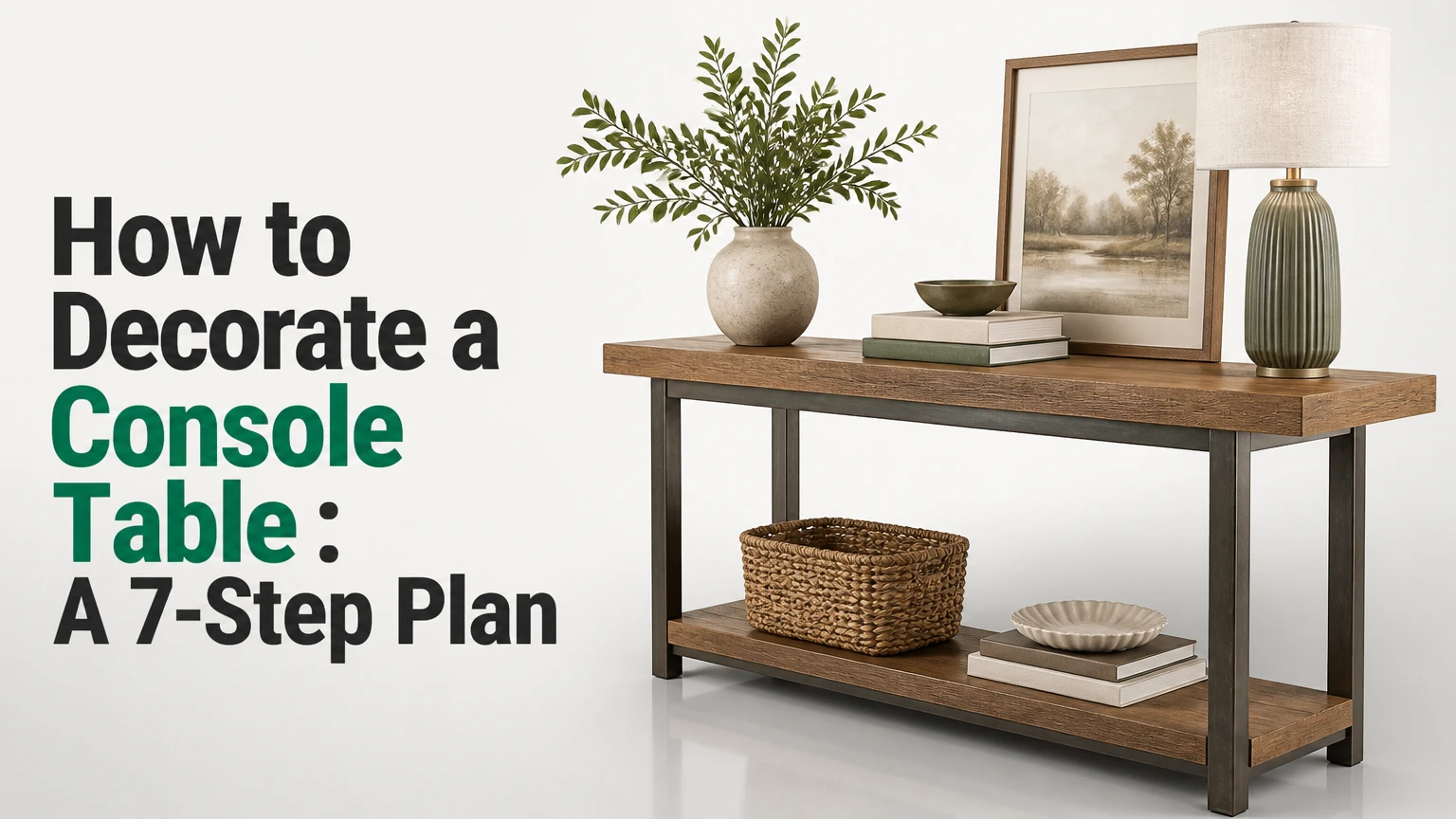
To decorate a console table in the USA, place a properly scaled mirror or artwork above it, add one tall light or botanical element, balance the opposite side with medium-weight decor, then layer a tray, books, and texture. Finish by styling the floor area while preserving safe walking clearance and practical access.
Key Facts at a Glance
A typical console table is 30-33 inches high and 12-15 inches deep.
A mirror or artwork usually works best at 60%-75% of the table’s width.
Leave approximately 4-6 inches between the tabletop and the bottom of mounted art.
A functional entryway needs about 36 inches of clear walking space in front of the table.
A complete arrangement typically takes 45-90 minutes and costs $50-$600, excluding the table.
The most reliable composition combines one anchor, one tall element, one low grouping, and one practical container.
What Makes a Console Table Arrangement Work?
A console table arrangement works when the furniture, wall, objects, and surrounding walkway form one visual and functional composition. The arrangement needs a dominant focal point, varied heights, distributed visual weight, and enough empty surface to prevent daily objects from becoming clutter.
Console tables commonly sit in entryways, behind sofas, along dining-room walls, and in hallways. Their narrow depth makes them useful in circulation areas, but the same narrow profile limits how many large objects the surface can hold.
The table should also match the room’s visual language. A black metal console with a round wood mirror creates a different effect from a painted pine table with a framed landscape. The objects should repeat at least one room attribute, such as wood tone, metal finish, wall color, or textile texture.
William Morris’s well-known design rule is useful here: “Have nothing in your houses that you do not know to be useful, or believe to be beautiful.” A console table needs both categories when it sits near an entry door.
Measure the Table and Walking Zone First
Measure the table width, depth, and height before buying decor. Record the distance from the tabletop to the ceiling, the location of outlets, the position of the nearest door swing, and the clear passage in front of the furniture.
| Table width | Typical depth | Anchor width | Recommended surface plan |
|---|---|---|---|
| 36 inches | 10-12 inches | 22-27 inches | One lamp, one tray, one compact object |
| 48 inches | 12-14 inches | 29-36 inches | One lamp, books, bowl, and small plant |
| 60 inches | 14-16 inches | 36-45 inches | Two lamps or one lamp with large art |
| 72 inches | 15-18 inches | 43-54 inches | Paired lighting, central object, wider grouping |
A 12-inch-deep table cannot safely hold a 14-inch-deep vase near an active walkway. The decoration must remain within the tabletop footprint, and fragile pieces should sit toward the rear rather than at the front edge.
How to Decorate a Console Table in USA, Step by Step
The most dependable process uses seven steps and takes 45-90 minutes once the furniture is in place. The anchor determines the composition, while lighting, height changes, negative space, and practical storage determine whether the finished display feels intentional or crowded.
Before styling, remove every existing object from the tabletop. Photograph the empty wall and table from the main viewing angle, because a composition that looks balanced straight on may appear crowded from a hallway or doorway.
Before You Start
| Requirement | Typical specification | Practical target | Why it matters |
|---|---|---|---|
| Styling time | 45-90 minutes | 60 minutes | Allows two arrangement revisions |
| Budget | $50-$600 | $150-$300 | Covers decor without replacing furniture |
| Tools | Tape measure, level, pencil | 1 of each | Prevents scale and hanging errors |
| Materials | Anchor, lamp, tray, books, vessel | 5-8 pieces | Creates layered variety |
| Clearance | 30-36 inches | 36 inches | Protects the main walking route |
Step 1: Establish the Wall Anchor
Choose one large mirror, artwork, or framed pair as the visual anchor. The anchor should be approximately 60%-75% as wide as the console table, although a narrow hallway may require a smaller 50%-60% proportion to preserve visual breathing room.
Center the anchor over the table, then position the bottom edge 4-6 inches above the tabletop when the piece is mounted. For a leaning frame, place the lower edge directly on the tabletop and secure the frame with museum putty or an anti-tip strap where children or pets can reach it.
You will know it worked when: the table and wall read as one unit, and the anchor remains the first object you notice from the room entrance.
Common mistake: hanging a small picture high above the table. Replace it with a larger frame, a grouped gallery arrangement, or a round mirror that fills more of the wall.
Step 2: Add One Tall Element
Place a table lamp, tall ceramic vessel, or botanical arrangement on one side of the tabletop. A lamp base between 10 and 14 inches high generally suits a standard 30-33 inch console, while the finished lamp height commonly falls between 24 and 32 inches.
Use one tall element first. Add a second only when the table is at least 60 inches wide or the design intentionally uses symmetry. Choose a warm-white bulb around 2700K-3000K for an entryway or living room, and route the cord behind the table rather than across the walking surface.
You will know it worked when: the silhouette rises clearly on one side without blocking the artwork or mirror.
Common mistake: selecting a lamp with a shade wider than the table depth. The shade can project into the walkway and make the furniture feel oversized.
Step 3: Balance the Opposite Side
Counter the tall element with a lower grouping that has comparable visual mass, not necessarily matching height. A stack of two or three hardback books under a ceramic bowl can balance a lamp without creating rigid symmetry.
Color matters as much as size. A dark lamp on the left can be balanced by a dark bowl, frame edge, or basket on the right, even when the objects have different shapes. Repeat one material or finish across the arrangement so the asymmetry feels connected.
You will know it worked when: the composition forms a stable visual triangle, with the anchor at the top and two lower weight zones beneath it.
Common mistake: placing a tiny object opposite a large lamp. Increase the counterweight by using a wider bowl, a substantial book stack, or two related objects grouped together.
Step 4: Build Depth With Layers
Move smaller pieces toward the front of larger pieces to create foreground, middle ground, and background. A practical arrangement might place the lamp at the rear, books in the middle, and a shallow tray at the front.
Keep 1-2 inches between independent objects unless the pieces form one deliberate group. Limit the primary tabletop grouping to approximately five to seven visible objects, because many small items create visual noise faster than a few large forms.
Use contrasting surfaces: glazed ceramic beside woven fiber, smooth metal beside rough wood, or paper beside glass. Texture should support the color scheme rather than introduce unrelated finishes.
You will know it worked when: each object remains identifiable from six feet away, and no item appears accidentally hidden.
Common mistake: filling every inch of surface. Remove the smallest objects first, then reassess the arrangement from the doorway.
Step 5: Add a Functional Catch-All
Place one tray, bowl, or lidded box where household members can reach it easily. A tray measuring approximately 10-14 inches wide works on most 12-15 inch-deep consoles without consuming the full surface.
Use the container for keys, sunglasses, mail, or dog-leash hardware. Reserve a defined daily-use zone near the entry side, and keep decorative objects in a separate zone so practical items do not spread across the entire table.
You will know it worked when: the table can absorb daily clutter without losing its designed composition.
Common mistake: using an open bowl for loose mail. A shallow lidded box or vertical file holder provides better containment and reduces paper buildup.
Step 6: Style the Space Underneath
Use the lower area only when the table’s legs and room scale support it. Two matching baskets can store shoes or accessories, while one upholstered ottoman can provide seating in a larger entryway.
Leave the area empty when the table has a strong sculptural base, the hallway is narrow, or the floor already contains a patterned rug. Empty space is a design choice, not an unfinished task.
| Under-table option | Typical size | Storage or function | Best location |
|---|---|---|---|
| Woven basket pair | 12-16 inches high | Shoes, scarves, toys | Family entryway |
| Upholstered ottoman | 16-19 inches high | Seating, hidden storage | Wide foyer |
| Low wooden bench | 17-19 inches high | Seating, baskets below | Mudroom-style entry |
| No object | 0 inches high | Preserves sightlines | Narrow hallway |
You will know it worked when: the lower area adds useful weight without touching the door swing, baseboard, or rug edge.
Common mistake: placing one undersized basket beneath a wide table. Use a matched pair, a wider trunk, or no storage at all.
Step 7: Edit From Multiple Viewpoints
Inspect the table from the front, the side, the doorway, and the seated eye level if the console sits behind a sofa. Remove one item before adding another, and photograph each version so you can compare visual density objectively.
Check that lamps are stable, cords are hidden, baskets open fully, and the anchor does not wobble. Keep candles away from curtains, paper, branches, and other combustible materials; the National Fire Protection Association identifies unattended candles as a significant home-fire risk, so flameless candles are the safer choice in active entryways.
You will know it worked when: the arrangement looks balanced in a photograph and remains usable during a normal weekday.
Common mistake: styling only for the front view. A side view often reveals excessive depth, exposed cords, or an anchor that is visually off-center.
Which Styling Layout Fits Your Room?
The best console table layout depends on the room’s formality, available width, and need for storage. Symmetry suits formal interiors, asymmetry creates movement in living spaces, and minimal negative space works best when the table or artwork has strong shape.
| Layout | Object placement | Visual effect | Best use |
|---|---|---|---|
| Strict symmetry | Two lamps, centered bowl | Formal and orderly | Traditional foyer |
| Asymmetric triangle | One lamp, books, low bowl | Curated and dynamic | Living room wall |
| Central anchor | One vase below centered art | Calm and focused | Dining room |
| Minimal negative space | One lamp, one object | Spare and quiet | Small apartment |
| Functional zoning | Tray at one end, decor at the other | Practical and controlled | Busy household |
Traditional and Transitional Styling
Traditional console styling favors paired lamps, framed art, matching accessories, and restrained finishes. Transitional rooms can soften the symmetry with one organic object, such as a carved bowl or irregular ceramic vessel, while keeping the overall arrangement centered.
Use brass, walnut, linen, porcelain, and framed landscape art for a classic combination. Keep lamp shades at the same height and align the central bowl with the mirror or artwork.
Modern and Minimalist Styling
Modern styling works with one oversized anchor, one sculptural lamp, and a small number of objects separated by generous empty space. Matte black, clear glass, polished stone, and natural wood create contrast without requiring many accessories.
A minimalist arrangement is not automatically a sparse arrangement. The remaining pieces need stronger scale and shape, because a small lamp beside a small vase can look accidental rather than edited.
Rustic, Farmhouse, and Organic Modern Styling
Rustic and farmhouse consoles benefit from weathered wood, woven baskets, iron accents, pottery, and botanical branches. Limit distressed finishes to one or two pieces, since multiple heavily worn objects can make the arrangement feel themed instead of collected.
Organic modern styling uses the same natural materials with cleaner silhouettes. Choose a smooth stone bowl, a rounded wood mirror, and one textured vessel rather than combining several visibly distressed objects.
Coastal and Eclectic Variations
Coastal rooms do not require literal seashell displays. Use pale wood, blue-gray ceramics, linen, woven fiber, and a landscape image to suggest the setting through material and color.
Eclectic rooms can mix periods, but one attribute should connect the objects. Repeating a black frame edge, warm metal, or terracotta color gives unrelated pieces a common visual vector.
How Much Decor Does a Console Table Need?
A typical 48-inch console table needs one wall anchor, one tall object, one medium grouping, and one functional container. The arrangement usually contains five to eight visible pieces, although the exact number depends on object size, table depth, and whether the surface must hold daily items.
| Decor category | Typical quantity | Typical size | Example |
|---|---|---|---|
| Wall anchor | 1 piece | 29-36 inches wide | Round mirror |
| Tall element | 1 piece | 24-32 inches high | Table lamp |
| Medium grouping | 2-3 pieces | 6-12 inches high | Books and bowl |
| Functional container | 1 piece | 10-14 inches wide | Key tray |
| Texture accent | 1-2 pieces | 3-8 inches wide | Brass object, vessel |
The rule of three can help create an immediate grouping, but odd-number rules are not mandatory. A single oversized vessel often looks more intentional than three undersized ornaments, particularly on a 36-inch console.
The practitioner rule is simple: prioritize silhouette before quantity. If the arrangement looks flat, change height or width first. If it looks cluttered, remove objects before changing the color palette.
What Is the Typical Cost and Time?
Typical console table styling costs $50-$150 for a budget refresh, $200-$600 for a curated mid-tier arrangement, and $800-$2,500 or more for designer or antique pieces. Most homeowners can complete the styling in 45-90 minutes, while sourcing a coordinated collection may take several days or weeks.
| Budget level | Typical US cost | Typical sourcing | Typical completion time |
|---|---|---|---|
| Budget refresh | $50-$150 | Target, HomeGoods, Amazon | 1-2 hours |
| Curated mid-tier | $200-$600 | West Elm, Pottery Barn, local shops | 3-5 days |
| Vintage mix | $150-$900 | Estate sales, antique malls, Etsy | 1-3 weeks |
| Designer collection | $800-$2,500+ | Serena & Lily, design studios, galleries | 2-4 weeks |
An itemized $150 budget might include a $45 lamp, a $25 tray, $30 in books or thrifted volumes, a $35 vessel, and $15 in museum putty or cord-management supplies. Prices vary by region, season, finish, and whether the objects are new or secondhand.
The fastest economical approach is to shop the house first. A framed print from another room, a stack of existing books, and a bowl from the kitchen can establish scale before any new purchase.
How Should You Style a Narrow or Small-Space Console?
A narrow console needs reduced depth, controlled object height, and a clear passage rather than more decoration. Choose a 10-12 inch-deep table, lean a shallow mirror, use one lamp, and keep all objects inside the tabletop footprint.
For renters, leaning art avoids drilling, but secure the frame if it sits where a door, child, or pet could knock it over. Acrylic or glass furniture can preserve sightlines in a small apartment, although transparent surfaces show dust and cords more readily than wood.
Avoid floor baskets in a hallway narrower than approximately 36 inches after furniture placement. A wall-mounted shelf, a drawer console, or a slim table with concealed storage may provide better function than an open-legged piece.
Narrow Entryway Layout
Place the lamp at the end farthest from the door swing. Put a lidded tray near the entrance side, but leave at least 2 inches from the table edge so keys cannot slide onto the floor. Use a vertical mirror or narrow artwork when a wide horizontal anchor would collide with adjacent trim.
Console Behind a Sofa
A sofa-back console usually needs a lower visual profile and protected cords. Keep the lamp or decor below eye level when seated, use a table height close to the sofa back, and avoid sharp objects that protrude into the seating zone.
Dark Entryway
Use one lamp with a 2700K-3000K bulb, a reflective mirror, and a light-colored ceramic or metal accent. A very dark arrangement absorbs the lamp’s limited light, while a reflective anchor spreads the available brightness across the wall.
What Should Go Above a Console Table?
A mirror is the most versatile choice above a console table because it adds depth and reflects light, while artwork provides stronger color and subject matter. The correct choice depends on the room’s light, wall width, and need for visual expansion.
| Wall option | Recommended width | Recommended gap | Strongest benefit |
|---|---|---|---|
| Round mirror | 60%-70% of table width | 4-6 inches | Softens angular furniture |
| Rectangular mirror | 60%-75% of table width | 4-6 inches | Expands a narrow wall |
| Single artwork | 55%-70% of table width | 4-8 inches | Adds color and personality |
| Two-panel artwork | 60%-75% combined width | 4-6 inches | Supports formal symmetry |
| Gallery arrangement | 65%-80% total width | 4-8 inches | Creates collected detail |
Do not assume a mirror must be centered if the table is intentionally offset from the wall or paired with a nearby doorway. Align the anchor with the table’s visual center, then check the relationship to windows, trim, and adjacent furniture.
How Do You Keep an Entryway Console Functional?
A functional entryway console separates daily-use objects from decorative objects. Assign one tray or drawer for keys and small items, one vertical location for mail, and one lower storage zone for shoes or accessories.
| Daily item | Containment method | Suggested location | Reset frequency |
|---|---|---|---|
| Keys | Heavy bowl or 10-inch tray | Door side of tabletop | Daily |
| 4-inch-deep file holder | Table drawer or side zone | 2-3 times weekly | |
| Sunglasses | Lidded box | Near keys | Daily |
| Leashes | Drawer or hook nearby | Adjacent wall | After each walk |
| Shoes | 12-16 inch baskets | Under table | Weekly |
A console table with drawers is usually better for a busy household than an open shelf, because concealed storage reduces visual noise. A heavy metal or stone bowl is less likely to move when several people place objects into it.
Do not use the tabletop as a permanent drop zone for packages, school bags, or bulky electronics. Those items exceed the scale and depth limits of most console furniture.
Common Mistakes and How to Fix Them
Console table mistakes usually come from incorrect scale, unmanaged depth, or unclear function rather than from the wrong decorating style. Each failure has a specific correction that can be made without replacing the furniture.
| Problem | Visible symptom | Likely cause | Reliable correction |
|---|---|---|---|
| Floating anchor | Large gap above table | Art hung too high | Lower bottom edge to 4-6 inches |
| Flat silhouette | Objects share one height | No vertical variation | Stack books or add one tall piece |
| Clutter trap | Many tiny objects | Weak scale and no grouping | Remove 2-3 small pieces |
| Top-heavy display | Wall feels heavier than table | No lower visual mass | Add bowl, books, or baskets |
| Unsafe depth | Decor enters walkway | Objects exceed table footprint | Replace with shallower pieces |
| Unusable surface | Keys cover the display | No functional zone | Add tray or clear a drawer |
A common counterintuitive error is adding more decor to fix a weak arrangement. More objects rarely solve a scale problem. A larger anchor or wider bowl often improves the composition more effectively than several small purchases.
Another practitioner rule is to check the arrangement with the room lights off. If the lamp, mirror, and frame create a strong silhouette in low light, the composition has adequate structural contrast. If every object disappears into one dark mass, add a lighter surface or move the lamp.
When the Artwork Looks Too High
Lower the frame rather than adding a taller tabletop object. A tall vase can disguise a measurement error from one angle, but the wall relationship will still look disconnected from the rest of the room.
When the Table Looks Too Busy
Remove all objects smaller than approximately 3 inches, except pieces with clear functional value. Consolidate loose items into one tray, then restore only the piece that contributes a different height, texture, or color.
When the Base Looks Empty
First decide whether the empty space is intentional. If the table has delicate legs and the room is wide, add two baskets or one substantial ottoman. If the hallway is tight, leave the floor open and strengthen the tabletop anchor instead.
How Do You Decorate for Children, Pets, and Renters?
Child- and pet-friendly console styling uses secured anchors, stable bases, closed storage, and break-resistant materials. Avoid unsecured leaning glass, tall top-heavy vessels, open flames, and small detachable objects where children or animals can reach them.
Renters can create a polished arrangement with a leaning framed print, removable picture-hanging strips rated for the frame weight, a table lamp, and a freestanding mirror. Follow the product’s weight rating and wall-surface instructions rather than assuming every adhesive hanger works on painted drywall.
For pets, place delicate ceramics above reach level and use weighted baskets below. For toddlers, an anchored console with rounded corners and closed drawers is safer than a lightweight open-frame table.
How Do You Choose Between a Lamp, Vase, or Branches?
Choose a lamp when the area needs practical light, a vase when the table needs a compact sculptural accent, and branches when the room can support irregular height. A lamp is the most useful default, but its base and shade must fit the table depth.
| Tall element | Typical height | Depth concern | Best design result |
|---|---|---|---|
| Table lamp | 24-32 inches | Shade may project 12-16 inches | Light and structure |
| Ceramic vase | 18-28 inches | Stable base under 10 inches | Sculptural color |
| Branch arrangement | 30-48 inches | Wide spread needs open wall | Organic movement |
| Narrow floor plant | 36-60 inches | Requires 14-20 inches floor width | Fills empty corner |
Branches need regular trimming because uncontrolled spread can obscure the anchor. Artificial stems reduce maintenance but may look artificial when the foliage has uniform color or repeated shapes.
The Bottom Line
The strongest console table arrangement begins with a measured anchor and ends with deliberate editing. For most 48-inch tables, use a 29-36 inch mirror or artwork, one 24-32 inch tall element, a lower grouping, one 10-14 inch functional tray, and optional storage below.
Use symmetry for formal rooms, asymmetry for collected interiors, and negative space for small apartments. Keep the walkway clear, secure unstable objects, control cords, and remove anything that does not contribute function, scale, texture, or visual balance.
A successful setup is not the one with the most accessories. It is the one that makes the table look connected to the wall, useful in daily life, and proportionate to the room.
Frequently Asked Questions
Can a console table go in front of a window?
A console table can sit in front of a window when the table remains below the sill, does not block curtains, and leaves the window hardware accessible. Use low decor, avoid tall lamps that interrupt the view, and maintain enough space for curtain operation and cleaning.
Should a console table match the coffee table?
A console table does not need to match the coffee table exactly. Coordinate one attribute, such as wood tone, leg shape, or metal finish, while varying the silhouette so the room looks composed rather than furnished from one collection.
How far should a console table be from a sofa?
Place a console table directly behind a sofa when the table depth fits the available walkway and the sofa does not press against the wall. Allow approximately 30-36 inches for a usable passage behind the table, and keep lamps away from the sofa’s moving edges.
Can you decorate a console table without a mirror?
Artwork, a textile panel, a sculptural wall object, or a pair of framed prints can replace a mirror. Artwork is preferable when the wall already receives strong natural light or when the room needs color rather than additional reflected depth.
How often should console table decor change?
Rotate console table decor seasonally or every three to four months, while keeping the functional tray and lighting in place. Change branches, textiles, and one accent object rather than replacing the entire arrangement, which preserves continuity and reduces cost.
What is the best console table style for a small apartment?
A slim console with a 10-12 inch depth, drawer storage, and an open or light-colored base usually works best in a small apartment. Choose one anchor, one lamp, and one tray, then preserve negative space so the entryway remains visually and physically open.
Conclusion
To decorate a console table in USA homes successfully, measure the furniture and walkway first, select an anchor sized at roughly 60%-75% of the table width, then build height, counterweight, texture, function, and storage in that order. The best result combines practical access with controlled visual variety, not maximum decoration.