
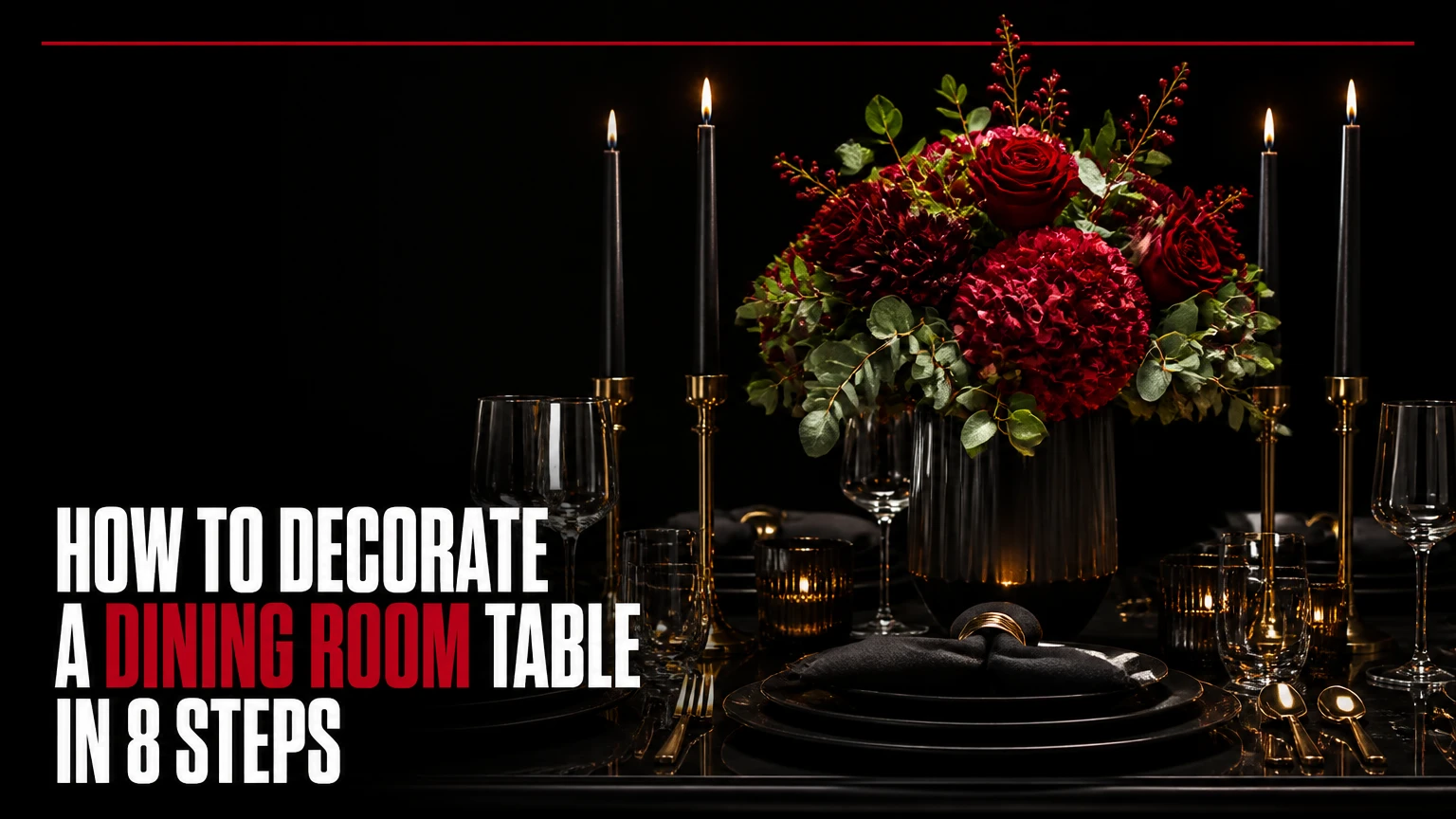
To decorate a dining room table, clean the surface, add a proportional textile, place a suitable centerpiece, layer texture, control height, and reserve enough space for dining. A complete everyday arrangement typically takes 15-30 minutes and costs $20-$200, but table shape, sightlines, and available serving space determine whether the result feels polished or crowded.
Key Facts
A dining table centerpiece should usually remain below 12 inches when seated guests need uninterrupted conversation.
The National Fire Protection Association recommends keeping candles at least 12 inches from anything that can burn.
A place setting generally needs about 15 inches of table depth, measured inward from the edge.
A centerpiece should occupy roughly the middle 12-14 inches of a narrow rectangular table, with wider arrangements requiring more clearance.
Everyday dining works best with one movable focal object, while hosted meals need clear zones for plates, glasses, and serving dishes.
Typical table styling costs $20-$50 on a budget, $50-$200 for a reusable layered setup, and $200 or more for event-level decor.
What Does Dining Room Table Decoration Include?
Dining room table decoration is the planned arrangement of a table’s base layer, centerpiece, lighting, dinnerware, and supporting objects. The purpose is both visual and functional: the arrangement should create a focal point without reducing usable eating space, blocking conversation, scratching the surface, or interfering with chairs.
Tablescaping is the event-focused version of the same practice. Everyday styling may use a runner and bowl, while a hosted tablescape adds placemats, chargers, napkins, glasses, candles, and place-specific details.
The strongest arrangements use a visual hierarchy. A textile establishes width, the centerpiece creates focus, smaller objects provide rhythm, and empty space prevents the design from becoming visual noise. William Morris’s well-known rule, “Have nothing in your houses that you do not know to be useful, or believe to be beautiful,” provides a useful test for every object placed on the table.
The five design variables that control the result
| Variable | Practical target | Visible effect | Typical error |
|---|---|---|---|
| Scale | Centerpiece width at 25%-40% of table width | Keeps decor proportional | Small bowl lost on a large table |
| Height | 8-12 inches for seated meals | Preserves eye contact | Opaque arrangement blocks guests |
| Negative space | 30%-50% of the tabletop visible | Keeps composition calm | Too many objects feel cluttered |
| Color | 60% neutral, 30% secondary, 10% accent | Creates hierarchy | Every item competes for attention |
| Texture | 3-5 distinct materials | Adds depth | Flat linen, glass, and ceramic lack contrast |
How Do You Decorate a Dining Room Table Step by Step?
Decorate a dining room table in eight stages: clean it, choose a base, establish the centerpiece, add secondary layers, adjust height, set dining zones, inspect the arrangement, and create a quick reset. Most tables require 15-30 minutes, one focal object, two to four supporting pieces, and enough exposed surface for the next meal.
Before you start
| Requirement | Typical specification | Why it matters |
|---|---|---|
| Time | 15-30 minutes | Covers cleaning and arrangement |
| Budget | $20-$200 | Supports budget to reusable styling |
| Tools | Cloth, measuring tape, felt pads | Prevents damage and guesswork |
| Core materials | Runner, bowl or vase, 2-4 accents | Builds the complete composition |
| Safety materials | Heatproof mat, flameless lights | Protects surfaces and households |
| Prerequisite | Confirm table dimensions and seating | Prevents blocked chairs and place settings |
Step 1: Clear and clean the tabletop
Remove dishes, paperwork, chargers, decorative objects, and food residue. Wipe wood, laminate, stone, or glass with a cleaner approved for that material, then dry the surface completely before adding textiles.
Success checkpoint: The table is dry, free of grit, and visible from every side.
Common mistake: Styling around existing clutter creates accidental focal points and makes the finished arrangement look smaller.
Step 2: Choose the right base layer
Select a tablecloth, runner, placemats, or bare tabletop according to the table material and the amount of daily use. A runner usually works best for a wood table that should remain visible, while a cloth offers stronger color control and protects a fragile or highly reflective surface.
For a rectangular table, use a runner 12-18 inches narrower than the tabletop, leaving approximately 6-9 inches of exposed table on each side. A tablecloth should normally hang 6-12 inches at the sides for casual use; formal settings may use a longer drop, but floor-length fabric interferes with knees and chairs.
Success checkpoint: The base layer is centered, flat, and does not touch chair seats.
Common mistake: A runner that nearly fills the table width leaves no visual margin and makes the centerpiece appear oversized.
Step 3: Place the primary centerpiece
Put the largest decorative object on the table’s visual center, not automatically the geometric center if the table expands or has a built-in leaf. Suitable anchors include a ceramic bowl, low vase, sculptural object, tray, lantern, or compact floral arrangement.
Choose width from the table’s scale. A 48-inch rectangular table often suits a 16-20-inch centerpiece grouping, while a 72-inch table can support a 24-30-inch linear arrangement if place settings remain clear.
Success checkpoint: The centerpiece looks intentional from the doorway and leaves at least 15 inches of usable depth at each occupied seat.
Common mistake: A single tiny object disappears on a long table. Repeat the object or extend the composition horizontally instead of adding random items.
Step 4: Add secondary layers
Build outward from the centerpiece with two to four supporting elements, such as candleholders, small bowls, greenery, books, seasonal objects, or folded napkins. Group related objects by material or color so they read as one composition.
The rule of three is useful when objects differ in shape or height. Three objects with similar height and unrelated colors may look accidental, so repetition, spacing, and alignment matter more than odd-number counting alone.
Success checkpoint: Each secondary object supports the centerpiece rather than competing with it.
Common mistake: Filling every empty area removes the negative space that makes the focal object visible.
Step 5: Control height and sightlines
Keep opaque centerpieces 8-12 inches high for meals where guests need to see across the table. Transparent glass cylinders, thin branches, or open metal frames can exceed that height because they obstruct less, but they still need secure bases and stable placement.
The 12-inch rule is a practical styling limit, not a universal design law. For a table that remains decorative between meals, a 16-24-inch arrangement may work when the room has enough visual scale and no one must converse across it.
Success checkpoint: Sit in every dining chair and confirm that faces remain visible.
Common mistake: Measuring height while standing gives a false sense of openness. Always test the arrangement from seated eye level.
Step 6: Add dinnerware without losing capacity
For a casual setting, place a dinner plate, fork, knife, spoon, napkin, and water glass at each seat. Allow approximately 24 inches of table width per person for comfortable dining, although 20 inches can work for compact meals and 30 inches feels more generous.
Keep the centerpiece inside the central zone. Serving dishes need a separate landing area, usually at one end of a rectangular table, on a sideboard, or on a nearby console.
Success checkpoint: Every guest can reach the plate, glass, and cutlery without moving decor.
Common mistake: Decorative chargers and oversized placemats consume the exact space needed for ordinary plates.
Step 7: Add lighting and seasonal detail
Use unscented candles, flameless lights, or a fixture above the table to create evening warmth. The National Fire Protection Association advises keeping a burning candle at least 12 inches from anything that can burn, which is a safer standard than the commonly repeated 3-inch decoration guideline.
Keep dried leaves, paper, fabric, and faux foliage away from open flames. Seasonal details should change color, texture, or one focal object rather than replace every piece in the room.
Success checkpoint: Lighting is stable, safe, and does not overpower food, conversation, or the room’s existing fixture.
Common mistake: Strong fragrance competes with food and can become unpleasant in a small dining room.
Step 8: Inspect from the room and create a reset
View the table from the doorway, each chair, and the main walking path. Remove roughly 20%-30% of the objects if the composition feels crowded, then photograph the arrangement so you can rebuild it quickly after cleaning.
Create a reset tray for everyday decor. A bowl, vase, and two small accents can move together in under five seconds when dinner begins.
Success checkpoint: The table looks balanced from all major viewpoints and clears without requiring a second storage area.
Common mistake: Styling only from the head of the table leaves side views unbalanced.
Which Base Layer Works Best?
A runner is the most adaptable choice for daily dining because it protects the center of the table while preserving the tabletop’s material and visual character. Placemats suit frequent meals, tablecloths provide the strongest color change, and a bare surface works when the table finish is attractive and durable.
| Base layer | Best table type | Typical dimensions | Cleaning burden | Typical cost |
|---|---|---|---|---|
| Runner | Rectangular or oval | 14-20 x 72-108 inches | Wash every 1-2 weeks | $15-$60 |
| Tablecloth | Scratched, formal, or glass table | 6-12-inch drop | Wash after spills | $30-$150 |
| Placemats | Family dining table | 12 x 18 inches each | Wipe or wash weekly | $20-$80 |
| Bare tabletop | Finished wood or stone | No added dimension | Wipe after meals | $0-$20 |
| Table pad | Delicate veneer or glass | Full tabletop coverage | Clean monthly | $40-$180 |
Material should match maintenance. Linen introduces relaxed texture but wrinkles easily, cotton washes simply, woven fibers add informal texture, and transparent vinyl protects a surface while contributing little visual warmth.
How Do You Choose a Centerpiece by Table Shape?
A rectangular table benefits from a horizontal arrangement, a round table needs a compact central composition, and an oval table can accept either a low central object or a short linear grouping. Extendable tables need removable decor or a composition that separates cleanly when the leaf is installed.
| Table shape | Recommended centerpiece | Working size | Placement rule |
|---|---|---|---|
| Round, 42-48 inches | Bowl, vase, or lantern | 12-20 inches wide | Center one compact grouping |
| Rectangular, 60 inches | Low vase with accents | 18-24 inches long | Align with the table’s long axis |
| Rectangular, 72-96 inches | Two matching groupings | 24-40 inches total | Leave 18-24 inches between groups |
| Oval, 60-72 inches | Low linear bowl or flowers | 20-30 inches long | Follow the central curve |
| Extendable, 60-96 inches | Modular tray and objects | 18-30 inches | Remove or divide before opening |
Glass tables need visual weight without heavy abrasion. Use a felt-bottomed ceramic bowl, a wood tray with protective feet, or a transparent vase with a controlled color accent. Avoid sharp metal bases and gritty stone objects that can mark the surface.
Large tables need horizontal scale more than height. A single 8-inch bowl on a 96-inch table usually looks undersized, while two related bowls or a long tray establish enough visual rhythm without blocking sightlines.
Which Dining Table Styles Suit Different Rooms?
Minimalist styling suits rooms with strong architecture, farmhouse styling benefits from tactile natural materials, modern styling depends on clean geometry, and maximalist styling works only when the table retains clear functional zones. Seasonal styling should modify the base arrangement rather than create a separate storage-heavy collection.
| Style | Base materials | Centerpiece | Accent colors | Typical budget |
|---|---|---|---|---|
| Minimalist | Bare wood, cotton runner | Single ceramic bowl | White, beige, charcoal | $20-$80 |
| Farmhouse | Linen, woven fibers, wood | Greenery or stoneware vessel | Olive, cream, tan | $35-$120 |
| Modern | Glass, metal, smooth ceramic | Angular sculpture | Black, white, brass | $60-$200 |
| Maximalist | Patterned cloth, layered textiles | Dense mixed grouping | Jewel tones, metallics | $100-$300 |
| Seasonal | Neutral base, removable accents | Branches, fruit, pods, foliage | One seasonal color | $25-$150 |
Minimalist and contemporary rooms
Use one strong object, such as a matte ceramic bowl or sculptural vessel, with no more than two supporting pieces. Repeated finishes create coherence: black metal candleholders, pale ceramic, and a walnut tabletop form a controlled palette.
Minimalism is not the same as leaving an undersized object alone on a large table. Scale, texture, and a deliberate offset can create interest without adding clutter.
Farmhouse and rustic rooms
Combine a washed linen runner, wooden board, stoneware vessel, and restrained greenery. Limit distressed finishes to one or two pieces because multiple faux-aged objects can make the room appear themed rather than lived in.
Seasonal arrangements
For spring, use a low vessel with fresh or faux foliage. For autumn, use a shallow bowl with natural pods or produce. For winter, use evergreen-like branches and warm neutral textiles. Keep all seasonal materials dry, stable, and far from open flames.
What Is the Difference Between Everyday and Hosted Styling?
Everyday styling prioritizes fast removal, durability, and cleaning, while hosted styling prioritizes layered presentation, coordinated place settings, and serving logistics. A daily arrangement should clear in seconds; a formal arrangement can require 30-60 minutes because it includes more textiles and tableware.
| Use case | Decor quantity | Clearance priority | Best centerpiece | Reset time |
|---|---|---|---|---|
| Daily family meals | 1-4 objects | High | Shatterproof bowl | Under 5 minutes |
| Small-space dining | 1-2 objects | Very high | Movable tray | Under 2 minutes |
| Casual guests | 4-8 objects | Medium | Low vase and candles | 10-15 minutes |
| Holiday meal | 8-14 objects | Medium | Linear seasonal grouping | 20-40 minutes |
| Formal event | 12-20 objects | Planned by seat | Florals and coordinated linens | 45-90 minutes |
Families with children should avoid unstable glass, narrow taper holders, loose beads, and objects with sharp corners. A washable runner, weighted bowl, and flameless lights provide texture with fewer breakage risks.
Small-space residents should choose a tray no wider than one-third of the table and keep it near the center. The tray lets the entire arrangement move to a counter or sideboard before food arrives.
Frequent hosts should invest in neutral foundations, such as white ceramics, natural linen, and simple metal accents, then change napkins, flowers, or one seasonal object. This produces several looks without storing complete table settings.
How Much Time and Money Does Table Decor Require?
A functional dining table arrangement usually costs $20-$50 and takes 15 minutes, while a reusable layered setup costs $50-$200 and takes 30 minutes to source and arrange. Fresh florals, specialty linens, and event tableware can raise the total above $200 and require 1-2 hours of preparation.
| Budget level | Typical purchases | Arrangement time | Best use |
|---|---|---|---|
| $20-$50 | Runner, bowl, gathered greenery | 15 minutes | Everyday refresh |
| $50-$100 | Linen, ceramic vase, candles | 20-30 minutes | Durable daily styling |
| $100-$200 | Quality textiles, tray, layered accents | 30-45 minutes | Frequent hosting |
| $200-$500 | Florals, premium linens, event pieces | 1-2 hours | Holiday or formal meal |
These are typical retail ranges, not fixed market prices. Existing household objects can reduce the cost to $0, while custom floristry, imported textiles, or rented tableware can exceed the upper range.
What Are the Most Common Decorating Mistakes?
The most common dining table mistakes are blocked sightlines, excessive objects, poor scale, unsafe heat, insufficient place-setting space, and incompatible materials. Each problem has a practical repair, and removing an item is often more effective than buying another decorative piece.
| Problem | Likely cause | Immediate fix | Prevention |
|---|---|---|---|
| Guests cannot see each other | Arrangement above eye level | Replace with an 8-12-inch centerpiece | Test from seated chairs |
| Table feels crowded | Too many accents | Remove 20%-30% of objects | Reserve serving zones |
| Decor looks lost | Centerpiece too small | Add a matching second object | Use table-length proportions |
| Surface is scratched | Abrasive or bare bases | Add felt pads or a tray | Inspect every underside |
| Table feels flat | One height and texture | Add one taller open form and textile | Use 3-5 material types |
| Food smells are obscured | Strong scented candles | Switch to unscented or flameless lights | Keep fragrance out of meal zones |
How do you fix a cluttered table?
Remove the smallest or least useful objects first, then restore one focal point and two supporting elements. Preserve a visible border around the composition and leave enough room for plates, glasses, serving dishes, and hands.
How do you fix a boring table?
Add contrast through texture or height rather than adding more color. A woven runner beneath a smooth ceramic bowl, or a shallow tray beside a taller transparent vase, creates dimension while preserving a restrained palette.
How do you protect wood, glass, and stone?
Place felt pads beneath ceramic, metal, and wood objects, and use a heatproof mat beneath warm serving dishes. Never drag decor across a tabletop, and avoid placing damp greenery directly on unfinished wood because moisture rings can appear within hours.
Can You Use Alternatives to Flowers?
Flowers are optional; bowls, branches, fruit, books, sculpture, lanterns, and greenery can create a complete centerpiece without a floral arrangement. The best substitute has enough mass for the table, remains stable near hands and plates, and can move quickly when dining begins.
| Alternative | Suitable table | Useful size | Maintenance | Typical cost |
|---|---|---|---|---|
| Ceramic bowl | Round or rectangular | 12-20 inches wide | Wipe weekly | $20-$100 |
| Wooden tray | Rectangular or oval | 18-30 inches long | Dust weekly | $25-$120 |
| Fresh fruit bowl | Family table | 10-16 inches wide | Replace weekly | $10-$50 |
| Branch arrangement | Large rectangular table | 20-36 inches tall | Replace every 1-3 weeks | $15-$80 |
| Sculptural object | Modern or minimalist table | 10-18 inches wide | Dust monthly | $40-$250 |
A fruit bowl is practical for families but can attract insects in warm conditions. Books add height but should not sit beneath damp vessels, and branches may shed debris that scratches a polished finish unless a tray contains them.
How Should You Use Candles Safely?
Use flameless lights for daily dining and keep burning candles at least 12 inches from foliage, paper, linen, and other combustible materials. Stable holders, visible flame clearance, and continuous supervision matter more than the number of candles or the style of the holder.
The National Fire Protection Association’s candle guidance is stricter than the 3-inch clearance often repeated in decorating lists. The 12-inch distance should be measured from the flame and exposed hot surfaces to nearby flammable materials, not merely from the holder’s edge.
Avoid candles on unstable placemats, near hanging napkins, or where sleeves can brush the flame. A dining table with children, pets, or frequent movement is generally better served by LED candles with a warm color temperature and a weighted base.
How Do You Match Decor to Table Material?
Match heavy materials with visual restraint: substantial wood can support stoneware and woven fibers, while glass benefits from transparent, lightweight, or felt-protected objects. The table’s finish should remain visible unless damage, glare, or formal use justifies full coverage.
| Table material | Best supporting materials | Avoid | Protection |
|---|---|---|---|
| Solid wood | Linen, ceramic, wood, greenery | Wet vessels, rough stone | Coasters and felt pads |
| Veneer | Cotton, glass, light ceramic | Heat and standing water | Heatproof mat |
| Glass | Transparent glass, smooth ceramic | Bare metal, grit | Felt or silicone feet |
| Marble or stone | Linen, wood, matte ceramic | Acidic spills, sharp bases | Sealed tray and coasters |
| Laminate | Washable textile, resin, ceramic | Excessive heat | Trivets and placemats |
The Bottom Line
To decorate a dining room table successfully, begin with the table’s shape, material, seating capacity, and daily function rather than with decorative objects. Use one proportional centerpiece, a restrained base layer, two to four supporting details, safe lighting, and enough negative space for plates and serving dishes. The best arrangement is attractive from the doorway and effortless to clear before dinner.
Frequently Asked Questions
Should a dining table always have a centerpiece?
A dining table does not always need a centerpiece. A bare table can look intentional when the material and surrounding room provide enough visual interest, while a bowl, vase, or tray is useful when the surface feels empty. For everyday dining, choose one movable object rather than a permanent cluster.
How far should a runner hang over a dining table?
A casual runner may extend 6-12 inches beyond each short end, although a shorter runner can work on a compact table. The runner should remain clear of chair backs, not bunch under place settings, and stay centered so the exposed tabletop forms an even border.
Can a centerpiece be taller than 12 inches?
A centerpiece can exceed 12 inches when it is transparent, open, narrow, or used while the table is not occupied. Opaque arrangements above seated eye level can block conversation, so test the object from every chair before keeping it for a meal.
How many decorations should be on a dining table?
Most everyday dining tables need one centerpiece and two to four supporting objects. Large rectangular tables may support two related groupings, while small tables often need only one bowl or vase. Count usable space first, because decor should never displace plates, glasses, or serving dishes.
What is the best dining table decor for a small apartment?
The best small-apartment arrangement is a compact tray containing one bowl or vase and one low accent. Keep the total width below one-third of the tabletop, use shatter-resistant materials, and store the complete arrangement on a nearby shelf so the table clears in under two minutes.
How often should dining table decor change?
Change everyday decor when the room’s season, textiles, or maintenance needs change, commonly every two to four months. Keep the base layer neutral and replace only napkins, greenery, or one accent object. Frequent full changes increase storage needs without necessarily improving the room.