
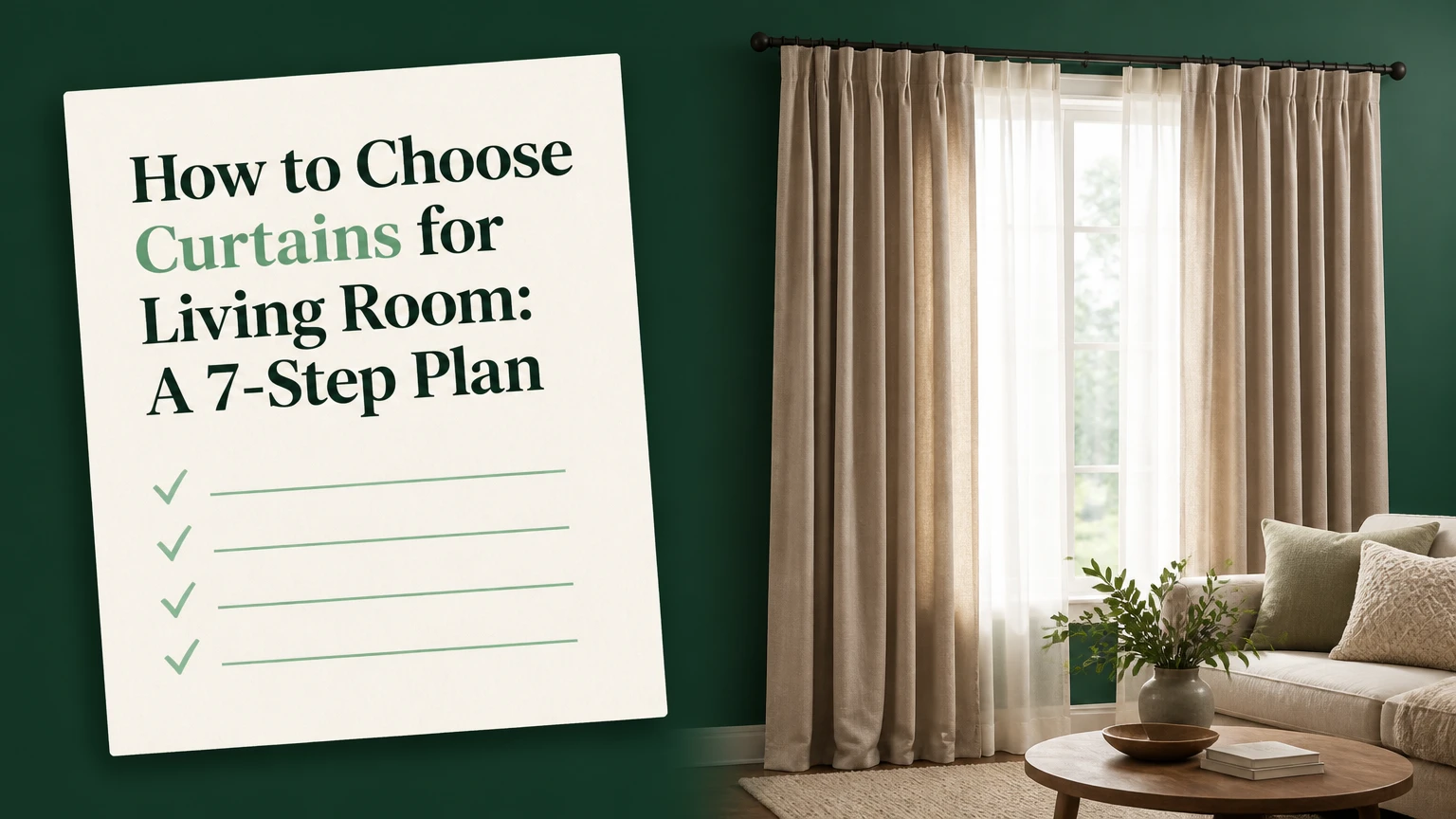
To choose curtains for a living room, first rank the room’s main need, then measure the window and available wall, select the correct opacity and fabric, choose a heading and hardware system, and coordinate color and pattern. The most important technical decision is finished width, because insufficient fullness makes even expensive curtains look flat.
Key Facts at a Glance
Curtain width is typically 2-2.5 times the track or rod width for lined curtains and up to 3 times for sheer fabric.
Mounting a rod 4-6 inches above the window frame usually improves proportions; mounting near the ceiling works for tall walls.
Finished curtain length should normally reach the floor, with a 0.5-inch float being the easiest style to maintain.
Sheers diffuse daylight but provide limited privacy after dark unless paired with a lined curtain or blind.
A curtain rod wider than the glass area allows panels to clear the window when open and preserves daylight.
Heavy velvet, lined cotton, and thermal curtains require stronger brackets than lightweight polyester panels.
What should living room curtains accomplish?
Living room curtains control daylight, manage sightlines, moderate drafts, soften acoustics, and establish the visual scale of a window. A west-facing room may need glare reduction, while a street-facing room may need privacy; choosing fabric before defining the problem often produces an attractive but ineffective result.
Curtains rarely perform every function equally well. A sheer preserves a view but offers weak nighttime privacy. A blackout lining blocks light but can make a small room feel visually heavy. A layered treatment, such as a sheer inside a lined drape, resolves more competing requirements than one fabric alone.
Start with the room’s dominant problem
Use the first priority to determine the specification, then use decor as the final filter.
| Primary room problem | Recommended specification | Avoid | Typical result |
|---|---|---|---|
| Television glare | Dim-out lining, medium-dark color, close side overlap | Unlined white sheer alone | Reduced reflected daylight |
| Daytime privacy | Semi-opaque linen blend, 1.8-2.2x fullness | Open-weave gauze | Diffused views with daylight |
| Nighttime privacy | Lined drapery plus blind or closed panels | Sheer-only treatment | Stronger sightline control |
| Cold window drafts | Thermal lining, full floor length, side returns | Short sill panels | Fewer exposed gaps |
| Decorative softness | Linen, cotton, or textured polyester, 2-2.5x fullness | Flat single-width panels | Fuller folds and better scale |
| Room darkening | Blackout lining, overlap at center, return at sides | Rod shorter than window | Fewer edge light leaks |
A living room curtain is not a substitute for properly sealed windows. Thermal fabric can reduce the sensation of cold near glass, but it will not correct failed weatherstripping, single-pane glazing, or a poorly fitted frame.
How do you choose curtains for a living room?
Choose living room curtains in seven actions: define the goal, measure the opening and wall, calculate finished width and length, select opacity and fabric, choose the heading, coordinate color and pattern, and verify hardware capacity. Allow approximately 60-90 minutes for measuring and selection, excluding custom fabrication or delivery.
The sequence matters because appearance depends on technical choices. For example, a pale linen panel may match a sofa perfectly, but its loose weave may fail a room that needs nighttime privacy. Likewise, a beautiful pinch pleat cannot operate smoothly if the track is too narrow or the fabric is too heavy.
Step 1: Define the primary function
Write one sentence describing the problem the curtains must solve. Use “reduce afternoon glare,” “prevent nighttime visibility,” or “make a drafty window feel warmer,” rather than the vague goal “make the room look nicer.”
Assign a secondary function only after choosing the primary one. If glare and privacy are both important, use a dual-layer system. If decoration is the only requirement, prioritize texture, proportion, and daily operating ease.
Success checkpoint: you can name the desired light level and privacy level before browsing fabrics.
Common mistake: choosing a color from a product photograph without checking lining, opacity, or window orientation.
Step 2: Measure the window, wall, and finished length
Measure the area the curtains will cover, not only the glass. Record the inside width of the window, the outer edges of the trim, the distance to the ceiling, the floor-to-mounting point, and any radiator, furniture, handle, or vent that could interfere.
For a typical wall-mounted rod, use these calculations:
- Rod or track width: window or trim width plus 6-12 inches, allowing 3-6 inches on each side.
- Finished fabric width: rod or track width multiplied by 2-2.5 for lined curtains.
- Sheer width: rod or track width multiplied by 2.5-3 for softer fullness.
- Finished length: mounting point to floor minus 0.5 inch for a practical float.
- Panel width: total finished fabric width divided by the number of panels.
For example, a 60-inch trim width may use a 72-inch rod. At 2x fullness, the curtains need 144 inches of total fabric width. Two 72-inch panels provide that width; two 50-inch panels do not, even if their combined width appears close to the window size.
| Window or opening width | Suggested rod width | Fabric width at 2x fullness | Two-panel width | Typical ready-made choice |
|---|---|---|---|---|
| 36 inches | 42-48 inches | 84-96 inches | 42-48 inches each | Two 48-inch panels |
| 60 inches | 66-72 inches | 132-144 inches | 66-72 inches each | Two 72-inch panels |
| 84 inches | 90-96 inches | 180-192 inches | 90-96 inches each | Four 48-inch panels |
| 120 inches | 126-132 inches | 252-264 inches | 126-132 inches each | Custom or four 66-inch panels |
| 144 inches | 150-156 inches | 300-312 inches | 150-156 inches each | Track with multiple panels |
Mount the rod 4-6 inches above the frame when the ceiling is much higher than the window. For a 96-inch wall, mounting close to the ceiling can create a taller vertical line, but leave enough clearance for the heading and rings. Do not mount directly beneath the ceiling if the curtain fabric will rub against crown molding.
Which curtain length is best?
Floor-length curtains are the safest choice for most living rooms because they connect the window to the floor and avoid the awkward mid-wall stopping point. Use a 0.5-inch float for easy cleaning, a barely brushing “kiss” for a tailored finish, and 2-6 inches of puddling only where maintenance and fabric weight are acceptable.
| Length style | Floor relationship | Best use | Maintenance demand | Main risk |
|---|---|---|---|---|
| Sill length | Ends 0.5-1 inch above sill | Radiator or furniture below window | Low | Looks short on tall walls |
| Apron length | Ends 1-3 inches below sill | Casual cottage interiors | Low | Draws attention to uneven trim |
| Floating floor | Ends 0.5 inch above floor | Pets, children, frequent vacuuming | Low | Requires accurate measurement |
| Kissing floor | Barely touches floor | Tailored formal rooms | Medium | Small measurement errors show |
| Puddled floor | Extends 2-6 inches onto floor | Decorative, low-traffic rooms | High | Collects dust and catches feet |
Measure from the actual hook, ring, or track position, not from the top edge of the fabric. Ready-made panels commonly come in 84, 96, and 108-inch lengths, but a 96-inch panel may still be too short if the rod is mounted high above a tall window.
Success checkpoint: the proposed panels reach the intended floor relationship and clear radiators, vents, and furniture.
Common mistake: buying by window height alone, then discovering that the rod position requires a longer panel.
Step 3: Match fabric and opacity to the room
Select opacity before color. Sheer and voile fabrics diffuse sunlight and retain views, semi-opaque linen blends soften glare while offering moderate daytime privacy, and lined or blackout drapes provide stronger light and privacy control.
Fabric behavior depends on weave, lining, color, and window exposure. White sheers may look bright in a showroom but glow at a sunny window. Dark velvet absorbs more light and adds weight, yet it can retain heat in summer and requires more careful cleaning.
| Fabric or construction | Typical opacity | Light behavior | Insulation and sound effect | Cleaning and durability |
|---|---|---|---|---|
| Polyester voile | 10-30% visual blockage | Diffuses direct sun | Minimal insulation | Machine washable, often durable |
| Linen blend | 30-60% visual blockage | Soft, uneven daylight | Low to moderate | May shrink or crease |
| Cotton canvas | 50-80% visual blockage | Reduces glare strongly | Moderate when lined | Washable if pre-shrunk |
| Velvet | 70-95% visual blockage | Absorbs light and glare | Moderate to high | Often dry-clean or spot-clean |
| Dim-out lining | 80-95% light reduction | Darkens without full seal | Moderate | Lining may require gentle care |
| Blackout lining | Usually 95-99% light reduction | Blocks most daylight | Moderate, with edge leakage possible | Check coating and cleaning label |
A blackout curtain is useful for a projector, television glare, or a room that receives intense afternoon sun, but blackout fabric is not automatically the best everyday living room choice. It can limit daylight, create a stark contrast at the window, and still leak light around the sides unless the treatment overlaps the opening.
Thermal curtains usually rely on multiple layers, dense fabric, or a coated lining. They can improve comfort near cold glass, but their performance varies by fit and construction. A snug blind combined with full-length curtains generally closes more gaps than a decorative curtain alone.
Step 4: Choose a heading that matches daily use
Choose grommets or wave headings for frequent opening and closing, pinch pleats for tailored drapery, and rod pockets for mostly stationary decorative panels. Heading style changes how curtains stack, slide, fold, and connect to the hardware.
| Heading style | Hardware | Fold or movement | Best room style | Main limitation |
|---|---|---|---|---|
| Grommet or eyelet | Round rod, typically 1-1.25 inches | Deep, regular folds; easy movement | Modern or industrial | Less suitable for traverse tracks |
| Rod pocket | Round rod | Gathered, compressed folds | Casual or stationary panels | Difficult to open repeatedly |
| Pinch pleat | Hooks with rod or track | Tailored, controlled pleats | Traditional or formal | Higher sewing and setup cost |
| Tab top | Round rod | Casual loops with visible gaps | Rustic or relaxed rooms | Can drag and resist movement |
| Wave or S-fold | Dedicated track | Continuous S-shaped folds | Minimalist, wide windows | Requires compatible track |
| Back tab | Rod through hidden loops | Clean front with moderate movement | Contemporary casual | Tabs can weaken with heavy fabric |
A wave track often produces the cleanest wall-to-wall appearance, especially across sliding doors or large glazing. It is less forgiving of incorrect width because the wave spacing must match the carriers and the track cannot be treated like a basic pole.
Grommets slide well on a properly sized rod, but metal rings can create noise and may scratch a soft finish. Nylon-lined rings reduce friction. Pinch pleats operate well with a traverse system when the room requires frequent opening, although the hooks must be installed at consistent intervals.
Success checkpoint: the heading, rod, and opening mechanism are compatible before purchase.
Common mistake: ordering pinch-pleat curtains for a simple pole without checking whether the included hooks and rings support the intended installation.
Step 5: Coordinate color, pattern, and texture
Choose curtain color by comparing the wall, sofa, flooring, wood tones, and daylight at different times. A close wall color makes the window recede, a darker related tone adds framing, and a controlled pattern can connect two or three existing colors without matching every item exactly.
Hold fabric samples beside the sofa and wall in morning and afternoon light. Online photographs are unreliable because screens, exposure, and lining alter perceived color.
| Existing living room feature | Curtain approach | Example color relationship | Pattern guidance |
|---|---|---|---|
| Pale neutral walls | Same-family tone or one shade deeper | Ivory wall with flax curtain | Small texture, low contrast |
| Gray sofa | Warm contrast or cool tonal match | Dove gray with oatmeal linen | Geometric pattern under 15% contrast |
| Patterned rug | Quiet solid curtain | Rust, cream, or charcoal from rug | Avoid a second large repeat |
| Dark wood furniture | Light textured drape | Natural linen or warm white | Vertical stripe can add height |
| Bold accent chair | Neutral curtain with accent piping | Cream curtain with rust detail | Repeat accent once, not everywhere |
| Low-light room | Light-reflective medium tone | Warm white, pale taupe, soft sage | Avoid dense dark prints |
Pattern scale should relate to the room and window size. A large repeat can overwhelm a narrow opening, while a tiny print may disappear across a wide wall. Vertical stripes can suggest height, but they do not physically raise the ceiling.
Step 6: Select hardware that can carry the treatment
Choose a rod or track based on the total fabric weight, span, wall construction, and opening frequency. A wide window typically needs a center support, and heavy lined panels need a stronger bracket system than lightweight sheers.
Use a rod diameter of approximately 1-1.25 inches for many standard drapery panels, but follow the manufacturer’s load rating rather than relying on diameter alone. Install brackets into studs where possible; otherwise use anchors rated for the wall material and the loaded curtain weight.
| Installation condition | Hardware recommendation | Support detail | Typical cost range |
|---|---|---|---|
| Small, lightweight window | 0.75-1-inch adjustable rod | Two brackets for spans under 48 inches | $20-$60 |
| 60-96-inch opening | Heavy-duty 1-1.25-inch rod | Center bracket near the midpoint | $40-$140 |
| Wide picture window | Metal rod or traverse track | Three or more brackets | $100-$350 |
| Floor-to-ceiling wall | Wave track | Ceiling or wall carriers at regular spacing | $150-$600 |
| Heavy velvet panels | Reinforced rod or metal track | Stud-mounted brackets preferred | $150-$500 |
| Motorized treatment | Motorized traverse or curtain track | Electrical or battery access required | $400-$1,500+ |
Extend the rod 3-6 inches beyond each side of the frame when wall space permits. Use a return bracket or wraparound rod when side light leakage and drafts matter. Finials are decorative; brackets and track carriers perform the structural work.
How much do living room curtains cost?
Typical ready-made curtains cost $20-$60 per panel, semi-custom curtains cost $70-$200 per panel, and fully custom curtains cost $250-$1,000 or more per panel. Installation usually takes 1-2 hours for a simple rod and 2-5 hours for wide, layered, or difficult openings.
| Quality tier | Typical price per panel | Typical installation | Expected service life | Best value case |
|---|---|---|---|---|
| Ready-made polyester | $20-$60 | 1-2 hours DIY | 3-5 years | Rental or temporary update |
| Better ready-made linen blend | $50-$150 | 1-3 hours DIY | 5-8 years | Texture at moderate cost |
| Semi-custom lined | $70-$200 | 2-5 hours or installer | 7-10 years | Correct width and lining |
| Premium custom | $250-$1,000+ | 3-6 weeks fabrication | 15+ years | Unusual windows or lasting fit |
| Motorized layered system | $400-$1,500+ | 2-6 hours installation | 7-15 years | Automation and difficult access |
Prices vary by country, fabric content, lining, width, labor, and delivery. Treat these as typical retail planning ranges rather than universal quotes.
Step 7: Install, train, and test the curtains
Install the brackets level, hang the panels, and test the full operating path before steaming. Open the curtains completely, confirm that the fabric clears the glass, then close them and check the center overlap, floor relationship, and side gaps.
Steam from the top downward while the panels hang. For pinch pleats and wave folds, arrange the fabric into consistent channels and leave it in position for several hours. Do not use an iron directly on coated blackout lining because heat can damage the backing.
Success checkpoint: the curtains travel without catching, the rod remains level, and the closed panels cover the intended opening.
Common mistake: steaming folds before confirming that the track or rod is correctly positioned, which trains the fabric to an incorrect stack.
Common mistakes and how to fix them
Panels are too narrow
If the panels equal the window width, they will look stretched when closed and lack usable folds. Add panels or exchange them for wider ones; do not solve the problem with tiebacks.
The rod sags in the middle
A center support is usually needed when a rod span exceeds approximately 48 inches, especially with lined or heavyweight fabric. Remove the curtains, install a rated support into a stud or suitable anchor, and confirm that the support does not obstruct the carriers.
Curtains stop above the floor
Short panels expose a strip of wall and can make the window appear disconnected from the room. Replace them with the next standard length or lower the rod only when the wall and trim allow it; adding fabric to the bottom often produces a visible repair.
The folds look uneven
Uneven folds commonly result from inconsistent panel width, crowded carriers, or fabric that has not relaxed after shipping. Steam vertically, set the folds by hand, use drapery weights at the corners, and check that each carrier is spaced consistently.
Curtains drag or make noise
Metal grommets on a rough rod can stick and scrape. Clean the rod, use nylon-lined rings where compatible, or change to a track with smooth carriers. Avoid household oils near fabric because they can stain and attract dust.
Light leaks around the edges
Edge leakage occurs when the rod is too short, the panels do not overlap, or the window recess is unusually deep. Extend the rod, add a center overlap, install returns, or pair the curtains with an inside-mounted blind.
Which curtains work for different living rooms?
Different living rooms need different specifications because window orientation, traffic, furniture, and operating habits change the practical choice. A renter, pet owner, home-theater user, and smart-home user should not buy the same curtain system simply because their rooms share a similar color scheme.
| Situation | Recommended treatment | Recommended length | Hardware | Reason |
|---|---|---|---|---|
| Renter with drilling limits | Lightweight polyester-linen panels | Floating floor | Tension rod only for light panels, otherwise rated adhesive system | Reduces wall damage |
| Pet-owning household | Washable polyester or cotton blend | Floating floor | Smooth, sturdy rod | Limits hair and snagging |
| Television or projector room | Blackout or dim-out outer layer with optional sheer | Floating or kissing | Overlapping rod or track | Controls glare and edge light |
| West-facing window | Lined medium-weight fabric | Floor length | Rod with side extension | Reduces late-day heat and glare |
| Historic home | Pinch pleat or tailored panel | Kissing floor | Metal rod or traverse track | Fits formal architectural detail |
| Large sliding door | Wave or pinch pleat on track | Floating floor | Ceiling or wall track | Handles wide movement efficiently |
For children, keep cords and chains inaccessible and secure tiebacks so they cannot form loops. Motorized curtains can improve accessibility, but the motor and track still need correct fabric weight and alignment; automation does not compensate for an overloaded system.
Should you use curtains, blinds, or both?
Curtains are best for softness, acoustic absorption, broad light diffusion, and full-height visual framing; blinds are better for precise privacy and light adjustment; combining both gives the widest control but costs more and requires enough recess or wall depth.
| Treatment | Light adjustment | Privacy control | Stack-back | Typical installed cost |
|---|---|---|---|---|
| Roller blind | High, with fabric selection | High when fully closed | 2-4 inches | $150-$600 per window |
| Cellular shade | Moderate to high | High | 2-4 inches | $250-$900 per window |
| Venetian blind | High, slat angle control | High | 4-6 inches | $150-$700 per window |
| Full-length curtains | Low to high, depending on lining | Moderate to high | 8-24 inches | $100-$1,500 per window |
| Blind plus curtains | Very high | Very high | 10-28 inches | $300-$2,000 per window |
Curtains are not ideal where furniture blocks the lower wall, a sill must remain accessible, or exact glare control is needed throughout the day. A blind-plus-curtain combination is often the more functional answer for bedrooms, street-facing glass, and rooms with changing sun angles.
How should bay windows and unusual openings be treated?
Bay windows usually work best with a segmented track or three-sided bay rod that follows the wall angles. A single straight rod across the front can leave side glass uncovered and may prevent panels from stacking outside the bay.
For sliding doors, measure the full operating width and keep the curtain stack clear of the door handle. For corner windows, use a corner connector or separate rods with enough overlap to prevent a visible gap. For windows above radiators, preserve manufacturer-required airflow clearance rather than letting thick fabric cover the heater.
FAQ
Should living room curtains touch the floor?
Living room curtains should usually finish at the floor, either floating about 0.5 inch above it or barely brushing the surface. Floor-length panels create a continuous vertical line and are easier to proportion than sill-length curtains, while puddling is best reserved for low-traffic formal rooms.
What curtain color is best for a gray sofa?
Warm white, oatmeal, taupe, charcoal, muted blue, and sage can work with a gray sofa, depending on the undertone of the gray and the room’s daylight. Compare fabric samples beside the sofa and flooring, because cool gray can make beige curtains look yellow while warm gray can make blue-gray fabric appear stark.
Do curtains need to be wider than the window?
Curtains need to be wider than the window when they must close with visible folds or stack outside the glass. Plan for a rod extending 3-6 inches beyond each side and fabric totaling about 2-2.5 times the rod width, with up to 3x fullness for sheers.
Are blackout curtains too heavy for a living room?
Blackout curtains are not inherently too heavy for a living room, but they can reduce daylight and require load-rated hardware. Use them for glare, projection, or strong sun exposure; choose dim-out lining or a layered sheer when the room needs daytime brightness and nighttime flexibility.
How often should living room curtains be cleaned?
Vacuum or brush curtains monthly in dusty rooms and wash or professionally clean them according to the care label, commonly every 6-12 months. Sun-exposed, kitchen-adjacent, or pet-heavy rooms may need more frequent cleaning, but coated blackout panels can shrink or crack if washed incorrectly.
Can curtains reduce drafts from windows?
Curtains can reduce the sensation of drafts by creating a still air layer near the glass, especially when they reach the floor and cover the sides. They cannot repair air leakage through frames or seals, so persistent drafts require weatherstripping, caulking, or window inspection.
The Bottom Line
The best way to choose curtains for a living room is to solve the room’s main functional problem before selecting a decorative style. Measure the complete rod or track area, use 2-2.5x fullness, choose a floor-length finish, match opacity to daylight and privacy needs, and verify that the hardware supports the fabric. For most homes, lined medium-weight panels on a sturdy rod offer the strongest balance of appearance, usability, and cost.